There is a peculiar moment in learning to solve a cube when the puzzle changes. The colors stop being the problem. You know where the pieces belong. Now your fingers catch, a layer stops short, and the next move collides with the last. The obstacle has become mechanical. For a company selling cubes, that is a useful moment to understand.
GAN, the Chinese brand also known as GANCUBE, makes equipment for that moment. Its speedcubes have adjustable tension, magnetic guidance and, in some models, sensors that record your turns. The customers range from curious beginners to competitors who can finish a solve before you have found the timer. The shared purchase is a particular feeling: control.
- Mechanical speedcubes tune how the puzzle moves.
- Smart cubes connect physical turns to CubeStation training and online races.
- Current listed prices run from $25.99 for an entry smart cube to $139.99 for the smart flagship.
A champion learns to make things
Jiang Ganyuan founded GANCUBE in Guangzhou in 2014. He had been China's first national speedcubing champion. That gave him an intimate knowledge of the activity, although his earlier business attempts exposed the distance between knowing a puzzle and manufacturing one.
Before GAN, products disappointed buyers, losses mounted and partners withdrew their money. In a later interview, Jiang credited Steve Jobs' biography with sharpening his attention to product quality. He began visiting factories, studying molds and assembly, sometimes arriving when spare production capacity became available at midnight. Manufacturing became something to learn firsthand.
The lesson travels beyond cubes. A founder's expertise can identify a worthwhile problem while leaving the means of solving it poorly understood. Jiang's response was concrete: get closer to the process that determines what arrives in the customer's hand. GAN eventually developed its own manufacturing operations; its main facility is in Foshan's Shunde district.
The argument hidden inside the plastic
Pick up an ordinary cube and you see colored squares. Open a performance model and the conversation changes to center travel, tension and magnetic positioning. These settings influence how readily a layer moves, how much the mechanism yields, and how confidently a turn settles into place. Different hands want different answers.
GAN's maglev designs replace traditional springs with repelling magnetic rings. That removes spring contact as one source of friction. Other magnets help guide pieces toward alignment. The cube still contains contacting plastic parts; magnetic levitation does not make the whole mechanism frictionless. The engineering claim is narrower, and more interesting, than the name initially suggests.
The 2026 GAN17 MagDrive makes the approach visible in numbers: the company specifies 196 magnets and a 17.5-millimeter magnetic core. Its launch film appeared in August. At a listed $84.99, it asks buyers to care about adjustable feel as much as the familiar six colors. Counting magnets alone, however, cannot tell you whether your own turning will improve. For a buyer, the sensible test is a repeatable practice session: use familiar scrambles, keep the settings steady and pay attention to catches as well as times. A setting that feels spectacular for one turn may be tiring across fifty solves.
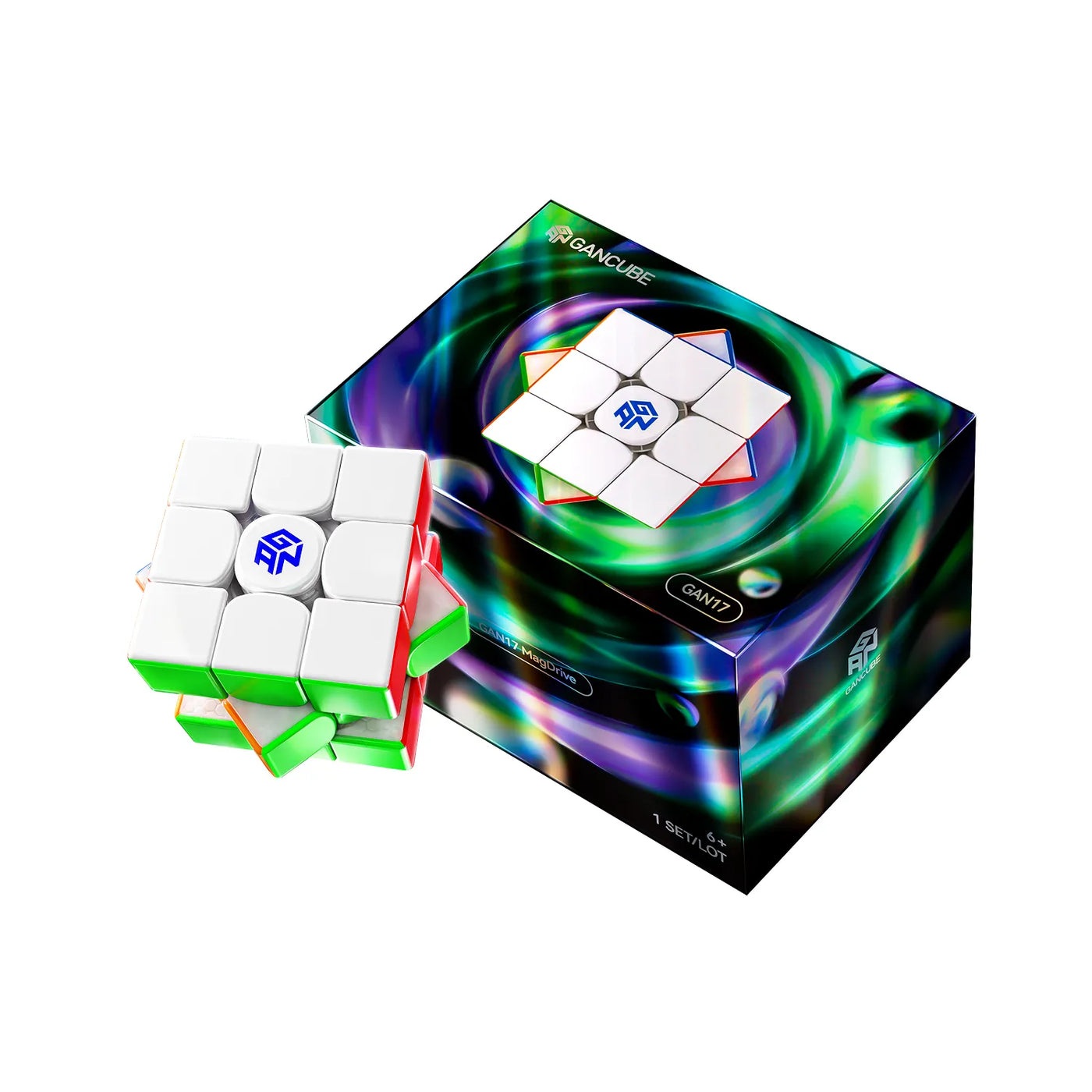 FIG. 02 / MECHANICAL
A stopwatch cannot explain a hesitation
A timer gives a verdict. A connected cube can give a record of what happened. GAN introduced its GAN356 i smart cube and CubeStation in 2019, adding a digital layer to a thoroughly physical habit. The app offers lessons, practice analysis and online competition, bringing opponents onto the phone beside your cube.
For someone learning, step-by-step guidance addresses a maddening problem: an instruction can be correct while the cube in your hands has already wandered somewhere else. For an experienced solver, move counts and replays make practice inspectable. CubeStation's public app description emphasizes statistics, algorithm recommendations and racing people of similar ability.
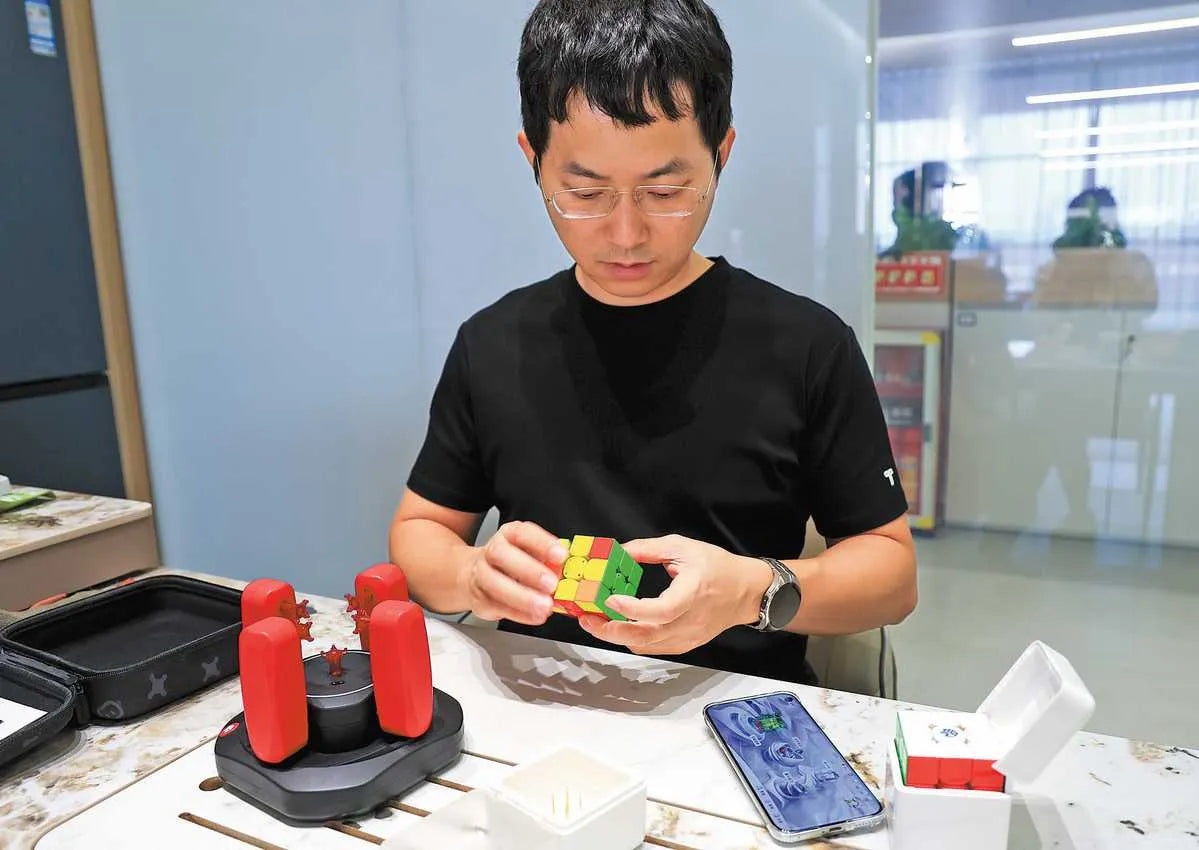
The hardware ladder matters here. The GAN356 i carry E is listed from $25.99, with turn tracking and app connectivity. The $139.99 GAN16 ui Maglev MAX adds a different level of hardware and advertised personalized training features, including its PiPi AI agent. GAN says personalized modeling and that agent are exclusive to this model. Buying a cheaper smart cube does not buy every flagship software feature.
The sport sells the equipment
GAN operates in a crowded field of specialist cube makers, including MoYu, QiYi and DaYan. Its position combines tunable hardware, champion associations and connected practice. None of those makes a purchase inevitable. A comfortable, cheaper cube can be entirely adequate for learning algorithms or enjoying a few solves after dinner.
Competition supplies a compelling reason to keep refining the equipment. GAN began its partnership with Feliks Zemdegs in 2017 and supports its GAN Gurus team. Independently, the World Cube Association records Yiheng Wang's 3.08-second single at XMUM Cube Open 2025 as a world record achieved there. Such times explain the appetite for precision; they do not establish that a particular cube caused the result.
The business earns through physical products sold on its own website, through marketplaces and through distributors. The catalog reaches beyond flagship 3x3s to 2x2s, larger cubes, shape puzzles, timers, lubricants and limited editions. Monster Go addresses children's puzzles; Swift Block broadens the leisure offering. There are several ways into the brand before anyone needs a flagship.
“A good cube must turn smoothly and without jams, with minimal resistance.”
JIANG GANYUAN / FOUNDER
Three million cubes, one pair of hands at a time
In an interview published in March 2026, Jiang put GANCUBE's 2025 sales at about three million cubes and said roughly 70 percent of annual sales came from outside mainland China. Those are founder-reported figures. They describe a business whose audience extends well beyond the competition table.
The system also has practical limits. Smart training needs compatible hardware and a working app connection. GAN's $125.99 Robot Arthur can automate scrambling and solving, but automatic restoration requires both robot and smart cube to connect to CubeStation. Older center caps may need replacement for mounting. Convenience arrives with a compatibility checklist.
The useful idea to copy is the sequence: improve the object, make practice easier to inspect, then give people a reason to return. It works when users value improvement enough to practice. If your interest ends at solving the puzzle once, elaborate tuning and analytics may have little to offer. GAN's most persuasive customer is the person who finishes a solve, looks at the time, and immediately scrambles again.