Hills Properties had a problem that looked, from a distance, like success. The leads were coming in. The company was paying internet listing sites to supply them. Yet the arithmetic behind those inquiries was unpleasant: too much money spent for too few leases. A busy inbox is a wonderfully persuasive prop. It can make a disappointing marketing budget look industrious.
THE STORY IN FOUR LINES
- G5 sells property marketing software and specialist services.
- Its useful question is which prospects become residents.
- Historical customer results show what changing the channel mix can achieve.
- Its multifamily offering is now RealPage Demand Marketing.
The inbox was busy. The economics were dreadful.
In G5’s 2018 account of the Hills relationship, the property operator’s listing-site leads were expensive and converted poorly. G5 redesigned individual property websites and combined search engine optimization with pay-per-click advertising. Hills began moving money away from listing contracts and into those direct channels. The decision was less glamorous than launching a campaign. It meant deciding which bill deserved to disappear.
“We’ve been canceling one ILS contract after the next”Maria Lashells · Hills Properties
G5 customer case study, 2018
The published result was a reduction of more than 90 percent in cost per lease compared with ILS leads, and the cancellation of all Hills’ ILS contracts. These are historical, vendor-reported customer outcomes, not a forecast for another apartment community. Their interest lies in the decision they supported. Lead quality gave Hills a reason to change its spending.
That distinction explains G5 better than the usual parade of marketing acronyms. Its customers own or operate properties; their customers need somewhere to live, receive care or store possessions. G5 works on the messy stretch between discovering a property and becoming a customer. A dashboard full of activity is useful only if it helps someone make a better choice.
The business began where the boxes went
Dan Hobin and Greg Meier founded G5 in Bend, Oregon, in 2005. Its early territory was self-storage, a business with little need for fashionable language. Someone needs a unit. Somewhere nearby, an operator has one. Hobin’s opportunity was to help those operators move from the Yellow Pages to the internet, with leads and analytics that made the spending easier to examine.
An Oregon Business profile in 2011 described five years of bootstrapping before outside funding arrived. That origin matters. G5 entered digital marketing through a specific commercial problem, then expanded into senior housing and apartments. Its expertise accumulated around properties and the people shopping for them. It did not need to become an agency for every conceivable advertiser.

In August 2010, G5 announced $15 million in financing led by Volition Capital to develop its platform. A $76 million recapitalization led by PeakEquity followed in 2015, with Milestone Partners co-investing. PeakEquity described employees trained to think like property owners and operators. It is a sensible instruction: advertising looks different when the vacancy belongs to you.
Teach the advertising what a renter sounds like
Consider the measurement problem. A prospect might encounter an advertisement, inspect floor plans, read reviews, leave and later call. The last recorded action can claim credit for a decision made across several encounters. G5’s analytics offering has included web and call attribution, campaign and keyword reporting, and AI Call Scoring designed to identify callers with an intent to rent.
The point of that machinery is to improve the next decision. Its advertising service combines specialists who choose and adjust strategy with technology that allocates spending. Search, display, social advertising and remarketing supply different opportunities to reach prospects. The useful output is a clearer view of which combinations produce valuable responses, rather than simply more traffic.
THE FEEDBACK LOOP · CONCEPTUAL
- 01AttractSearch & advertising
- 02AnswerWebsite & property facts
- 03IdentifyCalls & renter intent
- 04AdjustCampaigns & spending
A better signal returns to the next campaign.
The current Demand Marketing description makes the feedback explicit: AI Call Scoring identifies intent and sends signals back to Google to improve campaign targeting. That is a concrete use of AI. It helps the advertising system learn what the operator values. The property team still has to turn the ensuing conversation into a visit and a lease.
Brightwater Senior Living offers a historical example. It needed qualified prospects without increasing marketing spend. G5 paired Google Smart Bidding with Lead Insights and adjusted campaigns according to conversion performance. Its 2019 case study reported 4.5 times as many move-ins attributed to G5 sources and a 22 percent decrease in cost per lead.
Brightwater Senior Living · G5 case study, 2019. Customer-specific reported results.
At Smart Self Storage, G5 described using Lead Insights to identify better-converting keywords, campaigns and channels, then redirect spending toward them. Its September 2019 account reported 13 percent more inquiries. The mechanics are remarkably unromantic: find a pattern, change the allocation, look again. Useful marketing often has the temperament of a careful bookkeeper.
A website with a leasing job
G5’s websites belong in the same argument. A property site must communicate the brand, but it also needs to answer practical questions quickly. Its website services include creative work, an editable content management system and connections to property management and customer relationship platforms for live pricing and availability. The renter should not need to become a detective to establish whether a home is available.
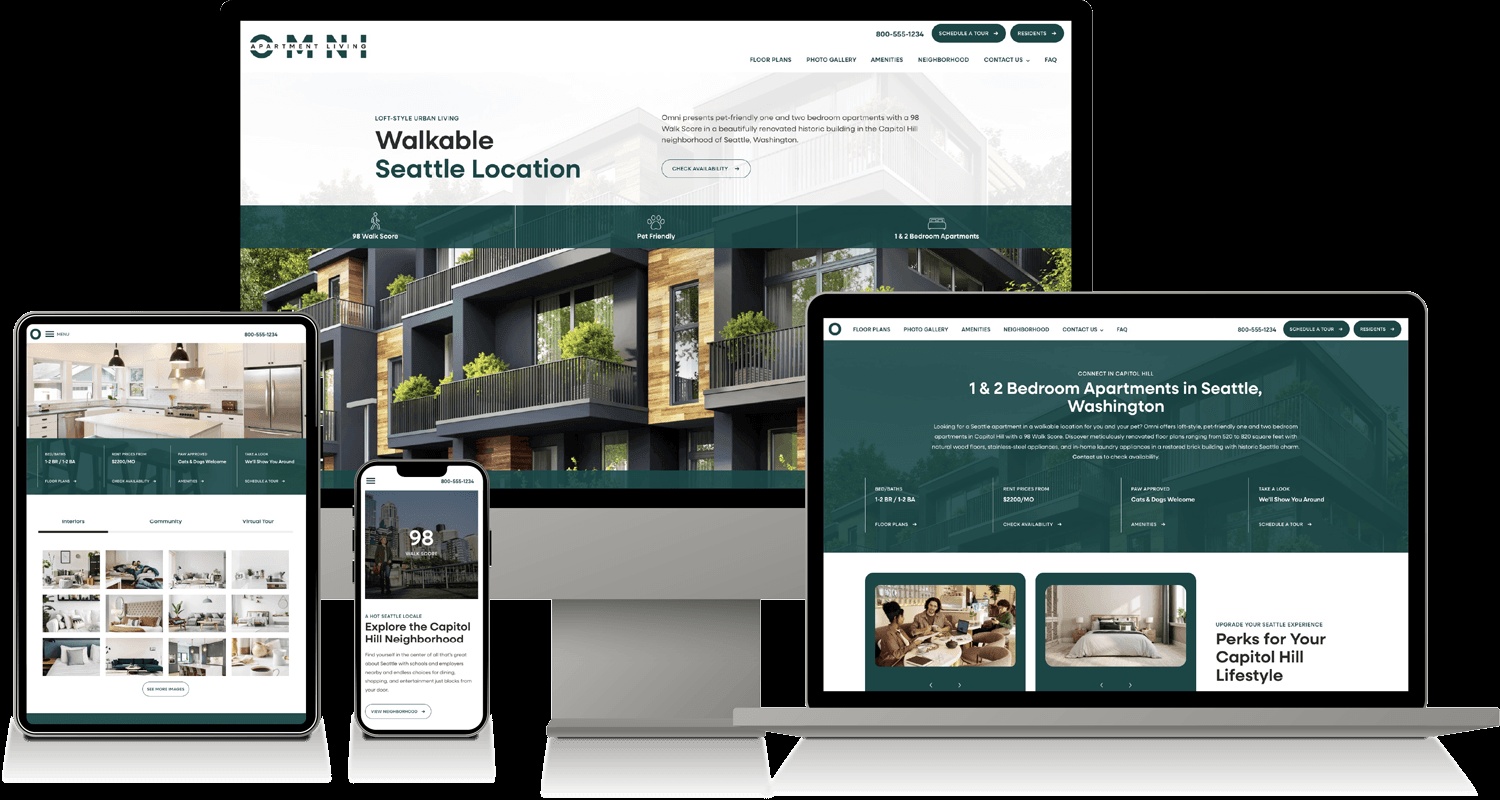
Reviews are another part of that shopping experience. G5’s Rep & Social product brought monitoring, responses, sentiment reporting and scheduled posts into a shared workflow. A negative review can be a marketing problem and an operational clue at the same time. Collecting it is merely the beginning; somebody must decide what to do about the complaint.
Today’s multifamily offering has an additional audience: the systems helping renters search. Under Demand Marketing, RealPage describes Agentic Websites with structured information and Agentic Search Optimization for traditional and AI-assisted discovery. The underlying editorial task remains familiar. Property facts need to be clear, current and consistent enough for another party to use them.
The software comes with people, and an invoice
G5 occupies the space between a software subscription and an outsourced marketing team. Customers buy technology alongside strategy, design and campaign services. Published G5 terms describe one-time charges and recurring fees generally billed per property per month, with prices specified in order forms. The economics therefore involve the chosen services and media budget, not a single price that describes every customer.
This territory has competition. Yardi’s REACH by RentCafe also offers apartment websites, SEO, paid search, reputation and social services, with marketing analytics. An operator can instead assemble separate vendors or do the work internally. G5’s pitch is the coordination of property expertise, customer-facing experiences and measurement. The sensible comparison is which arrangement makes the operator’s decisions clearer, at an acceptable total cost.
RealPage announced its G5 acquisition in July 2021; PeakEquity records an August exit. At the sale, G5 served more than 500 customers across 8,300 properties. PeakEquity also reported organic annual recurring revenue growth of more than 100 percent during its ownership. The deal brought the marketing business into a larger property software ecosystem, and RealPage’s live multifamily site now calls the offering Demand Marketing.
Before you cancel the next contract
The lesson to copy is the sequence of decisions, rather than Hills’ final channel mix. Define a meaningful outcome. Connect it to the acquisition activity. Compare the economics. Move spending in response to the evidence. A lead source can look expensive per inquiry and still earn its keep through leases; a cheap inquiry can occupy a team for no useful reason.
The same reasoning explains the limits. If availability is wrong, follow-up is slow or lease outcomes never make it back into the reporting, better targeting has a weakened foundation. Attribution also allocates credit; it does not, by itself, prove that advertising caused an outcome. Historical comparisons can change with pricing, seasonality and the properties involved.
For a buyer, that makes the demonstration a working meeting. Ask how calls are classified, how duplicate prospects are handled, how lease records reach the reports and what a budget change would look like for one actual property. These are practical questions to test an integrated system. An elegant chart is pleasant company, but it should be able to explain its arithmetic.
G5’s enduring proposition is that the marketing department and the leasing office ought to recognize the same success. A promising lead has somewhere to go. An available apartment gets a prospective resident who understands it. And the next budget meeting has something more useful to discuss than how impressively full the inbox became.
Follow the renter, then the links
Explore the current products and the people discussing them.