One revealing detail about a sports-streaming company is the opponent it chooses. In 2024, Fubo challenged a proposed service backed by Disney, Fox and Warner Bros. Discovery. It secured a preliminary injunction against Venu Sports. By October 2025, Disney controlled roughly 70% of the company formed by combining Fubo with Hulu + Live TV. The small challenger had joined the company across the negotiating table. For anyone trying to understand internet television, this is a useful place to begin.
- Fubo sells live sports, news and entertainment through an app.
- Hulu + Live TV shares its corporate parent, but keeps its own app.
- The latest experiment: a lighter sports plan with local networks added by market.
A $7 ticket into a bigger business
David Gandler, Alberto Horihuela and Sung Ho Choi founded Fubo in 2015 around soccer. Its early subscription cost $7 a month, carrying channels such as GolTV and Benfica TV. This was a precise proposition for a particular viewer: find the match that ordinary television made awkward to find.
Then came the familiar household complication. The person who wants soccer may live with someone who wants the news, a movie or a different sport. Fubo expanded into a broader cable replacement. Subscribers could buy a collection of channels without arranging a cable installation. The company’s own business motto captured the intended journey:
“come for the sports, stay for the entertainment.”Fubo’s September 2022 SEC filing
There was money behind the expansion: a $55 million Series C in 2017, a $75 million Series D in 2018, and a public offering that raised $183 million gross in 2020. Investors included media companies as well as venture funds. Buying a place in television required considerably more capital than building an app.
The remote control becomes software
Fubo’s useful distinction is the attention it gives the viewer with several things happening at once. Multiview lets subscribers choose simultaneous live channels on supported devices. It arrived on Apple TV in 2020, selected Roku devices in 2024, and selected LG televisions in 2026. That solves a very ordinary Saturday problem: several games, one television, and nobody willing to surrender the remote.
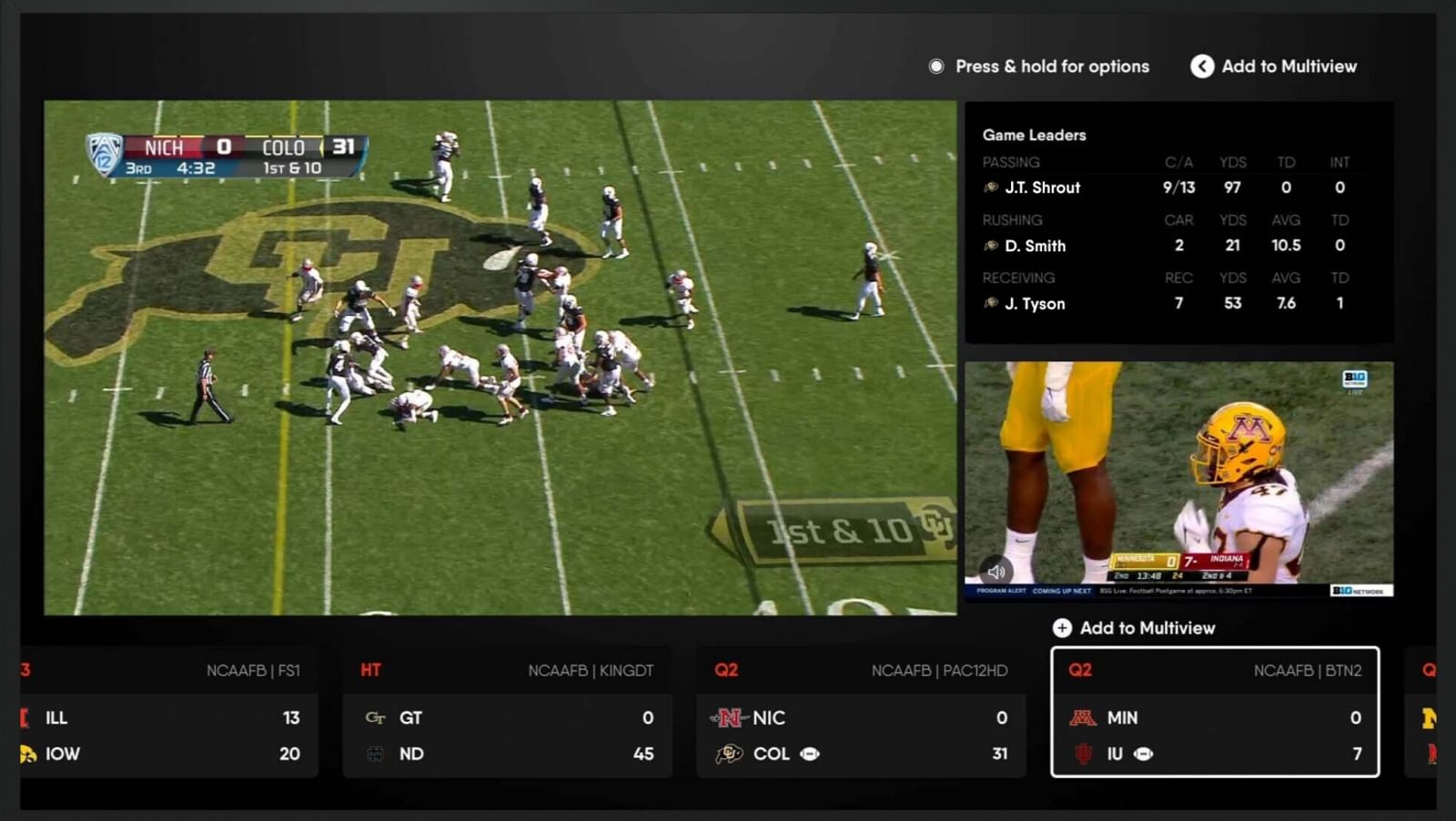
Live channels sit alongside on-demand programming and DVR features. The customer is buying convenience across connected televisions, phones and other supported screens. Device details still matter: some compatible Roku hardware supports two simultaneous views rather than four. A feature on a marketing page is only useful when the television in your living room can run it.
The bet that cost too much
Sports betting seemed a plausible neighbor. Fubo had sports viewers; a sportsbook could give those viewers another reason to participate. But on October 17, 2022, the company closed Fubo Gaming and ceased its sportsbook operations. Following a strategic review, it said the available opportunities would not sufficiently reduce funding requirements or generate adequate shareholder returns.
The accounting supplied a hard edge to the decision. The gaming operation recorded $135.5 million in operating expenses in 2022, including $87.4 million of impairments. Those expenses included noncash charges; they are not a measure of cash wagered or a clean lifetime startup bill. They do show how costly the experiment became.
The lesson for another company is practical: test an adjacent product against the money needed to sustain it. A shared audience does not guarantee shared economics. Fubo chose to stop funding wagering while continuing the streaming business.
From courtroom opponent to teammate
The Disney agreement was another change in direction. Announced in January 2025, it brought a $220 million payment from Disney, Fox and Warner Bros. Discovery as the litigation was settled, plus Disney’s commitment to a $145 million term loan in 2026. The combination closed on October 29, 2025. Existing Fubo shareholders held approximately 30% at closing.
Fubo and Hulu + Live TV continued as separate consumer services. The corporate group also owned France’s Molotov. Advertising operations moved toward Disney’s sales organization, while the combination promised savings and more flexible programming. In July 2026, former Disney+ president Alisa Bowen succeeded Gandler as CEO. The task had shifted toward making a larger collection of businesses work together.

The billion-dollar footnote
Scale makes the numbers impressive to look at. For the quarter ended June 30, 2026, Fubo reported $1.482 billion in global revenue and 5.75 million North American paid subscriptions across its services. But the comparable prior-year pro forma revenue, which treats the businesses as already combined, was $1.484 billion. Revenue was essentially flat on that basis.
Both quarters ended June 30. Bars start at zero. Bigger reported revenue after a merger does not automatically mean organic growth.
Adjusted EBITDA was positive $19.1 million; the GAAP net loss was $25.7 million. Both deserve space in the same sentence. The company had become bigger, while sustainable profitability remained work in progress.
A smaller bundle, down to your ZIP code
September 2026 brought My Local Sports, an add-on pairing participating regional sports networks with the lighter Fubo Sports plan. The announced standard Fubo Sports price was $64.99 monthly after introductory offers, with local add-on pricing varying by market. That gives fans another way to assemble national coverage and their nearby team without buying the broadest package.
Fubo competes with YouTube TV, DirecTV, Sling and cable. Its appeal depends on the channels a household actually needs. A missing rights agreement cannot be repaired by an elegant interface. Before subscribing, check your team’s schedule against your ZIP code’s channel lineup, your device and the complete bill. International availability does not turn a regional subscription into a worldwide sports passport.
That is the intriguing tension in Fubo’s next chapter. The company became larger to improve its economics. Its next useful product may be a package small enough to feel personal.