Before Frere Byrne was asking investors to back a different way of making fertiliser, he trained as a classical singer. His degree was in music. His next career took him through derivatives, bank operations and technology ventures. Now, as CEO and co-founder of PlasmaLeap Technologies, he is helping put chemical production closer to the farms that need it. A music graduate running a plasma business is the sort of career move that makes a university prospectus look insufficiently ambitious.
The surprise is useful, but it only gets us to the door. Inside is a more practical story about taking a scientific idea through the awkward business of making it work outside a laboratory. Byrne brings experience in capital, partnerships and operations to a company whose products have to survive contact with customers, crops and electricity bills. The chemistry is a team effort. So is the business built around it.
On 3 March 2026, PlasmaLeap announced almost A$30 million in Series A funding. Its plans included fertiliser hubs in New South Wales and Tasmania, wider field trials and further technology development. For Byrne, the announcement marked a change in the work ahead. After thanking the team and its backers, he wrote: “Now the real work begins.” It is a pleasingly unceremonious way to greet a substantial cheque.
A music degree, then several jobs inside one bank
Byrne’s early professional life belonged to music. He trained as a classical singer, earned a Bachelor of Music from the University of Melbourne and worked in the music industry. That chapter has a continuing connection: Western Sydney Philharmonic’s biography identifies him as a trustee of the Sylvia Fisher Fund, which supports young Australian singers. Music appears in his public life as both an earlier profession and a responsibility to other performers.
The banking years added another set of disciplines. At Commonwealth Bank, Byrne worked as a chief of staff, a derivatives dealer and a divisional chief operating officer before moving into its Innovation Labs. Those jobs brought him into different parts of a large organisation: the transactions, the machinery behind them and the search for new products. The sequence is more interesting than a single impressive title. He kept changing the kind of problem on his desk.
Describing those opportunities, Byrne said: “The diversity of opportunity is endless!” At the time, his title was Innovation Manager, Blockchain Strategy and Operations. He spoke about identifying emerging technologies and applying them to real business problems. Even inside a bank, his interest had moved beyond the familiar boundaries of banking. A new technology needed a use, an organisation willing to build around it and customers who could benefit from it.
He subsequently became Portfolio Director at x15ventures, Commonwealth Bank’s venture arm. His work spanned technology ventures involving blockchain, clean energy and payments with a social purpose. By the time PlasmaLeap became his focus, he had experience with both established institutions and ventures trying to gain a foothold. That combination gives his current role a clear commercial context: the person explaining the reactor also has to help build a viable company around it.
The chemistry has to leave the building
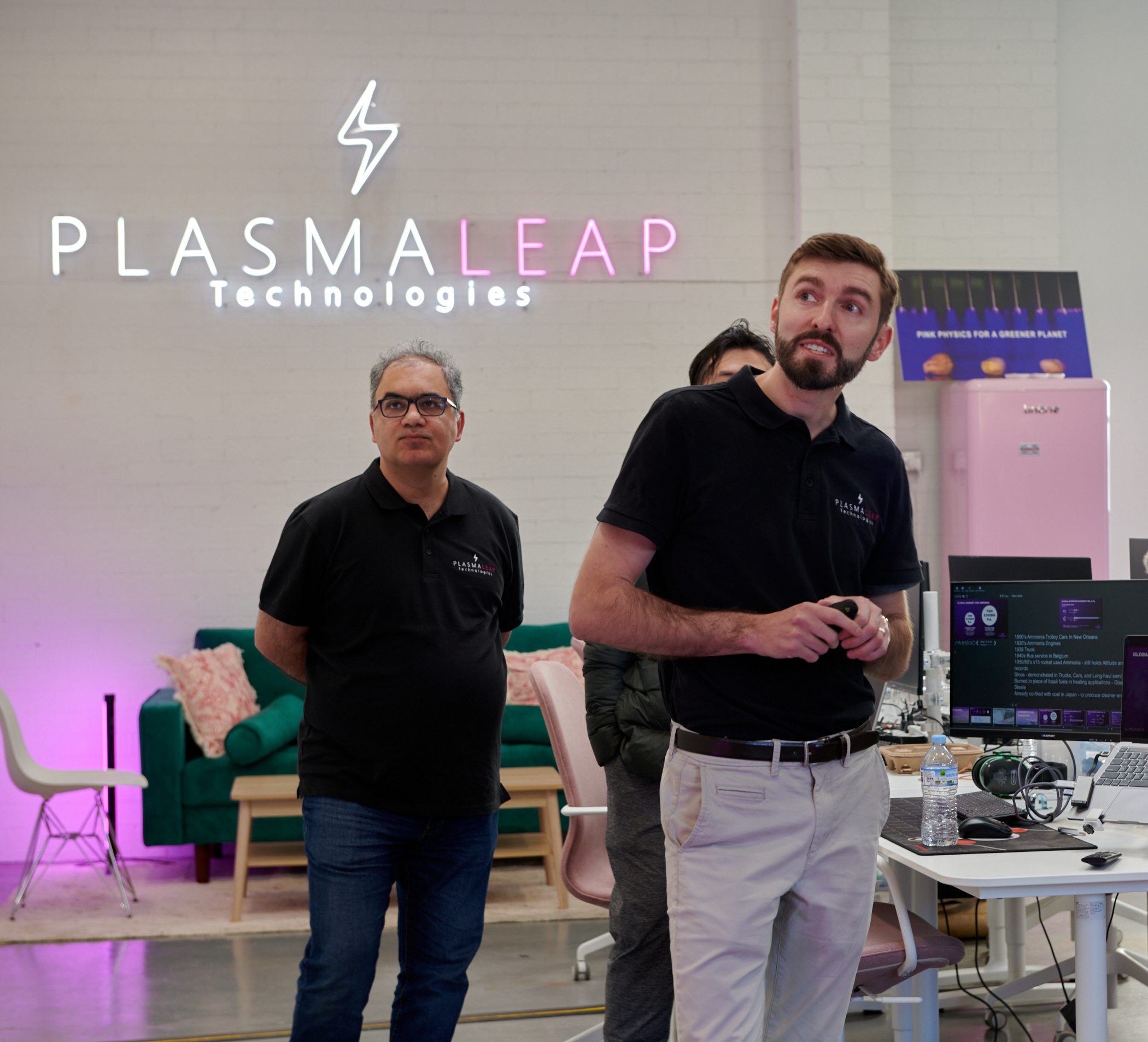
PlasmaLeap was founded in 2019. Its work centres on electrically driven plasma reactors, with applications in nitrogen chemicals and a longer-term programme in fuels. Byrne’s co-founders include Professor PJ Cullen and Samantha Cullen. The company grew from research technology towards chemical production, bringing scientific development into the same conversation as manufacturing, finance and the people who would eventually use the output.
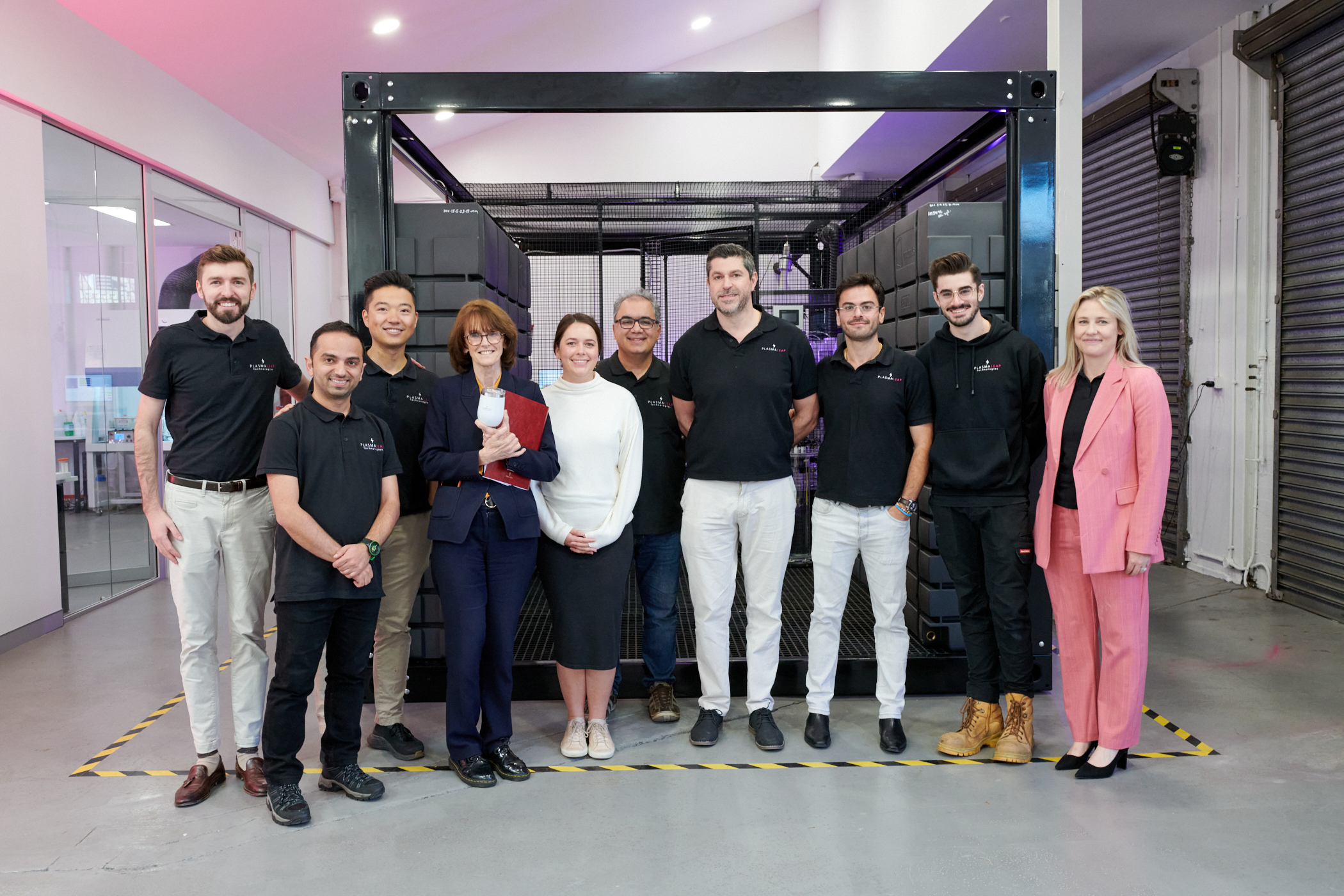
In July 2023, Australia’s Chief Scientist, Dr Cathy Foley, and NSW Chief Scientist, Professor Hugh Durrant-Whyte, visited PlasmaLeap to see its green-ammonia technology. Byrne was already its chief executive. The photographs show a working laboratory, equipment, scientists and visitors gathered around a tangible proposition. For a company pursuing a new production process, letting people see the apparatus matters. It gives an abstract promise a place, a scale and something to ask questions about.
Byrne credited Cullen’s work with University of Sydney and UNSW colleagues on a plasma-driven route to ammonia synthesis. His role in that account was to explain what the research might make possible commercially. It is an important division of labour in his story. A founder can help organise, finance and communicate a scientific venture while the scientific work remains the achievement of the researchers and engineers doing it.
The local-production proposition is straightforward to describe. PlasmaLeap’s systems use air, water and electricity to make useful chemicals, with renewable power central to its low-emissions ambition. Its modular approach is intended to put production on farms or in regional hubs. The commercial attraction is the possibility of making an essential input nearer the place it will be consumed. Fertiliser has a rather literal customer requirement: it must arrive where the plants are.
Produced nearer growers
Conceptual flow, not an engineering schematic. Commercial hubs are part of the company’s deployment plans.
A cheque comes with a to-do list
The March 2026 financing brought together the Gates Foundation, Investible and Yara Growth Ventures as lead investors. Yara Growth Ventures is the venture arm of Yara International, a nitrogen fertiliser producer. Other participants included funds and organisations connected to Australian agriculture, alongside investors in technology. Their involvement placed PlasmaLeap in a conversation with people who understand the existing fertiliser business as well as people seeking to change it.
The Series A had closed in January. Its announced uses were concrete: progress the first fertiliser hubs in New South Wales and Tasmania, expand trials and keep developing the core technology. Sustainable fuels and energy systems were also on the longer-term agenda. Byrne’s job now includes turning that list into delivery. Raising money creates room to work; the spending decisions determine how much of the promise reaches a customer.
His public response to the round was unusually useful as a description of the company’s position. He pointed to a proven core platform, an assembled technical and commercial team, and the passage between laboratory science and industrial use. He also emphasised manufacturing, trials and farm or industrial deployments. The vocabulary had moved towards the unglamorous verbs that occupy a growing hardware company: make, install, test, support, repeat.
A second March statement sharpened the supply-chain argument. Byrne spoke about the exposure of farmers and consumers to fertiliser price shocks during conflict in the Gulf. PlasmaLeap’s proposed answer was production closer to use, reducing dependence on distant supply. The ambition is tied to a familiar commercial worry: a grower can do many things well and still have little influence over the price or availability of a necessary input.
Applause in California, questions on the farm
Before the funding announcement, PlasmaLeap had won the overall prize at the 2025 THRIVE Global Impact Challenge. It also took the Clean Energy and Climate Tech category and the People’s Choice award. The competition received more than 2,000 applications from over 100 countries. For Byrne and his colleagues, those three awards put the company in front of an international agricultural audience and gave its work a useful public milestone.
The recognition belongs to the team. It is also a window into the range of audiences Byrne has to address. Scientists can question the reaction, investors the economics, and growers the product’s place in their operations. A prize brings those conversations closer together. It does not settle them. The interesting part of his current career is the need to carry a technical idea across all three conversations without losing the practical question each audience brings.
In a January 2026 conversation with Ash Sweeting, Byrne described similar supply and price pressures affecting small African farms and large Australian cropping businesses. He discussed containerised production units, regional facilities and smaller versions under development. His argument was about access as well as emissions. The proposed users have very different resources, but both need dependable inputs. Designing for that range makes the commercial task broader than selling one machine to one kind of buyer.
He also distinguished fertiliser development from the earlier-stage fuel work. That matters to the shape of his ambition. PlasmaLeap has several possible applications, yet they come with different schedules and stages of development. For a CEO, keeping those differences visible is part of setting expectations. A laboratory result, a pilot and an operating commercial facility each ask something different of the people financing and building them.
“Now the real work begins.”
Frere Byrne, on PlasmaLeap’s Series A announcement
An edible garden, and a very practical ambition
A later account of a European trip adds a lighter detail. Travelling with PlasmaLeap’s finance chief, Nick Bishop, Byrne described showcasing the company’s nitrogen fertiliser units, attending an industry conference in Budapest and meeting growers and technology providers at GreenTech Amsterdam. The itinerary included Dutch horticultural innovation centres. At Koppert Cress, his eye landed on what he called a “Willy Wonka-style edible garden.” Even a chemical-production trip can have a good dessert course.
The detail gives the story a person again. Byrne’s public work moves between investment announcements, laboratory equipment and growers’ businesses, but he can still report the pleasure of seeing what other people have made. His music background belongs in that same portrait without needing to explain every later decision. The singer, the banker and the founder are documented chapters of one career. They need not be squeezed into a convenient fable.
For now, the clearest expression of his aspirations is the work PlasmaLeap has committed to pursuing: local fertiliser production, more trials and technology that can serve customers with different scales of need. The next chapter is measured in facilities, products and use. Byrne has already changed professions more than once. This time, the hoped-for change extends beyond his own job description, all the way to where a grower gets the next load of fertiliser.