Frank Salmon’s early opportunity came in two sizes: 5¼ inches and 3½ inches. Desktop computers used one kind of floppy disk; newer portable machines used another. A person could have the right information and the wrong piece of plastic. CMS’s Megalink helped move data between the two. It was an awkward little problem, with a useful commercial consequence: Toshiba approved the product and began introducing the business to its resellers.
There are grander ways to begin a technology story. They tend to involve a prediction about the future. Salmon’s began with something that needed to work in the present. Over the following decades, he built CMS Distribution across countries and product categories, while maintaining connections to the part of Ireland he came from. Alongside the acquisitions are football pitches and school businesses. The same career accommodates all three, without requiring a motivational poster to explain the arrangement.
A small opening, measured in inches
CMS started in London in 1988 under the name CMS Peripherals. Its early work was systems integration, including the Megalink external drive. The customers’ inconvenience supplied a reason for the company to exist. Toshiba’s introductions supplied a way to reach more of them. By 1990, the business was moving towards specialist storage distribution.
That shift changed the job. Making a product solve a problem and helping other companies sell technology demand different capabilities. The second involves an expanding cast: manufacturers, resellers, retailers and the people eventually using the equipment. Salmon’s business grew into the spaces between them. A working device still needed a route to market.
Different formats. Information that still needed to travel.
The attraction of this origin is its scale. A disk-format mismatch seems modest beside an international distribution group. Yet it contains the kind of question that follows the business through its later history: what is preventing this technology from reaching the person who can use it? Sometimes the answer is hardware. Sometimes it is access to customers, expertise or a business in another country.
Three pounds, then a road back to Mayo
Salmon is a native of Knock, County Mayo. Before CMS, his first full-time job was cost accounting. He later recalled learning from the ways a business could be run badly. It is a compact description of an education: the accounts provide numbers, and the organisation supplies cautionary examples.
The ownership story has a less ordinary price tag. In 1990, he had the opportunity to buy CMS for £3, together with an obligation to repay a company loan. He raised £200,000 through letters to family and friends. Another major investor entered the picture through a chance meeting in a Las Vegas casino. The three pounds makes a fine opening line; the debt and fundraising explain why it was a serious undertaking.
In 1993, the business established its Irish operation in Kiltimagh. Salmon saw an opportunity to support the UK operation remotely from Mayo. The location had a commercial purpose as well as a personal connection. Work for a London business could be done from a town near home.
That arrangement also had limits. By 2008, he was discussing how the stronger euro had eroded the Irish base’s cost advantage. A place can matter to a founder without being exempt from arithmetic. The Kiltimagh chapter is more interesting for that complication: local commitment and commercial calculation had to share the same desk.
Buying the map is the beginning
Expansion eventually arrived through other businesses. In 2011, CMS bought CCI Distribution in Harrogate. The deal brought together storage operations with complementary ranges. When CMS Peripherals became CMS Distribution at the start of 2013, the name caught up with the work.
The machinery behind that change was unusually revealing. The combined business introduced a group SAP system and unified telephony. Customers were told they would continue dealing with their account managers. For people buying technology, continuity was part of the point. A new corporate identity had to coexist with the familiar person at the other end of a call.
- 1988CMS begins in London
- 1993An Irish operation in Kiltimagh
- 2011CCI joins the business
- 2017TNS Connect opens an Asia-Pacific route
- 2026Cables Direct integration completes
TNS Connect, acquired in 2017, brought consumer-technology expertise and an Asia-Pacific presence. French distributor Avesta followed in 2019. CMS added sysob in Germany and VLC in the United States in 2021. The map widened through businesses that already knew their products and customers.
There is a second date to watch after any acquisition. CMS bought Cables Direct in 2023; completion of its integration was announced in June 2026. Cablenet, also acquired in 2023, had its integration announced in January 2025. The interval is a reminder that a transaction and a functioning combined operation are different stages of the work.
His own travel offers a more personal view of that reach. Reflecting publicly on a business trip to Shenzhen, Salmon recalled first visiting in the mid-1990s. He noticed the changed skyline, electric cars and the welcome from local teams, including visits connected with vendor partners DJI and EcoFlow. The post returned to the prospect of developing those partnerships for customers. It is a small glimpse of the founder away from the financial announcement: looking around a city he has known for decades, noticing what has changed, and considering what the next visit might make possible for the businesses he works with.
For Salmon, the result is a company whose daily business crosses borders while depending on local knowledge. A reseller still needs an answer that fits its own customer. International reach helps only when the organisation can make those connections useful at the level of an individual order.

The accountant still gets a vote
For 2025, Storit Limited, CMS Distribution’s parent group, reported £594.997 million of turnover and £23.899 million of EBITDA. Revenue rose 4.2 percent; EBITDA rose 29.8 percent. Profit before tax was £12.981 million. These are group results, and the distinctions between the measures matter. A large sales figure does not become an equally large profit.
Year-on-year change from FY2024. Bars share a 0–30% scale; EBITDA is earnings before interest, taxes, depreciation and amortisation.
The group attributed the improvement to operating efficiencies, supply-chain work and disciplined pricing. It also completed systems integration across its US businesses. Growth here has an administrative life: shared platforms, fewer obstacles and the repeated effort to make transactions work better.
Salmon’s approach to AI has a similar practical streak. In 2024, he saw potential in upgrades and emerging vendors while questioning how the channel would earn revenue from the opportunity. His preparation list included automation, repetitive processes and accurate master data. The future, apparently, would still require tidy records.
“The further out you go, the easier it is to be optimistic about growth.”
Frank Salmon · on market expectations, 2024
He also described investment in staff education and personal development, including a graduate academy recruiting apprentices as well as graduates. These were operating priorities, with people learning how to do the work alongside systems designed to make it easier. The emphasis puts a practical question beneath every promising new technology: who will turn the possibility into something a customer can buy and use?
There is another team sheet
As a child, Salmon wanted to become a professional footballer. When answering questions about 2019, he reported that he was managing an under-12 team. Football had found him another occupation. His earlier questionnaire answers also included a previous life as a DJ and an enjoyment of coaching. There is more to his working history than a sequence of boardroom titles.
The football connection runs back to Mayo. Kiltimagh/Knock United was formed in 2002 from the merger of the two local clubs. Salmon supported the new club from the beginning and helped acquire the grounds now known as CMS Park in Cloolee, Knock.
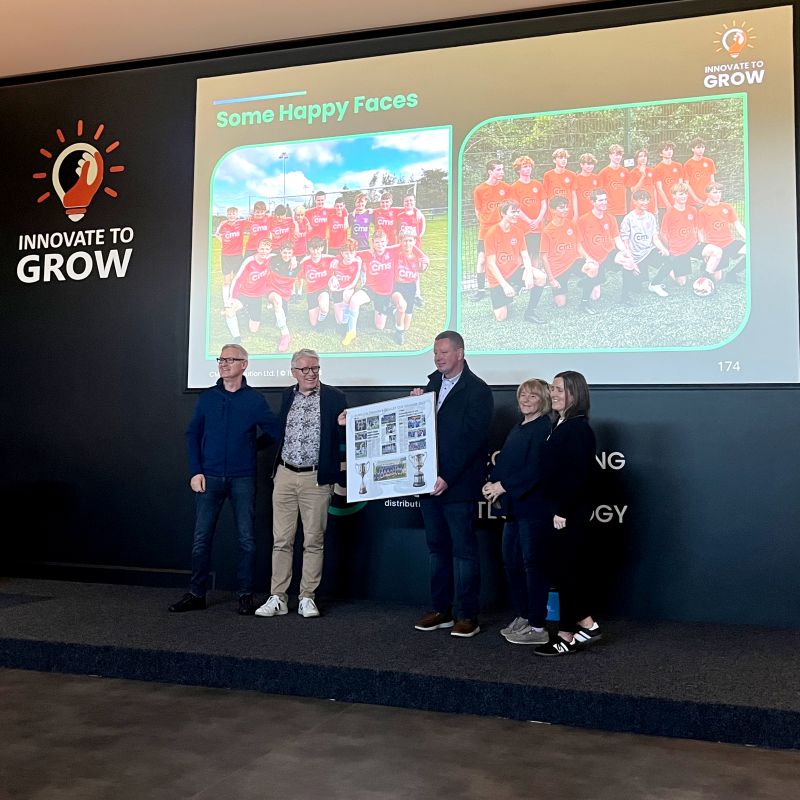
At CMS’s 2024 kickoff, representatives of the club were invited to speak about its development. A company gathering made space for a local football organisation. The relationship had accumulated enough history to be a story in its own right.
His recreational reading sometimes stays close to the pitch, too. In 2022, he named David Dein’s Calling the Shots, appreciating its account of football and Arsenal. Asked who might portray him in a film, he suggested Colin Farrell. Asked for a warning label, he offered: “Work hard, play hard and be happy.” There is no requirement that a distributor’s chief executive spend every answer discussing distribution.
A classroom with customers
Salmon’s interest in younger people also took a business form. CMS sponsored the Junior Entrepreneur Programme in Mayo, where primary-school pupils developed ventures of their own. The projects reported in 2014 included board games, culinary products and a school creperie. Even a very young business benefits from customers who arrive hungry.
By 2016, he was offering the 12-week programme free to participating schools and pupils across the county. It brought local businesspeople into contact with fifth- and sixth-class students. His stated ambition was to let children experience the enjoyment of creating and succeeding in a business. Their curiosity already existed; the programme gave them somewhere to put it.
The connection has lasted beyond that early Mayo initiative. The programme’s account of reaching 100,000 participants names Salmon among entrepreneurs who have spent time mentoring pupils in classrooms or online workshops. It places him in a wider effort whose output is measured partly in children willing to try an idea.
That is a useful place to leave his story. The first CMS product dealt with information stranded on the wrong disk. Decades later, there are companies being brought together, young colleagues learning a trade and pupils finding out whether anyone wants what they have made. Each setting has its own practical obstacles. Salmon has spent much of his career working on the connection that lets the next thing happen.