Four doors separated Adam Edwards from his future business partner. In Diamond Bar, California, Edwards’s family moved down the street from Patrick Oborn’s when the boys were 12. There would be football, surfing, college, and eventually a company. First, there was the ordinary convenience of having your friend nearby. The distance was small enough to cross without scheduling a meeting.
Decades later, their working relationship would help many other conversations happen: between businesses and suppliers, salespeople and engineers, buyers with a problem and people who might solve it. Edwards became co-founder and CEO of Telarus, the technology services distributor. The childhood proximity makes an appealing beginning. The more interesting question is how he turned familiarity into an organization that could be useful to strangers.
Four doors, then a company
Oborn’s recollections give Edwards something that corporate biographies often lack: a life before the title. He remembers a boy who played center on their football team, became an Eagle Scout, and learned to surf. He also remembers a student who worked hard at Brigham Young University’s accounting program. These are different kinds of competence, with different audiences. A wave has little interest in your transcript.
The friendship had an entrepreneurial rehearsal. As children in Southern California, the pair built a bike track and charged their friends ten cents a lap. It was a modest proposition, comprehensible to everyone involved. You supplied the bicycle. They supplied somewhere to ride it. Revenue arrived one small circuit at a time.
Patrick’s father, Kent Oborn, was an enduring influence on both boys. They would later describe him as a mentor whose work ethic and family values helped shape Telarus. The company’s beginnings belong to that wider network of encouragement, as well as to the two names on the founding story.
When Telarus started in 2002, the division of labor was plain. Oborn brought in prospects through ShopforT1.com. Edwards made sales. There was no grand distance between strategy and the next customer: someone had to generate the inquiry, and someone had to turn it into income. Edwards occupied the second chair.
The accountant picks up the phone
His earlier career had prepared him to examine a business from another direction. Edwards earned a Bachelor of Science in Accounting at BYU and worked as an auditor at KPMG. His experience there included small private companies, filings for large public companies, and work in the firm’s Korean Practice and Structured Finance Division. Before asking customers to buy, he had experience examining how organizations accounted for what they did.
At Silicon Film Technologies, where he served as vice president of finance from 1999 to 2001, he helped prepare the digital imaging company for a financing that raised $6 million in 2000. He then held the finance role at Quest Manufacturing from 2001 to 2002, working on an acquisition and financing arrangements. It was an education in what ambition requires once it reaches the accounts.
Then came the work of selling telecommunications services. Oborn remembers Edwards as their first salesman when the young company badly needed cash. That detail puts some weight back into the familiar word “founder.” Here, it meant taking the prospects available and doing the work that paid for the next stage.
The founders financed Telarus through savings and commissions. They reinvested recurring income in channel managers, developers, and legal help for the GeoQuote patent application. Software and people grew together. Each promised a different kind of relief from the friction of getting a sale done.
That early arrangement also explains something about his subsequent leadership. A distributor earns its place by making other people more effective. A useful quoting tool helps the salesperson facing a customer. An engineer helps resolve a technical question. The chief executive has to decide which kinds of help justify the next investment.
Buying room to grow
In October 2017, Telarus acquired CarrierSales. Richard Murray became part of the combined leadership. The transaction expanded the resources available to partners, including expertise in mobility, data centers, and unified communications. Size had a practical purpose: customers were asking questions that required more kinds of knowledge than one generalist could comfortably carry.
The geographic map widened, too. In 2018, Telarus moved into Australia and New Zealand, with Tony Heywood leading its international sales effort. Edwards described a cloud-first approach to those markets. It was a change from the wireline origins of the American agency model, and an acknowledgment that taking a business abroad could require a different opening conversation.
For years, reinvestment remained a point of pride. At Telarus’s eighteenth birthday in 2020, Edwards thanked Oborn and Murray for sacrificing luxuries to put money back into the company. He connected that independence to the ability to make decisions for partners without delays. The message was personal, but the underlying issue was governance: who gets to decide what the business does next?
Later that year, the financing changed. Telarus announced a growth equity investment led by Columbia Capital in December 2020. Existing management continued leading the business and retained a majority stake. The company that had grown through its own resources was bringing in an outside investor to support further expansion.
Edwards continued building through people as well as transactions. In welcoming Dan Foster as chief revenue officer in 2021, he emphasized a professional relationship stretching back more than ten years. When Telarus acquired Chorus Communications that year, his remarks focused on the founders’ integrity and passion. His public explanations kept returning to the people who would have to make the arrangement work.
When the CFO joins the AI meeting
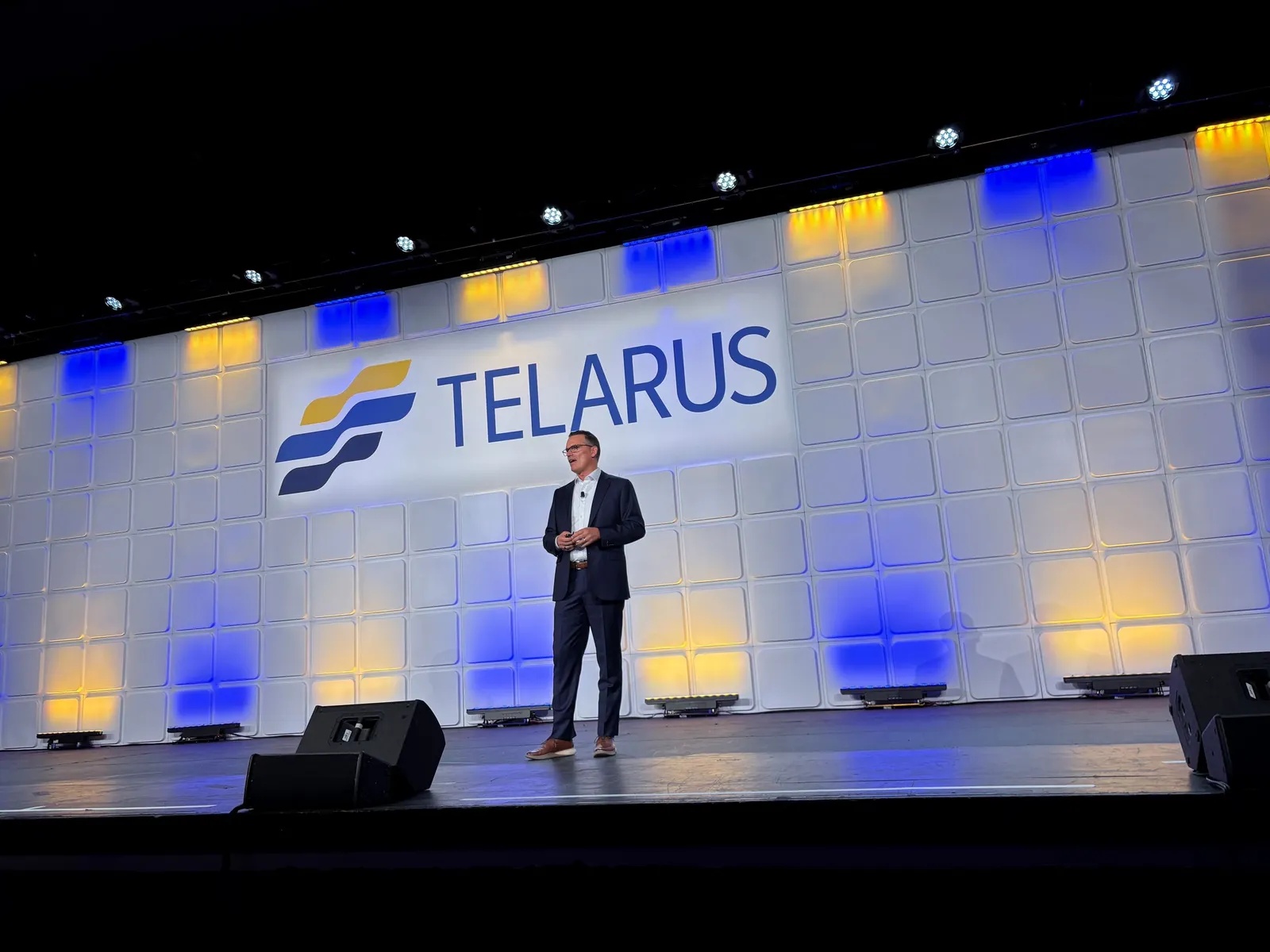
By August 2026, Edwards was onstage in Texas addressing a newer variety of business excitement. AI had become a central subject at the Telarus Partner Summit. His response carried a trace of the finance office: he described companies racing through budgets before chief financial officers began asking what the spending had accomplished.
The questions he recalled were basic ones. Were customers better off? Was revenue growing? Had cost or risk fallen? The comic ingredient was the gap between the scale of the enthusiasm and the difficulty of producing a satisfactory answer. Even an impressive technology eventually has to survive a meeting with someone holding the budget.
His argument at the summit was that customers needed help connecting AI projects to cloud, security, networking, and customer experience. A project could touch several systems at once. Advisors would have to help customers choose priorities and carry the work through. A supplier presentation could begin the discussion; it could hardly settle every consequence.
“AI has moved to execution.”
Adam Edwards, August 2026
The distinction becomes concrete in the buyer research Telarus released in September 2026. Its fourth annual Tech Trends Report, developed with Redpoint Insights, drew on more than 500 mid-market and enterprise IT decision-makers and more than 450 technology advisors. The findings exposed a mismatch between what advisors thought they provided and what buyers particularly valued.
More than half of advisors regarded cost savings as their primary value. Only about a quarter of buyers agreed. Buyers placed greater weight on implementation support, vetting suppliers, and planning integrations. A cheaper contract remains easy to explain. Getting different technologies to work together is a more demanding promise.
Someone still has to make the call
Edwards’s advice at the beginning of 2026 had already pointed in this direction. In his State of the Union address, he urged advisors to keep learning, become comfortable discussing AI, and preserve customer relationships beyond the initial purchase. He also cautioned against overlooking network infrastructure while attention moved to newer technologies. The foundations still had work to do.
There is a restraint in that last point. A career spent moving from telecommunications into broader technology services might invite a speech devoted entirely to the next thing. Edwards was also asking his audience to attend to the things customers already depended on. Continuity can be commercially useful, even when it makes a less exciting slide.
His own public description of his work is compact: “Advocating for partners and for the channel.” In practice, that has meant building an organization around independent businesses whose owners need access, expertise, and help with execution. Their success is part of the distributor’s business model. The relationship comes with an economic reason to keep being useful.
The childhood story does not explain every acquisition or management choice. It does make the length of the partnership easier to appreciate. Oborn has known Edwards as a teammate, student, salesman, and chief executive. Most professional relationships have to build trust without the benefit of having first met four doors away.
Edwards’s current assignment is to make that kind of dependable access available at a much greater distance. A customer has a question. An advisor needs an engineer, a supplier, or someone who understands the next step. After all the software, capital, and conference sessions, a recognizable piece of work remains: knowing whom to call, and giving them a reason to answer.
Keep the conversation going
- Watch the Larry Walsh interview on YouTube
- Adam Edwards on LinkedIn
- Telarus leadership biography
- 2026 State of the Union - watch and read
- Changing Channels interview with Larry Walsh
- The Rising Tide for Channel Partners - video interview
- Edwards’s 2025 year in review
- 2026 Partner Summit coverage
- 2026-27 Tech Trends findings
- Telarus website