The software team had a countertop problem. In a published account of its work for a 66-year-old manufacturer, Founding Minds admits that its designers did not fully understand the business they were supposed to digitize. So they visited the customer’s offices. Before the cloud storage, before the prototypes, there was a more basic assignment: learn what people actually did. It is an oddly reassuring detail to find on a technology company’s website. Someone had noticed that knowing how to build software was insufficient preparation for knowing what to build.
- Custom software and product incubation for startups and established companies.
- Financial workflows and healthcare feature prominently in its work.
- A one-month MVP offer starts with a deliberately narrow use case.
A factory visit beats a guess
The manufacturer still used pen and paper for parts of its operations. It was unsure where its digital requirements should begin. Founding Minds describes extensive exchanges to understand those routines, followed by working prototypes that helped refine the brief. The resulting system served employees and customers, with different access permissions.
The revealing admission is the team’s initial knowledge gap. The visit supplied context that a specification had not. For anyone commissioning software, there is something immediately reusable here: ask the designers to observe the job. A screen can look persuasive while misunderstanding the person who must use it. Prototypes become more useful when both sides can point to the same real task.
The spreadsheet had too many jobs
Consider another engagement, this time for an unnamed recordkeeping company. Its billing process combined SQL queries with Excel calculations and invoice templates. Fees depended on details such as employee numbers, market values and tiers. Discounts, minimums and exclusions complicated the arithmetic. The system’s burden was the growing collection of exceptions that people had to carry between tools.
Founding Minds built a configurable billing engine within a multi-tenant cloud system. Its account names .NET Core, Angular, SQL Server and RabbitMQ among the components. Scheduling, audit logs and accounting integration mattered alongside calculation speed. The company reports that fee calculation and invoicing fell from weeks to a couple of days. That is a vendor-reported outcome for one engagement, rather than a general performance promise.
of days
Fee calculation and invoice preparation, as reported by Founding Minds.
A month, with a smaller brief
Its startup offer applies a different constraint. MVP in a Box advertises a functional minimum viable product within one month, concentrating on essential features. The published phases distinguish discovery, listed at less than two weeks, from development at around four weeks. A buyer should treat those as separate planning steps when discussing a delivery date.
The commercial structure follows that sequence: fixed-rate discovery, monthly development billing and a fixed monthly retainer for continuing work. Strategy, design and engineering come together in the package. The transferable idea is to make the first release answer one useful question. A founder who keeps enlarging that question is also changing the conditions behind the timetable.
- 01DefineDiscovery + planning
Less than 2 weeks - 02BuildCore MVP
Around 4 weeks - 03ContinueIterate + support
Monthly retainer
The awkward middle of a project
Not every customer arrives with a clean starting line. A dental startup brought Founding Minds into development midway through the job. The case study describes changing requirements, an unclear scope and pressure for timed releases. Development stalled at points. The response was an iterative approach that allowed successive releases as the product took shape.
The work extended from patient and dentist registration to payment choices, including insurance and health spending accounts. It also included analysis of patient-uploaded dental photographs for an online evaluation and possible treatment plan. The case illustrates how much sits around the visible application: enrollment, payment, clinical information and continuing revisions. For a healthcare buyer, each of those deserves its own acceptance criteria.
A development team that stays
Named customers elsewhere on the site include corporate-card company Torpago, dental business OrthoFX and LE Smith Company. In his published testimonial, Torpago CEO Brent Jackson says the developers are “they truly are part of your team.” That sentiment helps explain the market position: an outside product engineering group that can remain involved beyond a single release.
“they truly are part of your team”Brent Jackson, CEO of Torpago
Company-published customer testimonial
For an older financial workflow platform, staying involved meant protecting continuity. Founding Minds describes outdated browser support, difficult maintenance and users accustomed to the existing system. It used test groups, a redesigned interface and phased migration. New API connections gave other systems access to underlying processes. Here, moving carefully was part of delivering useful change. The customer’s habits were a design input.
Five people, then a longer relationship
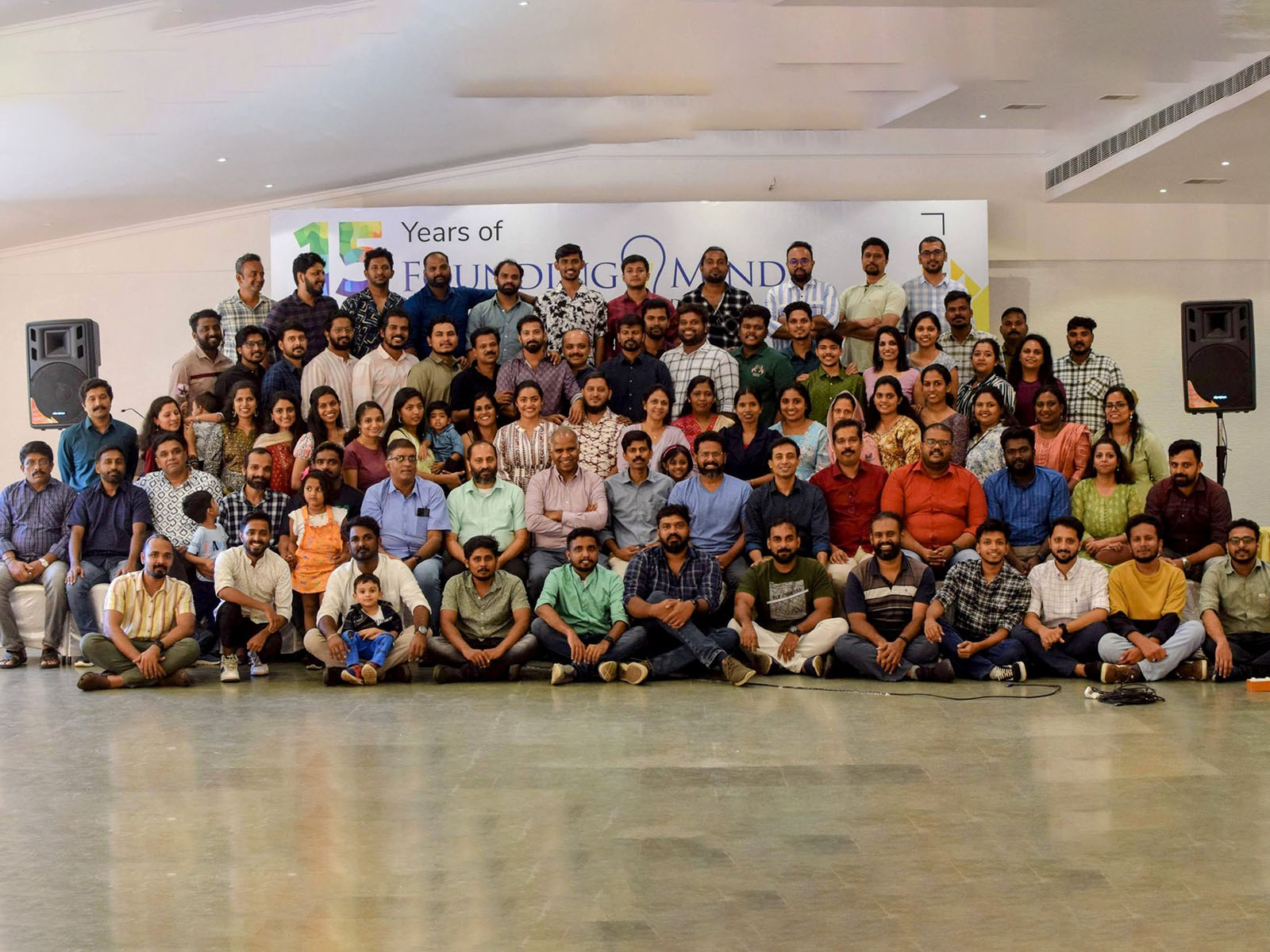
The company’s anniversary account identifies Babu Sivadasan as its founder and traces the organization to five employees. It connects his ambition to a difficult job market and a desire to create employment while supporting entrepreneurs. At its August 2023 celebration, Founding Minds reported more than 120 people. Its own history dates the incubator’s beginning to 2008.
The organization now lists Regi Roy as CEO and Jayan Chacko as managing director. Its engineering operations span Trivandrum and Kochi. The company describes most customers as long-term partners and says its culture makes room for personal aspirations. Those promises matter in a services business: accumulated understanding can leave with the people who acquired it.
AI still needs a specific job
Founding Minds also offers computer vision, document processing and other machine-learning work, supported by DevOps services for deployment and monitoring. In June 2025, it announced architect Harikrishnan Kuttan Pillai’s machine-learning doctorate; his research examined turning natural-language requirements into software interfaces and logic.
The sensible buying question remains wonderfully plain: which task should improve? An internal engineering team or another development consultancy offers an alternative. Founding Minds makes its case through combined product work and ongoing delivery. The strongest lesson in its public record is available even to someone who never hires it. Visit the workplace. Understand the exceptions. Agree what the first release must accomplish. Then start the clock.