The trouble with a successful software system is that people keep using it. More files arrive. More customers log in. Yesterday’s tolerable delay becomes today’s queue. At MX Studio, a media-processing business described in Navtech’s case study, growth exposed an expensive mismatch: manual quality checks, slow archive searches and annual software licensing above $220,000. Navtech’s first assignment was modest. Test the existing product. Find the regressions. Make the next release behave.
- Navtech builds custom business software, cloud systems and industry-specific AI.
- Its customers bring detailed workflows: legal research, media delivery, tax credits and solar installation.
- The recurring idea: fix a bounded problem, prove the result, then expand.
That small beginning is a useful introduction to the company. Founded in 2013, Navtech sells engineering help to organizations whose operations have become too particular for a generic application. The work includes product development, cloud infrastructure, mobile apps, data pipelines and technical consulting. Its recent positioning puts domain-specific AI at the front. Underneath sits an older business: learning how a customer works, then building something that fits.
A repair job earns the keys
According to the media case study, testing expanded into full project responsibility as delivery improved. Modules previously taking six to eight weeks took three. The company describes replacing licensed components, automating media checks and keeping processing on the customer’s infrastructure. Its reported outcome is striking: the annual licensing bill fell to zero.
There is an important distinction inside that number. Licensing is one expense. An owned platform still needs engineers, machines, maintenance and someone responsible when it stops working. For a buyer, the interesting calculation is whether those continuing obligations cost less than the subscription and the operational friction they replace.

The library had a different problem
For Lexworth, the awkward object was the law book. The business behind the legal-research platform had a publishing legacy, with physical volumes becoming stale as authorities changed. An earlier digitization effort had stalled without a dedicated technical team. Navtech’s account describes a customer choosing its next partner carefully after that experience.
“Sticking with the status quo was never an option.”
Saksham Gogia, co-founder, Lexworth.ai
The engineering combined optical character recognition, search indexing, vector embeddings and retrieval that mixes keywords with contextual matching. Put plainly, the system first needed to turn fragmented judicial records into material a lawyer could find and inspect. Navtech reports research-time reductions of up to 90%. That is a case-study result, rather than a promise that every legal question becomes easy.
The transferable lesson is quite practical. Before asking a model to answer questions, organize the evidence it will consult. A convincing sentence is a poor substitute for a traceable authority.
Sometimes the breakthrough is a quotation
Truzon Solar’s bottleneck lived closer to the sales desk. Its team worked across six states, with quotations passing through a shared Excel file. Payroll was manual. Navtech describes a 15-month implementation with its engineers embedded at the customer’s offices. The resulting system joined sales, finance, procurement and other operations, with customer and referral apps alongside it.
A pricing engine included more than 4,000 preset combinations. The case study reports quotation turnaround falling to two to four hours. This is customization at its most understandable: put the rules inside the tool so a field salesperson can produce an answer without continually borrowing an expert’s time.
RetroTax supplies another variation. Enterprise buyers required stronger compliance credentials while tax-credit processing remained manual and fragmented. Navtech describes introducing security controls, connecting more than 15 HR systems and automating submissions. The reported outcome included SOC 2 Type II certification and 25% faster processing. Here, the software problem and the sales problem were intertwined.
The product behind the product
These engagements explain Navtech’s place in the market. A customer can hire its own engineers, buy existing software or commission a specialist team. Navtech competes for that third decision. Its commercial offering spans projects, dedicated development capacity and continuing support. The named platforms in its portfolio demonstrate customer work; they should not all be read as a shelf of Navtech-owned subscriptions.
InfraSight360’s account makes the staffing question explicit. An earlier development partnership suffered high turnover, while internal work progressed slowly without a dedicated team. Navtech supplied sustained engineering capacity for the data-center platform. Continuity was part of what the customer was buying.
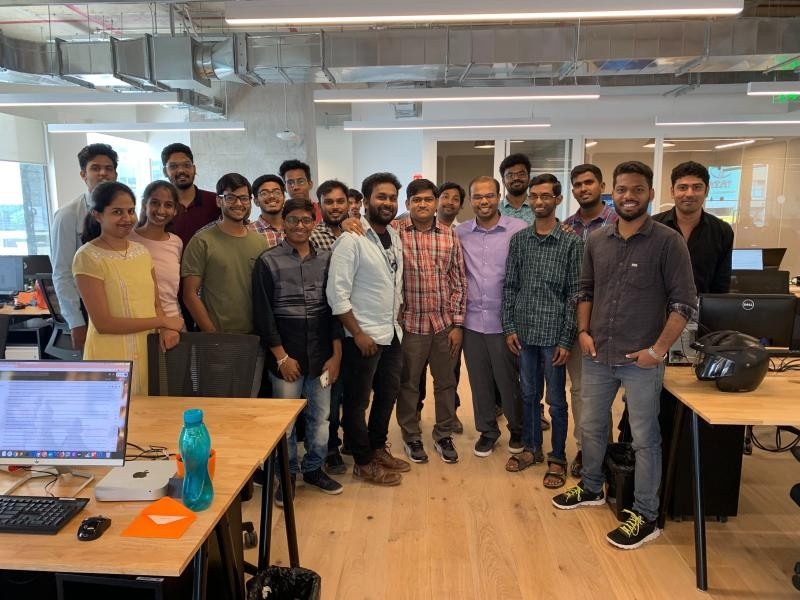
The founder, Shyam Visamsetty, described the original opportunity in a GoodFirms interview as encouraging public-cloud adoption and building cloud-first products. The company’s stated working practices include daily stand-ups, sprint demonstrations and overlap with client time zones. They are unglamorous details. They also give a buyer something observable to assess before awarding a larger assignment.
Give the model a proper job
Navtech’s AI proposition follows the same logic. Voila, a tutoring platform it built, combines lesson preparation, transcription, scheduling and payments. Bilingual lessons require recognizing speakers and language switches. Resonant’s Bintly engine addresses a different task: adapting the delivery of a message to a recipient’s communication preferences. Specific jobs produce specific engineering choices.
The company describes choosing among fine-tuned models, retrieval-based systems and simpler prompting according to the task. Its latest banking commentary, published in October 2026, stresses governance and infrastructure alongside automation. That emphasis matters most when a workflow crosses sensitive data, business rules and several existing systems.
For a reader considering similar work, the useful move is to copy the sequence: identify a costly recurring task, establish a baseline, test against real examples and expand after the result holds. Custom engineering makes more sense when volume and complexity justify its upkeep. A small team with standard requirements may be better served by an existing application. Navtech’s clearest argument begins at the point where that application repeatedly leaves someone finishing the job by hand.