An air-freight shipment does not necessarily need an airplane. It needs to arrive when promised. Between those two statements sits Forward Air’s original business: put suitable freight on a scheduled truck, place terminals near airports, and make the highway useful to people who sell speed.
- The useful trick: scheduled ground freight for shipments with an arrival deadline.
- The big bet: buying Omni added global forwarding and contract logistics.
- The unfinished job: improving operations while absorbing acquisition write-downs and customer risk.
That distinction sounds small until you are paying the bill. Forward occupies the space between ordinary freight and the urgency that justifies air transport. Its story also contains a second, less comfortable lesson: knowing how to move a pallet does not automatically make combining two companies straightforward.
01 The airport trick
Forward’s corporate roots go back to Landair in 1981. Scott Niswonger helped build that predecessor; Forward Air operations followed in 1990. The business went public under Landair Services in 1993. In 1998, the truckload business was spun off, and the remaining company took the Forward Air name. The specialization had become the company.
Its early customers help explain the design. Freight forwarders, cargo carriers and airlines already had customers and shipments. What they needed was dependable transportation between markets. Forward could supply that leg. A forwarder could therefore be the customer of a company that a shipper might never notice.
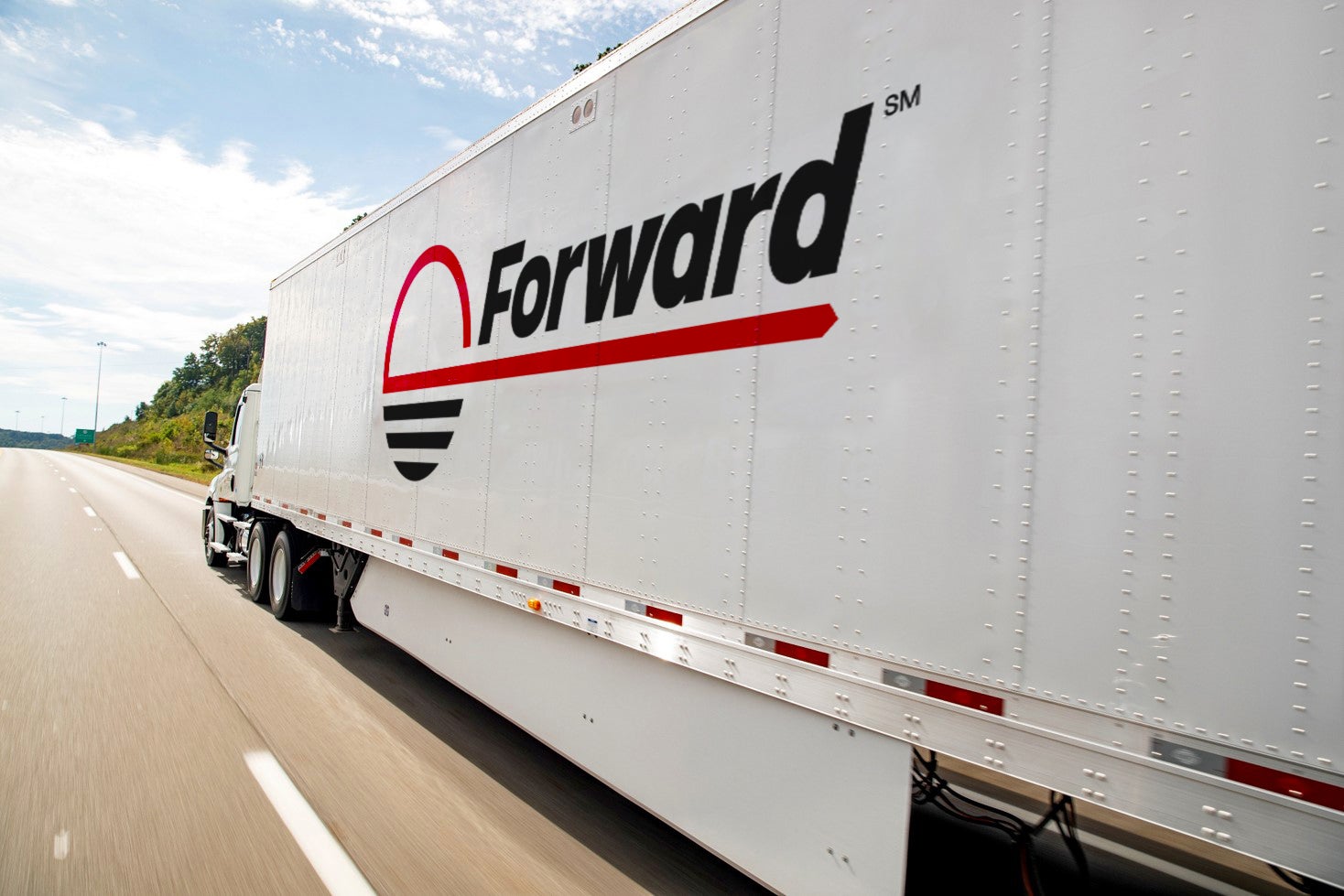
Today, its expedited less-than-truckload service is marketed for palletized shipments over 1,000 pounds traveling more than 1,000 miles without filling a trailer. That is a suggested sweet spot, rather than a description of every shipment. Several customers share capacity; each buys transportation without buying the whole truck.
Forward’s sales line is wonderfully direct: If it’s bigger than a box, think Forward.
The practical details are less catchy but more valuable: late cutoffs, scheduled lanes, early freight recovery and weekend service in selected markets. Those details shape whether a shipment can meet its next appointment.
A simplified journey. Pickup, delivery and transit commitments depend on the service purchased.
02 A menu becomes an integration job
The offering now extends beyond that original airport network. Full truckload serves larger or dedicated loads. Brokerage sources capacity through other carriers. Intermodal drayage moves containers between ports, rail terminals and their next stop. Digital tools provide quotes, tracking and electronic delivery records. Forward sells transport and related services to businesses, with both shipment-based and contractual work.
Its description of itself as asset-light requires a little care. There are physical facilities, trailers and employees. The model also relies on owner-operators and purchased transportation. The expertise lies partly in coordinating that capacity. Compared with conventional LTL or air cargo, Forward’s distinguishing proposition is scheduled premium ground service; the right alternative depends on the lane, deadline and handling requirements.
Then came Omni Logistics. The acquisition closed in January 2024, bringing international air and ocean forwarding, customs brokerage, fulfillment and contract logistics. Technology, retail and life-sciences customers could buy more of their supply chain from the combined business. Forward could potentially carry freight generated by a company it now owned.
For customers, that broader menu can reduce the number of providers they coordinate. A manufacturer might need forwarding, storage and a final ground movement rather than an isolated truck booking. The attraction is a connected service. The operational burden is making different systems, teams and customer relationships work together.
The 2025 annual report records approximately $2.274 billion in total purchase price and noncontrolling interest. That includes about $1.644 billion of cash, much of it associated with extinguishing Omni debt, plus equity and contingent consideration. It is a purchase-accounting figure; the original announced deal valuation was different.
03 A bigger map, a harder calculation
The early damage appeared in the acquisition’s accounting value. Forward recorded roughly $1.028 billion of Omni goodwill impairment for 2024 after adjustments. A write-down does not mean that cash left the bank that quarter. It means the value carried on the books no longer held up.
Under Shawn Stewart, who became CEO in April 2024, the work shifted toward making the combination function. The company described unifying U.S. ground operations into One Ground Network and repricing freight that did not earn enough. A separate review explored strategic alternatives. In May 2026, Forward said no actionable proposal to buy the whole company had emerged; selected non-core asset sales became the stated course.

Second-quarter 2026 results captured the tension. Revenue reached $673 million, up 8.8% year over year. Another $244 million Omni goodwill impairment helped produce a reported operating loss of $201 million. Excluding that charge, adjusted operating income was approximately $43 million. Better operations and an expensive acquisition legacy were visible in the same quarter.
Adjusted operating income
Excludes goodwill impairment · non-GAAP
Reported operating loss
Second quarter 2026 · GAAP
Customer concentration complicates the calculation further. A July non-binding memorandum envisaged retaining at least half of the roughly $250 million in 2025 revenue from one large customer, potentially another quarter. That was an expectation under an MOU, not a completed definitive contract. A broader service menu does not eliminate a customer’s wish to diversify suppliers.
04 Start with the deadline
For a shipper, the copyable idea is to work backward from arrival. Compare the complete journey, including pickup windows, terminal waits and delivery arrangements. Ground can be attractive when its schedule fits. An impossible road transit, an unsuitable shipment or a lower-cost requirement can point elsewhere. Forward’s premium service earns consideration when predictability has economic value.
A useful quote request starts with the shipment’s dimensions, weight, origin, destination and required arrival time. Ask which parts of the journey are included, who handles collection and final delivery, and what happens if the schedule slips. Those questions make comparisons meaningful. A low linehaul rate can become less attractive when the full service requires additional arrangements at either end.
There is also a specific product to examine: Forward advertises door-to-door guaranteed delivery with photo verification at pickup and delivery, and a refund of the service fee and transportation cost if the guaranteed date is missed. Buyers should match the applicable service conditions to their shipment before treating that promise as protection against delay.
There is a human detail beyond the balance sheet, too. Forward’s fifth Drive for Hope golf tournament raised $700,000 in 2026 for Hope For The Warriors, taking five years of partnership support above $2.4 million. The company’s reach can connect communities as well as terminals. Its commercial challenge remains precise: turn a larger collection of services into journeys customers choose to buy again.