A restaurant group’s head-office phone system is an unlikely place to look for a technology company’s personality. Yet Spaghetti House offers a useful introduction to FLR Spectron. Calls were dropping. Cabling was outdated. The automated attendant had stopped working. Before anyone needed a conversation about artificial intelligence, somebody needed to make the phones behave.
FLR surveyed the workstations and data points, prepared the replacement equipment, and moved the office onto an internet-based telephone system in a single day. Its account of the project, published in December 2025, describes new Wi-Fi, Yealink handsets, restored call routing and staff training. This is business technology with its sleeves rolled up: a working connection, a person who answers, a migration that does not swallow the week.
That practical starting point helps explain an unusually broad company. FLR Spectron sells telecommunications, managed IT, networking, security, data services and custom applications. Its wider portfolio also reaches into cooling, interiors and fire protection. The common thread is the equipment and infrastructure surrounding everyday work - and the responsibility for making the pieces cooperate.
First, stop losing the calls
Spaghetti House, described in the case study as a ten-branch London restaurant group, approached FLR about its head office. That distinction matters: this was a specific office migration, rather than a claim that every restaurant received a new system. The immediate problem was ageing ISDN2 infrastructure and unreliable service. The replacement was FLR’s 1-Voice All IP offering.
Pre-configuration did much of the heavy lifting. With equipment prepared beforehand, installation and migration fitted into one day. Direct dial numbers and hunt groups improved routing; voicemail could reach staff by email outside working hours. Cisco Webex integration gave remote users access to the voice system, while live analytics made call volumes and waiting times visible to management.
There is a useful purchasing lesson here. Start with the failed interaction, then trace the systems behind it. A dropped call may involve the line, the handset, wireless coverage or the routing configuration. Buying another handset without checking the rest would leave much of the original problem untouched. FLR’s project began with a survey, which is less exciting than a product launch and considerably more relevant to an office manager.
- 01Survey
Workstations + data points - 02Prepare
Pre-configure the hardware - 03Migrate
One-day installation - 04Support
Training + call analytics
A phone company with more rooms to enter
The legal business was incorporated on October 6, 2000, as Freelinerental.com Limited, adopting the FLR Spectron name in 2005. Its operational address is in Orpington, Kent. Robert Fee identifies himself as a co-founder; a Best Companies workplace profile names Fee, Peter Scott-Wilds and Jerry Watts as owner-directors. The company describes its origins in fixed-line and mobile telecommunications and says it subsequently broadened its offering.
Today, that expansion is visible in the service menu. Connectivity covers leased lines, local networks, Wi-Fi, hosting and cloud infrastructure. Communications extends from mobile and machine-to-machine SIMs to internet telephony, Teams Rooms, call recording and audiovisual equipment. Managed support includes Microsoft 365, Azure, hardware procurement and infrastructure monitoring.
Security adds another layer: endpoint protection, mobile-device management, vulnerability testing and recovery planning. The data practice offers warehousing, governance and Power BI dashboards. Application developers build custom software and integrate existing platforms. For a business with several suppliers and no appetite for refereeing their disagreements, that breadth is the attraction.
FLR fits the market as a business technology integrator and service provider. The alternatives are a telecoms specialist, a managed IT firm, a software development agency, or a collection of those suppliers. Its distinctive proposition is the span of work it can take on. Buyers still need to judge the depth of the particular team assigned to their project: a long menu is an invitation to investigate, rather than a performance guarantee.
The meeting that no longer needs a technician
Another December 2025 project involved an unnamed private equity investor with offices in London, Dublin and New York. Its old meeting system required IT assistance whenever a call was scheduled. A London refurbishment created the opportunity to change that routine.
FLR installed Logitech and Neat equipment configured for Microsoft Teams, introduced one-touch meeting controls and moved telephony to 1-Voice2Teams through Operator Connect. It also installed Verkada cloud-based CCTV and door access. The company reports a reduction of more than 70% in meeting setup time and 20-30% in communication costs.
Those are project-specific results reported by the supplier. They describe a useful combination of fewer manual steps and consolidated systems; they do not establish a standard saving for another office. The practical test is straightforward: can a colleague walk in, join the meeting and include remote participants without summoning technical help?
less time spent setting up meetings
FLR’s December 2025 case study; a single client outcome.At iMist, the work continued after installation
The relationship with fire-safety company iMist shows a different side of the business model. Here FLR describes “remote insourcing”: taking responsibility for managing and developing the customer’s IT while working closely with the organisation. The work reached beyond infrastructure into the daily movement of leads, customer records and staff information.
FLR reworked the CRM, automating processes across sales, installation and servicing. It connected website enquiries directly to that system and developed an HR application covering documentation, onboarding, training and performance reviews. Its December 2025 account describes continuing feature development and operational improvements over three years.
Reported outcomes include up to 40% less manual workload and 20-30% lower IT maintenance and support costs. The figures belong to that customer relationship, with its particular legacy systems and workflows. They are useful as examples of what to measure: administrative effort, support costs and the quality of records, alongside whether staff actually use the new tools.
The commercial distinction is important. FLR can supply equipment and implement a defined project, but it also provides continuing management, maintenance and development. Its published terms tie charges to a quotation and scope of work, with provision for monthly payments. A prospective customer is therefore buying an agreed package of work and responsibility. The scope deserves as much attention as the headline price.
AI arrives with homework
FLR’s current AI pitch follows the same pattern of looking beneath the visible tool. In July 2026, it introduced a campaign called The Missing Middle, aimed at smaller businesses struggling to turn interest in AI into something useful. The offer includes a free, 60-minute readiness assessment to identify a few worthwhile opportunities and prioritise the next step.
The campaign concentrates on data quality, working processes and staff capability. Its landing page gives the human obstacles names: Gary needs knowledge and training, Sandra needs help with change, Nigel needs continuing support. It is an unexpectedly domestic cast for a technology website, and an effective reminder that implementation happens among colleagues with habits, questions and other work to finish.
FLR offers AI consultancy, natural-language applications, machine-learning models and data preparation. Its readiness approach also gives buyers a sensible boundary: spending more on a tool will not automatically repair fragmented records or create a clear business use. The company’s iMist case study places BI, AI and connected-device capabilities on a future roadmap, keeping those ambitions distinct from the work already described.
A reader can copy the sequence without copying the supplier. Pick one recurring task, establish how it works today, inspect the information it uses, and decide who will own the changed process. Then compare performance. If nobody can explain the intended improvement, the project needs a clearer brief before it needs a larger technology budget.
The partners are part of the product
Much of FLR’s expertise lies in deploying and supporting other companies’ technology. In January 2025 it announced Microsoft Solutions Partner status for Modern Work. The following month it hosted an event at BT’s London headquarters with BT Wholesale and the Royal Warrant Holders Association. Logitech and SMART Technologies were among the trade-stand participants.
This ecosystem matters because customers encounter the finished service, while its components come from several vendors. A phone, a cloud account and a room camera have separate capabilities and support arrangements. The integrator’s job includes choosing, configuring and maintaining the combination. FLR’s customer testimonials span property, contracting, mailing and leisure businesses, reflecting that broadly applicable role.
“They acted with complete professionalism and were extremely courteous”
Shaun Hetherington, Stewart & Partners, on FLR’s engineers
The recommendation is notably about people arriving on site and doing the work well. For an installed service, that is a consequential detail. The equipment specification describes what can happen; engineering, training and ongoing support determine much of what the customer experiences.
Gold accreditation, golf clubs and a school coach
FLR’s people story has some concrete markers. In October 2025, the company said it had retained Investors in People Gold, first awarded in 2019. Its Best Companies profile describes directors sitting among staff in open-plan offices and an incentive scheme whose 2018 first prize was £2,000. These are specific workplace practices rather than a claim that a benefits list explains an entire culture.
Its community activity is equally tangible. A June 2026 account describes more than 100 golfers gathering at Westerham Golf Club for FLR’s annual charity tournament with Variety Golf. The event supported a Sunshine Coach for Oak Lodge School, which serves pupils with additional needs. Customers, partners and sponsors contributed to the fundraising.
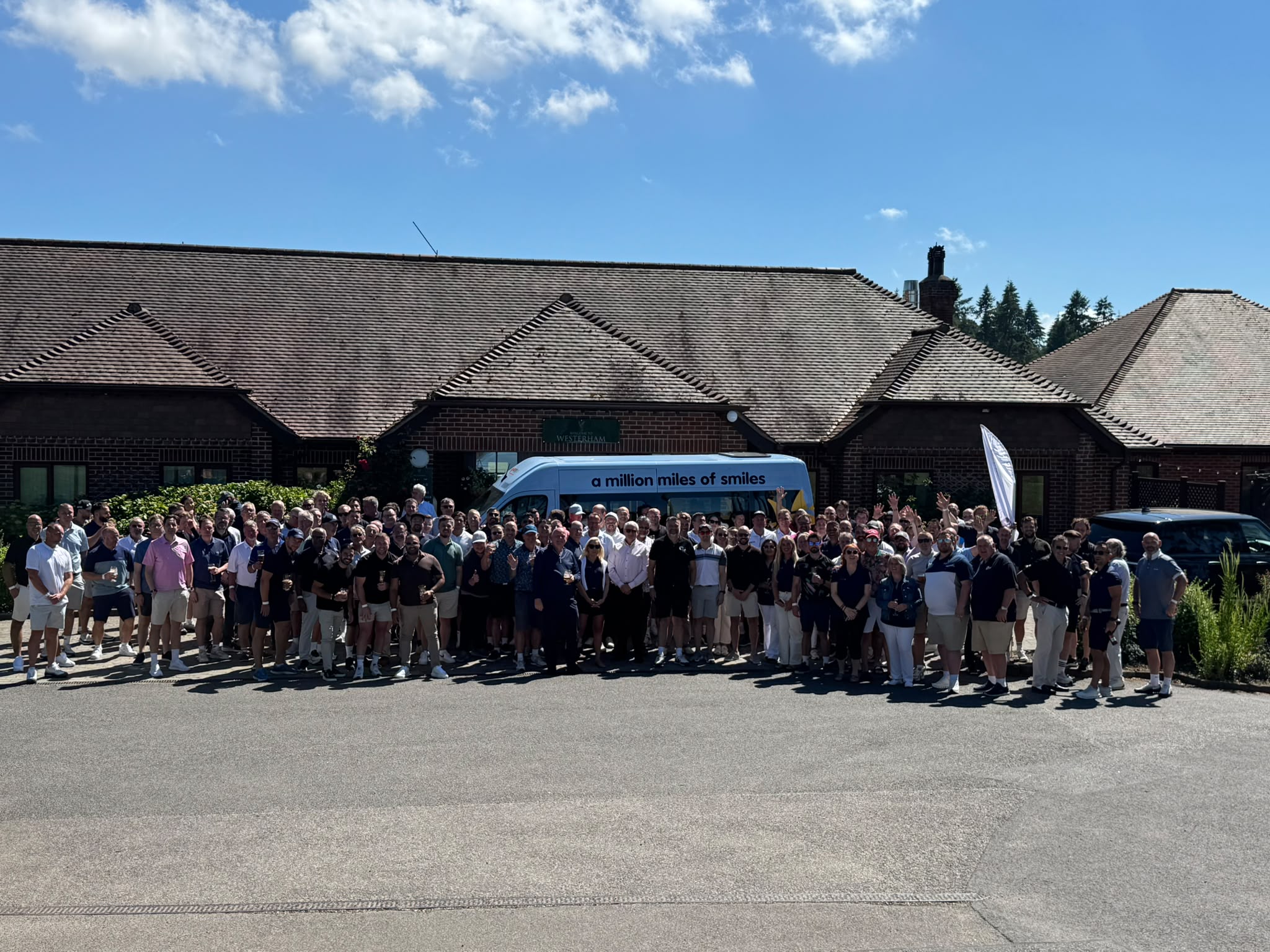
The business is easiest to understand through these small, observable outcomes: a caller reaches the right person, a meeting begins without a rescue mission, a lead reaches the CRM, a school gains transport. FLR’s proposition rests on doing the surrounding work that makes an installation useful. For customers weighing its broad offering, the most revealing question is equally concrete: who will make this work on Monday morning?