Florian Hillen's company began with a wonderfully inconvenient question: where could artificial intelligence be useful enough that people would actually change how they worked? At MIT and through Harvard research, he tested the question across radiology, dermatology, ophthalmology, biology, and mammography. The answer eventually arrived in a room with a reclining chair, a bright lamp, and a small stack of X-rays. Dentistry had images, repeated decisions, busy professionals, and a remarkably direct route from software to everyday use.
It was a narrow answer discovered by a person with a broad education. Hillen studied medicine in Germany, management and technology at the Technical University of Munich, and technology management at the Center for Digital Technology and Management. He later earned two master's degrees at MIT, one in computer science and another in technology and policy. He also worked at McKinsey, founded an earlier digital health startup called ninu, and spent time with Eko, the San Francisco company that developed a stethoscope able to analyze heart sounds.
The résumé reads like a committee designed it, but its contradictions became useful. Medicine taught him the texture of clinical decisions. Computer science supplied the machinery. Policy made regulation impossible to ignore. Consulting and a first startup gave him a commercial vocabulary. Videa needed every dialect. The product could be technically impressive and still fail if it interrupted a dentist, confused a patient, annoyed an office manager, or arrived without the evidence a regulator required.
A category hidden in plain sight
Hillen dates the first line of what became Videa to research code written in 2016. He founded the company at the end of 2018 as an MIT spinout. The distinction matters. Videa did not spring from a weekend brainstorm with a clever domain name. It emerged after two years spent comparing problems, speaking with industry leaders, and looking for a place where technical performance and commercial incentives could coexist.
His earliest pitch contained a useful act of self-policing. “We tried not to be a nerdy MIT startup but a commercially viable and impactful company,” he told Dentistry Today. The sentence is funny because it admits the temptation. A lab-born company can fall in love with what it knows. Hillen wanted Videa to be judged where the software met the appointment.
That meant placing a second set of digital eyes beside the clinician, then presenting the result in a form that could support a conversation. The dentist retained the judgment and the surrounding context. The software supplied a consistent reading of the image. In Videa's product logic, the colorful overlay was never merely decoration. It gave clinician and patient something concrete to point at together.
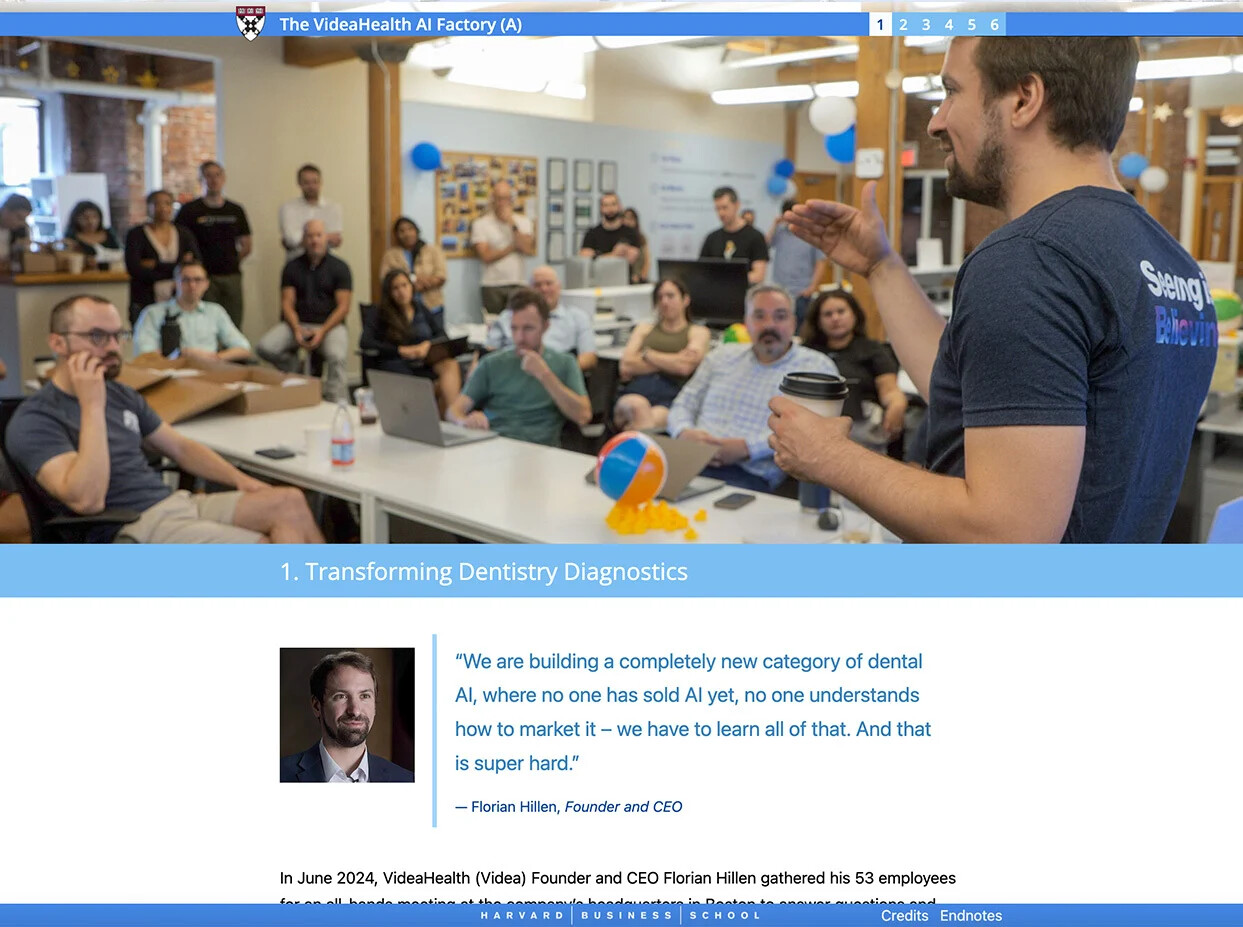
“We are building a completely new category of dental AI.”Florian Hillen, at a Videa all-hands meeting
The boring work becomes the moat
New categories make excellent conference slides and unruly businesses. When Videa started, Hillen said, the FDA had no clear framework for dental AI. The team had to work closely with the agency as the path took shape. It was slow work with a peculiar reward: every hard-earned clearance made the product easier to trust and the company harder to imitate casually.
Then came integration. Dental offices already had imaging systems, practice-management software, billing routines, and full calendars. A useful model living in a separate tab would be one more obligation. Videa connected its software to the systems practices already used, including products from Henry Schein One. The best interface, in this case, was often a workflow that barely appeared to change.
The underlying data posed a parallel design problem. A model trained on a narrow population could perform neatly in a demo and unevenly in the world. Videa assembled images and data points from universities, insurers, dental organizations, and other partners, then treated representation as an engineering requirement. Hillen has repeatedly tied technical quality to the variety of the material used to train and test the system. It is a policy lesson expressed in code: whom the data includes affects whom the product can serve reliably.
This is also where his technology-policy training earns its keep. A clearance is more than a stamp at the end of development. It forces the company to state what the software does, how performance is measured, where human judgment remains essential, and what evidence supports each claim. Those boundaries can feel restrictive to a team that enjoys possibility. They are clarifying to the person expected to use the product during a busy day.
The commercial leap came through networks. A single dental organization can support hundreds or thousands of practices. One agreement therefore carries unusual leverage, but it also turns a software installation into an exercise in choreography. Heartland Dental selected Videa after years of evaluation and collaboration. Dentalcorp followed with a Canadian deployment. Each win offered reach and imposed discipline.
Videa learned to treat onboarding as part of the product. The company monitored use, offered training, collected feedback, and adjusted the rollout. Hillen has described implementations completed across large footprints in less than ten weeks. The contract opened the gate; change management got people through it. Adoption was no longer a line at the bottom of a sales funnel. It became an operating system.
A founder who keeps translating
The Videa story is full of translation. Researchers speak in performance measures. Regulators ask for evidence and boundaries. Clinicians want a dependable assistant. Patients need a clear explanation. Operators care about consistency across locations. Investors want to understand how all of this becomes a durable business. Hillen's unusual training lets him move among the rooms without pretending they are the same room.
He is also candid about the difficulty. At a June 2024 all-hands meeting, captured in a Harvard Business School case, he told the team that nobody had sold this category before and nobody yet understood how to market it. “We have to learn all of that,” he said. “And that is super hard.” It is the sort of sentence employees remember because it offers neither panic nor perfume. The work is hard; now the room can discuss why.
His public operating advice is equally plain. Hire for talent density. Decide what the company will decline to do. Stay customer obsessed. These are familiar phrases until they meet the constraints of a regulated enterprise product. Saying no protects the evidence plan. Strong hires shorten the distance between a clinical question and an engineering answer. Customer obsession means noticing whether the tool survives Monday morning.
There is a small company ritual that captures the proximity Hillen values. He has said Videa employees ask their dentists to run their own X-rays through the software before treatment. Engineers are not famous for volunteering to become test cases, yet the habit keeps the product personal. A detection is more than a box on a screen when the image belongs to your colleague.
The billion-patient horizon
By late 2024, Hillen said Videa had integrated into the workflows of more than 30,000 dental professionals and was reaching 40 million patients annually. VentureFizz reported more than 40,000 clinicians by March 2025. In January 2025, Videa announced a $40 million Series B led by Threshold Ventures, with Avenir, BAM Corner Point, Spark Capital, Zetta Venture Partners, and Pillar VC participating.
The money funded a broader chapter. Videa expanded beyond image analysis into administrative workflows, practice insights, and conversational tools. In 2026 it announced an AI Leadership Council with dental executives and clinicians, widened availability to independent practices, and introduced Ambient Intelligence for documentation and operational insight. The company still begins with the chair, but it now follows more of the work around it.
The investors around the table reflect the company Hillen had built. Pillar VC and Zetta Venture Partners supported earlier rounds, Spark Capital joined later, and Threshold led the Series B. Strategic relationships mattered just as much. Henry Schein One offered a route into familiar software. Heartland Dental supplied the demands of a large American network. Dentalcorp extended the test into Canada. Each connection gave Videa distribution, but also a sterner examination. Products tend to become less romantic and more useful when thousands of people are waiting for the next release.
Hillen's role changed accordingly. The researcher who could compare applications had to become the executive who chooses priorities, recruits leaders, raises money, and preserves a culture while the headcount rises. The connective skill remained the same: translate the distant mission into today's decision. One more feature may be attractive. One more integration may unlock a network. One more customer request may pull the roadmap sideways. Scale is a long series of such choices, usually made without the courtesy of certainty.
Hillen's stated horizon is one billion patients. It is a number too large to picture, which may be why his path toward it remains stubbornly concrete: integrate one system, train one team, earn one clearance, support one conversation. Grand ambition often wears ceremonial robes. Here it arrives carrying an implementation checklist.
The choice of dentistry looks obvious only in retrospect. That is the little joke history plays on focused founders. First they spend years noticing what everybody else has walked past. Then, if the company works, the market behaves as though the opportunity had been waving all along. Hillen's contribution was to see the ordinary room clearly, respect everyone already working inside it, and keep refining the machine until it belonged there.