Before there was another funding announcement, Alex Senemar was calling warehouses. It was 2020, COVID had upended ordinary business, and he wanted to learn whether people running industrial sites would buy his idea for applying artificial intelligence to their working day. The scene requires no garage, no midnight revelation and no prophetic napkin. It requires someone willing to pick up the phone.
Years later, he would remember the beginning as “cold calling warehouses during COVID”. That small detail does useful work in a career otherwise described by company names and investment rounds. It places the customer before the announcement. Somebody, somewhere, had to explain a problem well enough that a warehouse operator would stay on the line.
Senemar went on to co-found and lead Voxel, which put computer vision to work on footage from industrial security cameras. He now leads LuminX, another company concerned with what happens inside warehouses. Its attention falls on the freight itself: what arrived, what departed and whether the record agrees with the load. His career has returned to the loading dock with a different set of questions.
A camera with a second job
Voxel began in 2020. Its premise had an appealing economy: industrial buildings already had cameras, and those cameras could be given more useful work. Video could help operators spot blocked routes, vehicle movements and other events that deserved attention. A system installed to preserve a record could also help people decide what to do while work was happening.
The attraction is easy to understand. A camera can collect far more footage than a manager can reasonably watch. Recording everything creates an archive; deciding which moments matter creates a product. Senemar’s business sat in the gap between those two activities, turning a familiar piece of infrastructure into a way of reading the operation around it.
He built with colleagues whose backgrounds connected computer vision to moving machines. Anurag Kanungo had worked in Uber’s self-driving operation; Harishma Dayanidhi brought experience from Uber and Aurora; Troy Carlson had worked at Google. Kanungo had also co-founded Sherbit with Senemar. The team combined an existing working relationship with experience drawn from a demanding branch of AI.
A warehouse is a revealing place to apply that expertise. The software has to interpret a physical environment in which the scene keeps changing. A route may be clear in one frame and obstructed in another. The commercial question becomes wonderfully specific: can the system find something useful, put it before the right person and do so in time to matter?
“We get up and running within 48 hours at customer sites.”
Alex Senemar, describing Voxel’s deployment in 2023
That claim gives his pitch a practical scale. Forty-eight hours is a period a site manager can put in a diary. It also makes integration part of the proposition. A product that depends on a lengthy reconstruction of the workplace asks its buyer to take on a second project before the first one can begin.
The team on the other side of the lens
Senemar also discussed how Voxel should fit into conversations between supervisors and staff. The platform did not use facial recognition. He described footage as material for coaching and discussion, including recognition of good practice. Knowing that an event occurred was separated from automatically attaching a person’s identity to it.
There is a human judgment embedded in that choice. Video inside a workplace carries a relationship with it: between the people doing the work and the people responsible for the site. Software enters that relationship whether its builders acknowledge it or not. Senemar’s explanation placed the subsequent conversation inside the product’s purpose, alongside the detection itself.
The concern had appeared in his writing years earlier. In May 2015, Senemar published an essay about how analysts could connect Instagram photographs with purchasing behavior. He argued that combining information from different datasets could reveal more about somebody than any individual post suggested. That earlier interest gives his later comments about workplace cameras a longer history. The value of visual data, and the conclusions drawn from it, had occupied him well before Voxel.
By May 2022, Voxel had announced a $15 million Series A led by Eclipse Ventures, with MTech and World Innovation Lab participating. In August 2023 came a $12 million strategic round led by Rite-Hite. A loading-dock equipment business was joining the cap table of a camera-analysis company. The connection between software and the industrial world was becoming quite literal.
Announced round sizes, not valuations or personal wealth.
His ambitions then included taking Voxel beyond North America. In June 2023, he joined Pete Miller on the Predict & Prevent podcast to discuss putting computer vision into existing workflows and measuring changes. The setting varied; the recurring subject was making information useful to the person who had to act on it.
Two announcements, one unusual week
By June 2024, Vernon O’Donnell was introducing himself as Voxel’s new CEO. Senemar’s story continued elsewhere. That month, Senemar announced he was joining The Bond Fund as a venture partner, bringing his experience building AI companies to other founders. The fund describes a collective model in which members pool capital and vote on early-stage software investments.
The move gave him another seat at the table. As a founder, he had spent years asking people to commit to a young company. At the fund, he would help support that process from the investment side. In his announcement, he invited entrepreneurs to connect, explicitly linking the new role to the experience of building and scaling companies.
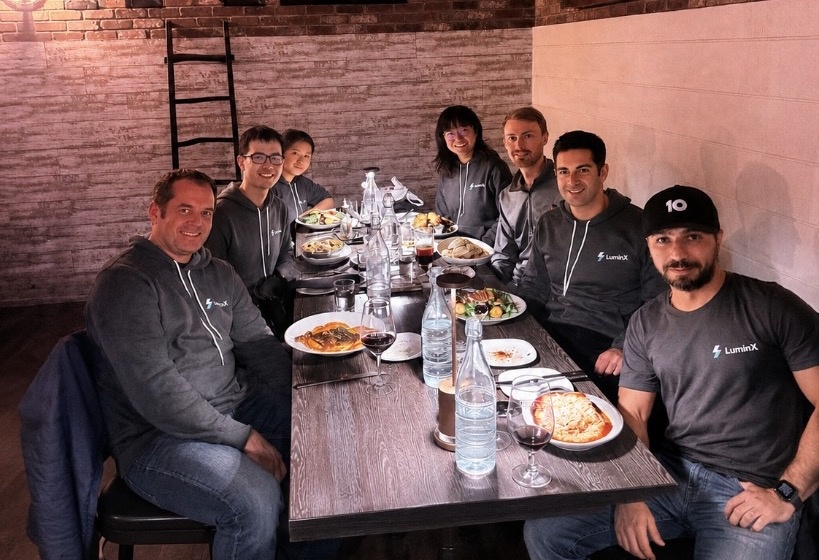
Then came LuminX, founded in San Francisco in 2024. Senemar teamed up with Mohammadreza Javanmardi, also known as Reza or Mamrez, who had led AI research at Voxel. Another chapter began with somebody who understood the previous one. Familiarity with warehouse AI travelled with them; the new business would concentrate on inventory automation and visibility.
On June 2, 2025, LuminX announced a $5.5 million seed round. Its investors included 1Sharpe, GTMfund, 9Yards, Chingona Ventures and The Bond Fund. Voxel announced its own Series B that same week. Senemar marked the coincidence with the phrase “Went full circle last week”. His old company and his new company had briefly shared the news cycle.
He used the occasion to write about difficult startup days, the teams involved and the lessons he would carry forward. The tone was appreciative rather than possessive. Voxel was continuing under its own leadership, while he was beginning again. A founder’s résumé makes these transitions look tidy. His reference to difficult days supplied a little resistance to the polished version.
What the pallet knows
LuminX’s starting problem is a disagreement between physical freight and digital records. A load passes through a door; somewhere else, a system says what it contains. Between those two descriptions sit labels, counts, photographs and the people asked to check them. Anyone trying to settle a discrepancy would prefer the evidence to have travelled with the shipment.
The company’s 2025 announcement described vision language models running on affordable hardware inside warehouses. Combining image understanding with language capabilities allows the system to work with labels and other information in the scene. Its planned deployment settings included docks, conveyors, forklifts and handheld devices. The research ambition was paired with an ordinary business need: fewer manual checks and better records.
Javanmardi’s role matters here. He brought research experience in machine learning and computer vision, alongside his earlier work at Voxel. Senemar brought experience building a company around industrial buyers. Their partnership joins the work of interpreting an image to the work of persuading an operation to rely on the result.
A pallet moves through the loading area.
Compare the captured information with shipment records.
Give the team images behind a discrepancy.
A simplified view of LuminX’s published workflow.
LuminX’s current product presentation makes the idea tangible. Two narrow units sit at a dock door, using local AI processing and power over Ethernet. They capture three faces of a passing pallet. The system compares what it captures with a bill of lading and warehouse records, leaving images available when a shipment needs another look.
There is something pleasingly unglamorous about the object of all this computation. The pallet does not care how fashionable the model is. It has to get through the door. Senemar’s new venture makes its case in the space between that movement and the paperwork, where a useful image can save a long argument about what somebody remembers seeing.
Back to the people who answer
The continuity across these companies lies in the distance between seeing and understanding. Voxel asked what existing cameras could reveal about a working site. LuminX asks what visual evidence can establish about a shipment. Senemar has stayed close to physical operations, where the consequences of a software decision can be examined on the floor.
His public reflections return to teams, lessons and the chance to keep building. They fit the origin he chose to remember: a founder contacting warehouses to test whether an idea resonated. The call came before the camera system, before the investment rounds and before a second company returned him to the same industrial setting.
At the loading dock, the question remains agreeably stubborn. Something has just moved. Does the record tell the same story? Senemar has made that gap the subject of his next company. Somewhere between a passing pallet and a person checking a screen, the answer has to become useful.