At Mount Sinai’s Department of Neurosurgery, the assignment was straightforward enough: launch two multicenter clinical trials, INVEST and 5-ALA. The complication was the staffing. There would be no expansion. In the hospital’s published case study, clinical trials manager Ashley Friend described how coordinating multiple centers multiplied the work of managing documents, audit trails and external access. The science needed a larger administrative surface area. The team had the same number of hands.
In late 2016, the department began replacing paper trial master files with Florence eBinders. That decision offers a useful entrance into Florence Healthcare. Look past the language of clinical trial transformation and there is an ordinary problem: people doing consequential work spend too much time getting paperwork to one another.
- Florence connects research sites with sponsors and contract research organizations.
- Its core tools manage documents, signatures, consent and remote monitoring.
- Customer results are specific examples; adoption and training determine what travels.
Start with the person holding the binder
Founded in 2014 by Ryan Jones, Andres Garcia and Michael Kassin, Florence sells cloud software for the operational side of research. Its users include regulatory coordinators, investigators, monitors and sponsor teams. Jones brought experience from Microsoft SharePoint and Pubget, a business that helped institutions access scientific literature. Garcia brought a background in security technology. Documents and permissions were familiar territory.
The product names describe different positions around the same study. eBinders holds the site’s investigator records and participant documentation. SiteLink connects sites with sponsors and CROs for document exchange and remote review. eTMF manages the sponsor’s trial master file. eConsent brings informed-consent workflows into digital form. Together, these tools address the movement of evidence as well as its storage.
Florence’s pitch starts with making the site’s work manageable. That is a competitive position, though hardly an uncontested one: Veeva’s SiteVault also offers site regulatory records and remote access. Buyers are choosing among workflow systems, integrations and established habits. A digital binder earns its place when staff actually use it.
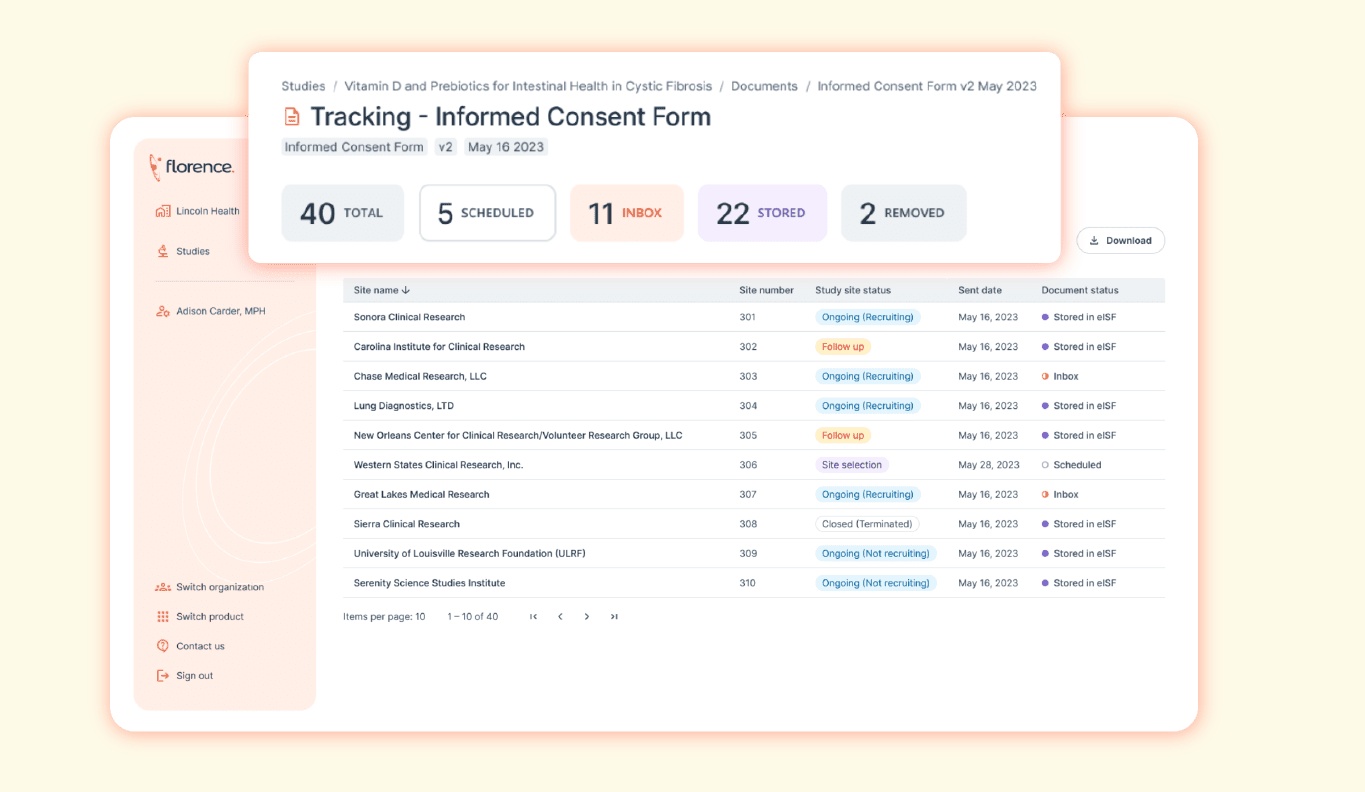
The dividend hiding in the handoff
Consider Florence’s published case involving a large US oncology research network: 168 sites and 1,400 principal investigators. The organization introduced electronic regulatory and source-document workflows, including signatures, document collaboration, project management and remote monitoring. The case study reports a 41.8% reduction in document cycle time and a 12.5% increase in study capacity without adding resources.
Those figures describe one implementation, with no claim here that every customer will reproduce them. Their usefulness lies in the relationship: administrative work consumes capacity, so reducing it can create room for more studies. The bottleneck may sit between two people who have already done their individual jobs.
Index: before = 100. Illustration of the reported 41.8% reduction, not absolute days or a controlled comparison.
There is a distinction here for anyone evaluating the software. A document repository answers where a record lives. An operational workflow also answers who owes the next action, which version needs a signature and whether a monitor can see it. Florence combines these jobs. The reason to buy that combination depends on how often those questions interrupt the team. A site with orderly records and few outside handoffs faces a different calculation from a network coordinating many investigators. Before a demonstration, buyers can count their own delayed signatures, duplicate uploads and hours spent preparing access. Those measurements turn an attractive customer percentage into a question their own organization can answer.
Mount Sinai’s experience supplies a smaller, more human detail. Friend said the team adopted eBinders quickly and found last-minute audits easier because of the audit trail. Her verdict had the impatience of someone who had found a better routine.
“I don’t know why everyone isn’t using eBinders.”
Ashley Friend · Mount Sinai case study
When travel stopped, the documents had to move
The pandemic changed the stakes of remote access. In Florence’s May 2021 financing announcement, Jones described virtual collaboration becoming a requirement after COVID-19. The company said it was serving more than 8,500 sites in 34 countries. Remote workflows helped research continue when the people overseeing a study could not simply visit its files.
Insight Partners led an $80 million Series C that month, followed by a $27 million Series C-1 in June 2022. These were investments in the business, separate from what customers pay. Florence said the later financing would support hiring, products and network connectivity.
In September 2023, Florence acquired VersaTrial. Its tools addressed a tellingly unglamorous part of research: bookmarks, passwords, feasibility responses and changing study contacts. Florence now advertises StudyOrganizer as free. Even a well-equipped research site can lose time finding the doorway into its equipment.
The price of changing a habit
Florence’s commercial model is business software sold to sites, sponsors and CROs, with core-product inquiries routed through sales. SiteLink also entered AWS Marketplace in October 2025. An implementation asks for more than a purchasing decision: templates, responsibilities, access permissions and training have to match the study’s actual work.
UCLA’s public instructions make that concrete. Staff need authorization and relevant training; external monitors need training, required forms and an access window set by a coordinator. At Medical College of Wisconsin, an OnCore integration creates basic binder structures and team roles. A ScienceMedia partnership moves training records into eBinders. Each connection can remove another manual transfer.
Inside Florence, the organization stretches across Atlanta, Belgrade and remote workers. Its careers materials advertise flexible hours and remote opportunities. A May 2024 Great Place To Work profile reported that 81% of employees called it a great workplace. Culture, like workflow performance, is more interesting with a date and a denominator attached.

Give the agent something worth finding
In June 2026, Florence announced Model Context Protocol access across eleven workflow tools. Its announcement put the network at 65,000 sites. The accompanying AI lineup distinguishes available feasibility assistance from early-access document intelligence and site navigation. That distinction matters when planning a purchase around a demonstration.
The practical lesson reaches beyond clinical research. First, measure where work waits. Standardize the recurring records. Give people appropriate access. Connect the systems that otherwise demand duplicate entry. Then automate the chase. If staff keep parallel paper processes, permissions prevent review or records remain incomplete, a new interface has little to work with. Florence’s opportunity is the accumulated work underneath: the right record, reaching the right person, before another day disappears.