Ntiedo Etuk went to Pilates to recover from a foot injury. He kept going. Yet after roughly three months, he reckoned he still did not know most of the people around him. Here was an establishment selling the pleasures of community, populated by strangers. The machines were doing their job. The introductions were another matter.
- FitGrid helps studios notice fading clients and give staff a reason to contact them.
- Its instructor app puts relationships closer to the people teaching the classes.
- Its newer AI advisor examines pricing, class economics and performance against peers.
The people a roster cannot introduce
FitGrid, founded in 2017, grew out of that gap between attendance and attachment. A booking system can record a visit. It cannot, by itself, make the visitor feel expected. Etuk’s proposition was that the connections among instructors, clients and staff could be made more deliberate, and that a studio could earn money by doing so.
To understand the owner’s side, he ran a pop-up studio. The experience supplied a less glamorous problem: whom should he contact each day? Somewhere in the customer list was someone about to disappear. Knowing that person existed did little good when he could not identify them. This was a failure of attention before it was a failure of sales.

That distinction gives FitGrid its place in the market. Its customers are boutique fitness and wellness operators, from individual studios to businesses with multiple locations. It connects to booking platforms including Mindbody, Mariana Tek and ClubReady, adding communication and analysis around the records those systems already hold. Its expertise sits at the intersection of client behavior, instructor relationships and studio operations.
A familiar name in the inbox
The practical answer is a daily queue. Client Outreach groups people by situations a front desk can recognize: an introductory offer nearing expiration, a milestone reached, a package almost exhausted, visits becoming less frequent. Templates give staff a starting point for the message. The owner still needs to configure which offers and recurring plans mean what.
FitGrid Pro gives instructors their own mobile tools for knowing clients and following up. Win-back messages can come from the instructor a missing client visited most. Replies allow the conversation to continue. The logic is rather human: a note from someone you recognize has a different weight from another business announcing that it misses your wallet.
“Fitness is all about the people.”Ntiedo Etuk, in a 2023 Athletech News partnership feature
This arrangement also reveals FitGrid’s idea of company culture. Its About page describes a business organized around making connections mutually beneficial. The sentiment has an operational expression: give the instructor information, give the front desk a task, give the owner feedback. Caring becomes something with a place on the working day’s list.
Customer testimony makes the appeal tangible. Citizen Pilates says instructors receive information before clients arrive; P2O Hot Pilates describes connecting individually with people in the room. FitGrid publishes substantial retention and spending improvements beside such accounts. Those are company-presented customer claims. They suggest what users value, while leaving open how much improvement belongs to the software versus the team using it.
The arithmetic behind the applause
Relationships explain why someone returns. They do not settle whether serving that person is profitable. FitGrid’s newer Business Health Dashboard brings those questions together. AI Advisor, named Amina, provides guidance around class economics, pricing and revenue scenarios. QuickScan offers a shorter diagnostic of risks and opportunities.
Class Economics considers instructor pay, attendance, capacity and contribution margins. Pricing Strategy looks at how customers actually use their plans. Its table includes the proportion of visits, client counts, average visits per client and effective price per visit. Owners can inspect twelve months of trends and filter by location, instructor and month.
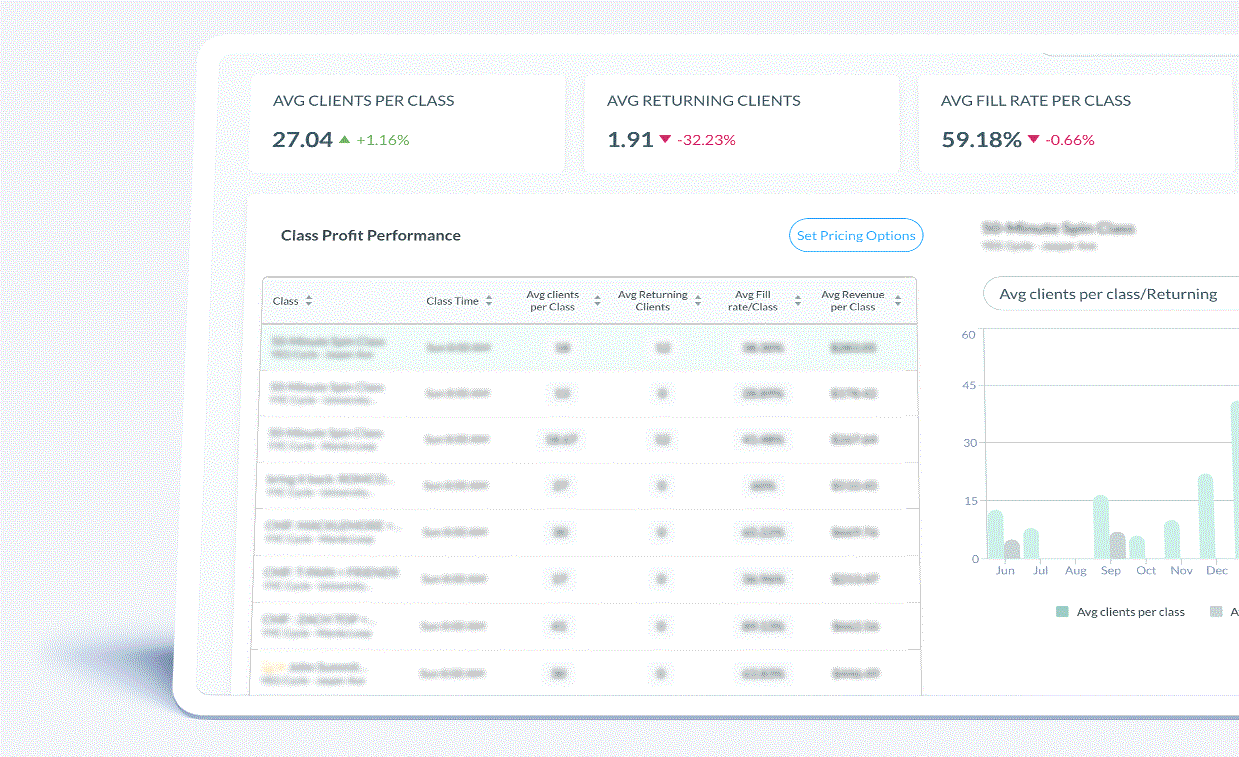
Consider FitGrid’s published pricing scenario: an unlimited plan produces $9 per visit, a ten-class pack $18, and drop-ins $25. The unlimited plan accounts for 62% of visits. These are illustrative figures, not a named studio’s audited results. Their usefulness is the question they provoke: which offer is filling the room, and which is paying for it?
The Revenue Simulator lets an operator model changes before making them. A proposed price increase or capacity adjustment becomes a projection to examine. That can focus a discussion, but the projection remains dependent on assumptions about attendance and customer behavior. Amina supplies decision support; the owner retains the uncomfortable privilege of deciding.
The price of paying attention
FitGrid sells subscription software to studios, with demos and free trials as entry points. There are costs beyond the subscription: its texting documentation lists separate provider charges, and staff must spend time configuring offers, reviewing segments and answering clients. An automated message is an opening move. Someone still has to play the conversation.
Its pandemic response illustrates the same preference for connecting existing pieces. FitGrid LIVE bridged Mindbody bookings and payments with Zoom classrooms, generating meetings and distributing access links. Etuk’s account describes a rapid rollout after stay-at-home orders. The problem had changed from keeping clients returning through the door to keeping the class accessible when the door was shut.
A studio needs a peer group
The next problem is comparison. A studio’s own reports can show a decline without explaining whether its neighbors face the same one. FitGrid now emphasizes standardized KPIs and benchmarks across booking platforms. In March 2026, Studio Grow announced a partnership adopting that comparative intelligence for its consulting work.
FitGrid therefore competes for attention with fitness CRM and marketing tools such as Loyalsnap and LoopSpark, while also collaborating with booking providers. Its distinctive proposition joins instructor relationships, outreach and class-level economics with wider market context. Operators should test whether that combination answers a question their existing reports leave unresolved.
The lesson is copyable even without buying software: identify clients drifting away, assign a person to contact them, and examine revenue per visit alongside attendance. It works best when records are accurate, messages are welcome and staff follow through. Poor data or unwanted outreach can spoil the exercise. A full room is satisfying. Knowing why people return, and what each return earns, is more useful.