On February 22, 1999, a woman moved $100 between two bank accounts at the Museum of American Financial History in New York. The woman was financial author Virginia Morris. The bank was First Internet Bank. The transaction was small enough to be forgettable, except for what surrounded it: a public demonstration that a bank could open its doors without actually having doors for customers to walk through.
Founder David Becker had arrived at a deceptively simple proposition. People wanted access to their money on their own schedules. A building with limited opening hours was an expensive way to provide it. His bank would operate online, with real-time transactions, telephone support and ATM access. It donated the demonstration computer, along with $5,000, to the museum. Banking history had acquired a new exhibit.
- A chartered bank serving consumers, businesses and fintech partners.
- Launched with $15 million in capital, according to president Nicole Lorch.
- Branchless delivery saves buildings; it does not remove lending risk.
The expensive part of having no branches
The absence of branches can sound like an absence of obligations. First Internet Bank had the opposite experience. Recalling the launch in 2024, president and chief operating officer Nicole Lorch said a bank of its size would normally have needed $5 million to start. Concern about the unfamiliar internet model meant it launched with $15 million. Removing the familiar shopfront required a larger cushion of capital.
“I was still renting VHS tapes from Blockbuster,” Lorch recalled. The detail puts the experiment in its proper setting. This was a bank designed for a habit that many people had yet to acquire. Its precise historical distinction matters: it was the first state-chartered, FDIC-insured institution to operate entirely online. That is narrower, and more useful, than claiming to have invented every form of internet banking.
Becker came from financial technology. In 1981, he had founded re:Member Data Services to process information for credit unions. Later businesses included card processing and internet services for financial institutions. The founder understood the machinery behind a bank before he offered customers a new entrance to one.

Three customers, one set of pipes
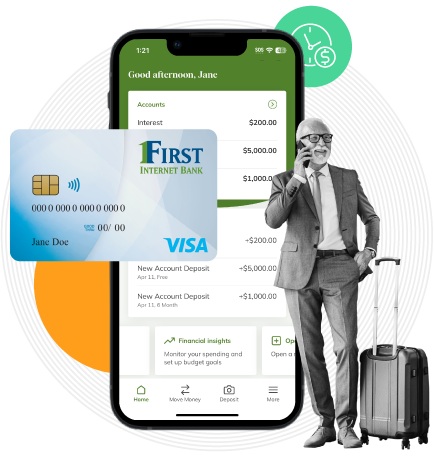
Today, a saver can open checking, savings, money market or certificate-of-deposit accounts. The practical attraction is familiar: manage balances digitally, move money and earn interest without scheduling a branch visit. Shoppers can compare it with other online banks, including Ally and Synchrony, while checking fees, withdrawal needs and account terms rather than assuming that “online” guarantees the best deal.
A business owner needs something different. Do More Business Checking combines transactions with cash-flow tools. The bank advertises no monthly maintenance fee or minimum balance, with dollar restrictions applying to transactions. Its commercial teams provide working capital, real-estate financing and public finance; some relationship-based commercial lending is focused on Indiana and Arizona. Nationwide access does not make every product equally available everywhere.
The third customer may never put First Internet Bank’s name on the front of an app. Through banking-as-a-service, the bank supports fintech deposit and payment programs. A partner supplies a customer experience; a regulated bank supplies banking capabilities underneath it. First Internet occupies both sides of the market: a destination for account holders and infrastructure for other financial businesses.
Make the payment less mysterious
Consider payroll. For the person waiting to be paid, the useful question is when the money will arrive. For the operator sending thousands of payments, that question becomes an operational headache. First Internet Bank and Increase developed High-fidelity ACH to make network events and payment timing easier to see.
Their work won the Payments category in American Banker’s 2025 Innovation of the Year awards. The appeal lies in a modest improvement to an everyday task: show people where a payment is, rather than make them guess. This is a useful pattern for product teams to copy. Find a recurring uncertainty, then expose the information needed to resolve it.
The economics remain recognizably banking economics. Deposits help fund loans and investments. Interest earned, less funding costs, produces net interest income. Lending, loan sales, servicing and fintech programs also generate income. A branchless operation can distribute those services nationally, but technology, compliance and customer support still have to be paid for.
A branchless operation can distribute services nationally. Technology, compliance and support still have to be paid for.
The loans stayed stubbornly real
Small-business lending made the model more consequential. In 2024, First Internet Bank funded $610 million of SBA 7(a) loans, up 44% from the previous year. That is money for businesses with equipment to buy, acquisitions to finance and bills that do not wait for a software release. Coleman Report named it 2024 Online Lender of the Year.
Then came evidence of the limits. In its January 2026 results, management described credit challenges in SBA and franchise-finance portfolios. The response included tighter underwriting and investment in collection and risk-management tools. An October 2025 partnership with Parlay Finance targeted manual work in SBA applications. The bank anticipated efficiency gains of up to 50%; that was an expectation, not a demonstrated result.
A separate decision made the price of adaptation visible. In September 2025, the bank sold $836.9 million of performing single-tenant lease-financing loans to Blackstone-affiliated buyers for $794.2 million in net proceeds after transaction costs. That initial closing left a $42.7 million gap between principal and proceeds. The bank retained servicing responsibilities.
Management’s explanation was specific: reduce exposure to lower-coupon, fixed-rate loans, improve capital ratios and create room for new lending. The loans could be performing and still be less attractive to hold. For a digital bank, the interest-rate arithmetic remains as physical as the buildings securing its loans.
Includes transaction costs; not a standalone accounting loss figure.
What survives the experiment
By June 2026, First Internet Bancorp, the bank’s parent, reported about $5.6 billion in assets and $4.8 billion in deposits. Its second-quarter provision for credit losses was $13.4 million. Scale and credit costs belong in the same picture. Neither a clean interface nor national distribution settles the question of who will repay.
The human side is equally concrete. The bank lists “Put People First” among its values and offers U.S.-based relationship bankers. It also helped secure a $125,000 housing-counseling grant for Indianapolis Neighborhood Housing Partnership in 2025. The money supported a nonprofit’s work with renters and prospective homeowners; it was not a venture round for the bank.
The transferable lesson is to remove a costly constraint, then build the capabilities customers still need. That approach suits people comfortable handling routine banking remotely and businesses willing to work with specialists at a distance. It fits less neatly when customers need frequent counter service or when lending expands faster than risk controls. The museum demonstration showed that money could move without a branch. The years since have tested everything else a bank must do.