Open a Relay account and the name you remember is Relay. That is where the software lives, where a business owner organizes money, and where the next payment begins. Yet the banking underneath belongs to another institution: Thread Bank. The relationship offers a useful little puzzle. How does a community bank reach people who may never set foot in its community?
- Thread puts accounts, cards and payments inside partner software.
- Its customers include fintech platforms, small businesses and individuals.
- Distribution can travel. Banking responsibility stays with the bank.
Relay’s explanation of the arrangement is refreshingly concrete. Relay handles the app, integrations and team permissions. Thread holds deposits and provides banking services, including cards and money movement. A customer gets one experience assembled by companies with different jobs. Thread’s bet is that this division of labor can become a bank’s growth engine.
The branch has moved into the workflow
The bank traces its history to 1906. Investors and executives recapitalized it in May 2021; the former Civis Bank took the Thread name in 2022. Its Rogersville main office and Sneedville branch still serve East Tennessee. The old banking geography survives, alongside a distribution system whose entrances are screens.

For a small-business software company, the attraction is practical. Its customers already arrive to manage some portion of their working lives. Adding an account or a payment can spare them a trip between systems. Thread supplies the regulated banking capabilities; the partner shapes the experience around a particular customer’s work.
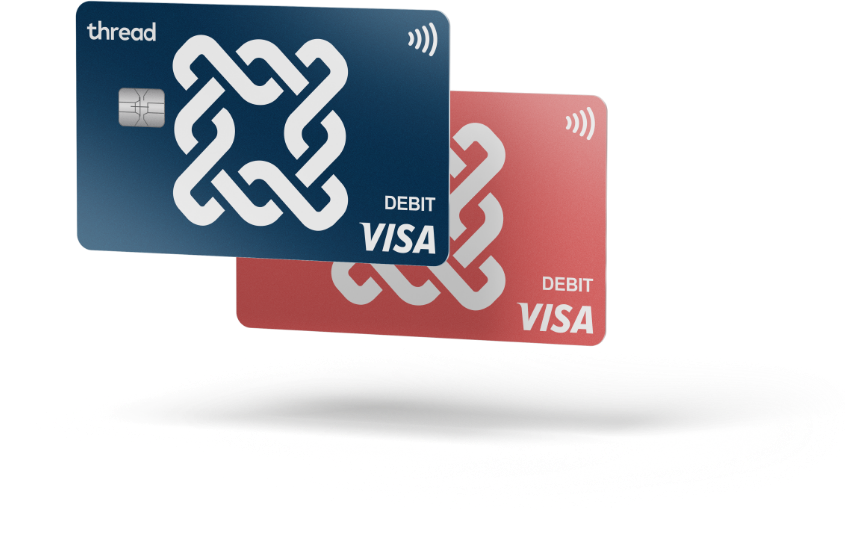
Thread calls these relationships digital branches. The phrase is useful because it describes distribution without pretending every software company has become a bank. ThreadConnect advertises deposit accounts, money movement, card programs and lending. Its Threaded Payments offering covers merchant payment acceptance. Together, these services reach from holding money to moving it and accepting it. A business can use checking and savings, issue physical or virtual debit cards, send ACH transfers and wires, and make mobile check deposits. Availability depends on the particular offering.
A simplified relationship map. Products vary by program.
The physical footprint changed too. In April 2025, Thread opened a corporate headquarters in Nashville’s Wedgewood-Houston neighborhood, moving its loan and deposit production office from Brentwood. The third-floor space occupies more than 20,000 square feet. Keeping East Tennessee branches while adding a Nashville base makes the strategy tangible: local banking continues while the partner business looks beyond the next town.

The expensive part is underneath
The appealing version of embedded banking is an interface problem: put a banking button beside an accounting button. The less photogenic version involves transaction records, identity checks, suspicious activity and people who must reconcile what happened. Adding partners also adds ways for information to arrive in incompatible forms.
In an October 2025 interview, CEO Chris Black described an instructive discovery. Thread first applied its push for consistent data to Bank Secrecy Act and anti-money-laundering work because of the cost burden. The aim was to normalize information into one monitoring system, rather than have analysts work across four or five. Black said the broader usefulness became clearer as that approach was validated.
“We plug banking into what they do”
Chris Black · Banking Transformed · October 2025
That is a more useful explanation of the technology strategy than a promise to move faster. Different customer experiences become easier to support when the bank can see the underlying activity consistently. The lesson a reader can copy is organizational: identify the information everyone needs to trust before adding more places where customers can transact.
Oversight was also a regulatory issue. A May 2024 FDIC consent order required stronger fintech-partner risk assessments, board-approved risk limits and plans for unwinding third-party business lines, among other measures. Thread consented without admitting or denying the charges. The FDIC terminated that order on December 22, 2025. Those dates belong together.
During 2025, Thread also announced specific infrastructure choices: Finxact from Fiserv for its banking core, with Infinant’s Interlace layer, then LoanPro for lending operations. The latter was intended to centralize origination, servicing, payments and lending records across internal and embedded programs. A shared record is part of the product, even when customers never see it.
Follow the money
The scale was becoming meaningful. In December 2025, parent Thread Bancorp announced a $30.5 million financing led by Portage Ventures, with Rockmont Partners and other investors participating. It combined a $27.6 million initial raise with a $2.9 million extension. The company reported more than $2 billion in partner deposits and more than threefold embedded-deposit growth between January 2024 and October 2025.
Thread Bancorp financing announced December 16, 2025. Capital raised is distinct from money spent.
Partner deposits are a program measure, so they should not be read as the bank’s standalone balance-sheet deposits. Nor does an equity raise tell us the cost of a technology conversion. What it does establish is investor backing for expansion, with banking infrastructure and oversight among the work that expansion requires.
One visible revenue mechanism sits in the deposit sweep disclosure: receiving banks pay Thread fees linked to average daily balances. The service places eligible money across participating banks. Advertised coverage can reach $3 million, subject to program conditions, existing deposits, ownership categories and applicable pass-through requirements. Convenience at the front depends on careful accounting behind it.
Build the plumbing once
Thread occupies a particular place in financial technology: a chartered bank supplying capabilities that software businesses can distribute. Unit, for example, is a technology partner rather than a substitute for that charter. Traditional banks remain alternatives for direct accounts; other sponsor banks compete for platform relationships. Thread’s pitch brings community banking and partner distribution under one institution.
The approach suits companies whose customers already have a reason to return. It becomes harder when a partner cannot supply reliable records or support bank oversight. Those are conditions of the model, not details an integration can wish away. For prospective partners, the useful questions concern data access, approvals, support and exit arrangements.
Customers looking for Thread directly can explore its personal and business banking offers, while checking current enrollment availability; its website routes new digital customers to waitlists. Builders can review its advertised developer capabilities, although public snippets remain labeled coming soon. The proposition is appealingly ordinary: let customers bank where they already work, and give the bank enough control to make that possible.