A card tap looks almost insultingly simple. A terminal chirps, a phone vibrates, and somebody gets coffee. Behind that tiny performance is a committee of machines asking whether the card is genuine, whether the account has room, whether the purchase fits its controls, whether a fraud rule objects and where the money should settle. i2c Inc. sells the machinery that makes those questions feel like one answer.
The Redwood City company is an issuer processor, but that label has become too small for what it does. Its software helps banks, credit unions and fintechs launch credit, debit and prepaid programs. It also runs deposit accounts through a cloud core, orchestrates transfers across payment rails, scores suspicious activity, handles disputes and supplies customer-care teams. Consumers rarely buy anything from i2c. They experience it through somebody else's card, app or bank account.
That makes i2c a useful specimen of modern finance: consequential and nearly invisible. Payoneer has used its platform for global remittance cards. Belize Bank chose it to modernize credit. CoinZoom is using it for crypto-enabled debit cards intended to work across more than 152 countries. Archa uses it to give Australian small businesses spending rules and controls. These products share infrastructure while presenting entirely different faces.
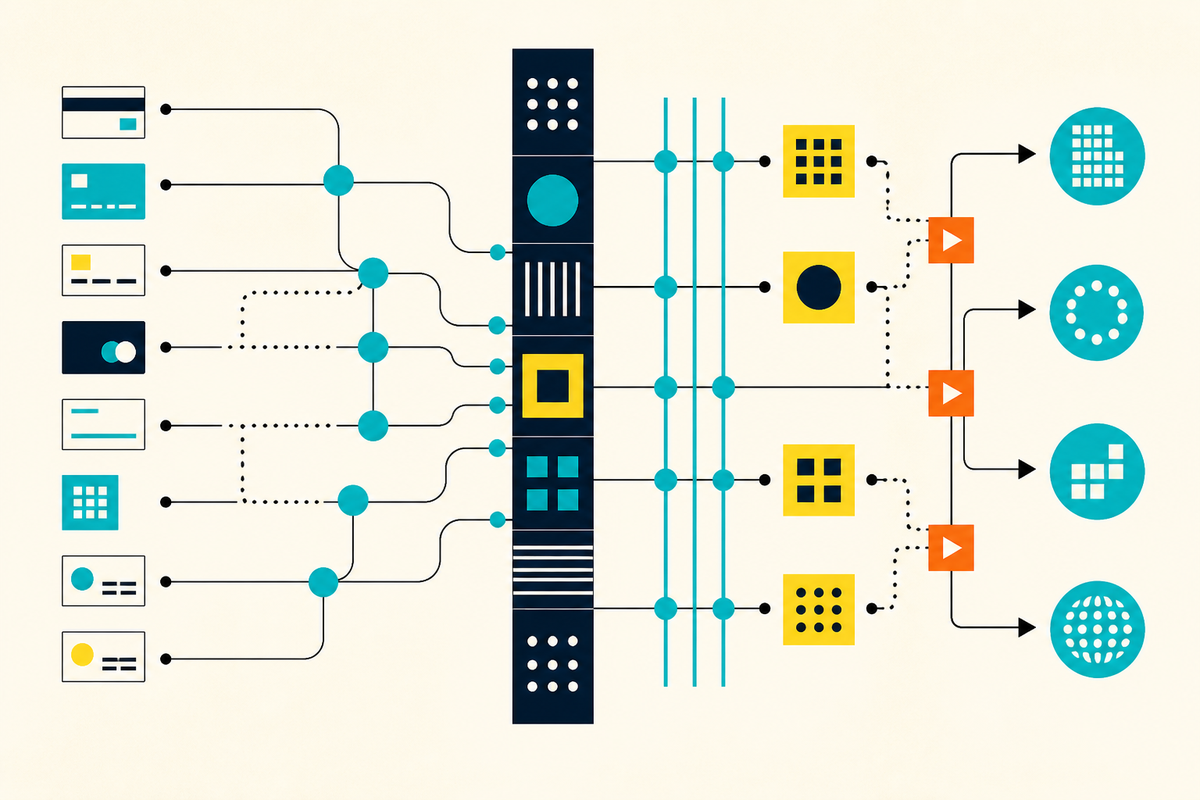
A large box of financial Lego
Founder and chief executive Amir Wain started i2c in 2000 after building payment software at Innovative Private Limited. His original problem was rigidity. Traditional processors were dependable, but changing a product could mean a queue, custom code and a long wait. Newer providers later made integration more approachable, but banks could still end up stitching together ledgers, processors and compliance tools from several vendors.
i2c's answer was to build one system in-house and make its behavior configurable. The company now advertises more than 100,000 pre-coded building blocks and more than 300 APIs. A client can combine those pieces to set fees, limits, rewards, repayment plans, wallet access, transaction alerts, currencies and fraud responses. The analogy to Lego is imperfect - Lego bricks do not need to satisfy banking regulators in 216 countries and territories - but it explains the attraction.
Configuration changes the economics of experimentation. A credit union can test a secured card, graduate selected customers to a standard credit line and add rewards without commissioning a separate processing stack for each stage. A commercial issuer can assign spending limits by employee, department or merchant category. A prepaid program can support several currency purses. The unglamorous benefit is fewer change requests passed back and forth between institutions and vendors.
“What we've needed from a processing partner has been the ability to handle complexity.”Hanna Zaidi / VP, Payments Strategy
What the platform actually sells
Issuer processing remains the center. When a purchase arrives, i2c can authorize it in real time, update the ledger and trigger the correct alert. Its credit tools cover secured cards, revolving accounts, commercial lines, co-brands and installment plans. Debit includes virtual issuance, mobile-wallet provisioning, multi-currency support and granular controls. Prepaid stretches from travel and payroll cards to government benefits and earned-wage access.
One stack, different jobs
The core-banking product adds checking, savings, certificates of deposit and money-market accounts to that same environment. Payment Hub handles another layer: selecting and connecting rails such as FedNow, ACH and Visa Direct, with support for services including Mastercard Send and RTP. A community bank that once needed several integrations can use a narrower set of APIs and one operating view.
Then there is the human work around every transaction. i2c offers implementation help, fraud specialists, dispute and chargeback operations, and round-the-clock multilingual customer care. This is important because a perfect API does not calm a cardholder whose vacation purchase was declined. Financial infrastructure is software wrapped in operations.
The customer is an institution; the user is everyone else
i2c makes money as a B2B technology and processing provider. Pricing is negotiated rather than posted on a menu. Its revenue likely mixes implementation, platform, transaction and managed-service fees, though the private company does not publish the recipe. An outside company-data record supplied for this profile estimates annual revenue at $201.1 million; i2c does not release audited sales or valuation figures.
The buyer may be a bank replacing an aging processor, a startup launching its first card, a government distributing benefits, or a brand embedding credit. The end user is the person checking a balance, freezing a card or choosing installments. i2c's work solves two opposite anxieties at once: institutions fear moving too slowly, but they also fear that a newer vendor will fail at scale.
For a smaller institution, that tension is particularly sharp. Its customers compare the mobile experience with the country's largest banks, while its technology team may fit around one conference table. Buying processing, fraud tools and operational support together can narrow that resource gap. For a fintech, the calculation is different: infrastructure must survive a sudden jump in volume and a launch in a second country without turning the product team into a compliance department. i2c is selling both groups a kind of borrowed scale - access to systems and specialists they would be unlikely to build alone.
That is the competitive wedge. Fiserv, FIS, TSYS and Jack Henry represent established scale. Marqeta, Galileo, Highnote, Lithic and Episode Six represent newer API-led infrastructure. Core specialists such as Mambu and Thought Machine attack another piece. i2c tries to sit between the camps: a modern, configurable stack with 25 years of operating history, spanning more functions than a card-only processor.
Breadth can create its own risk. An all-in-one platform must keep each component competitive, and large migrations remain difficult regardless of vendor. Banks also dislike concentration risk. Yet i2c's internally built architecture is a meaningful distinction. A suite assembled through acquisitions may offer many logos while preserving separate data models underneath. i2c argues that a shared foundation lets changes travel across products without another integration project.
Reliability is a feature, not a footnote
Payment companies enjoy talking about speed. Their clients remember outages. i2c reports 99.999 percent historical availability through dual-active data centers - roughly five minutes of downtime a year if maintained continuously. It says nearly one-third of its more than 1,600 specialists work in research and development, accounting for more than 1.5 million engineering hours annually. Those are company-reported measures, but they reveal where i2c wants scrutiny directed: the engine room.
The same pattern appears in fraud. More than 250 configurable rules and machine-learning models score transactions in real time, while managed teams can tune and monitor a portfolio. i2c says its fraud system has reduced losses by as much as 62 percent against industry norms in evaluated programs. The figure will vary, but the product logic is sound: fraud controls work better when they see the authorization, account and customer data without waiting for another system.
Wain's team began an AI and data-science environment in 2009, according to the company's history. In 2025 it extended agentic AI into multichannel customer service. The interesting point is not that a processor now says “AI.” Everyone does. It is that transaction businesses have had machine-learning problems - anomaly detection, decisioning and routing - for years, with clear costs when the model is wrong.
The processing platform begins with a configurable architecture.
An AI and data-science environment joins the operation.
Credit processing broadens the product lifecycle.
Core banking turns a processor into a wider banking stack.
Payment Hub adds multi-rail money-movement orchestration.
New leaders and a CoinZoom partnership point toward global expansion.
From the back room to the product roadmap
Recent partnerships show issuer processing becoming less like a utility and more like an operating system. Finastra now connects i2c's card services to its Phoenix core for North American institutions. Mastercard selected i2c as an early processing partner for One Credential, which lets a cardholder route purchases among debit, credit, prepaid and installments. Visa certified i2c to enable Click to Pay globally through a single integration.
The company also added senior growth, partnership, marketing, legal, finance and client executives in 2026. Awards followed - including Overall FinTech Company of the Year from FinTech Breakthrough - but the more useful signal is the widening set of jobs clients expect a processor to perform. The processor is now asked to help design products, connect networks, watch fraud, handle service and carry a program into new countries.
That is where i2c fits in the market: below the glossy app, above the raw payment rails, and increasingly across the core in between. Its value appears when an institution wants to change something without replacing everything. The next time a card moves instantly into a phone wallet, a suspicious purchase triggers a useful alert, or an account offers a surprisingly specific control, there is a decent chance the clever bit came from a company whose name the cardholder will never learn.