FinTech Australia began with a problem familiar to the founders it represented: the money might run out before the idea proved itself. At its February 2016 launch, the association had just over 50 founding members and less than two months of cash runway, according to its first-year retrospective. The proposed product was collective influence. The immediate requirement was survival.
A decade later, more than 400 fintech companies belong to the constituency it represents. In September 2026, its Intersekt conference became the venue for a government announcement on the future of financial innovation. Between those two moments sits an unusually instructive company story: an organisation built to do the work that ambitious businesses struggle to do alone.
Its business is representation. FinTech Australia gathers the complaints, evidence and commercial experience of financial technology companies and brings them into policy discussions. It also runs events, publishes research and helps members find one another. For a founder who has spent the morning fixing a product and the afternoon deciphering a consultation paper, that division of labour has an obvious appeal.
A startup for the startups
The organising began in late 2015. Venture investor Reinventure describes its part in assembling the national body, preparing a Treasury policy document and building support ahead of the first annual general meeting. Simon Cant became the first chair in March 2016. The association’s 2015 roots and 2016 public launch explain the two dates that appear in its history.
Danielle Szetho, previously at Fairfax Media, became its first chief executive in 2016. In an interview about her appointment, she identified a national fintech census as an early priority. To argue persuasively about the industry’s needs, the association first needed a better picture of its size, composition and gaps. That is a useful founding instinct: count the problem before campaigning about it.
Early members spanned different businesses. Sharesight, the investment-tracking service, described joining as a founding member alongside companies working in lending, payments and automated advice. Their products differed. Their need for a community, a hearing and a workable operating environment overlapped.
Cash runway at launch, recalled in FinTech Australia’s first-year review.
The bill for a shared voice
The finances matter because an association must persuade members to pay for benefits that can spread beyond the people writing the cheques. A better rule can help an entire market. FinTech Australia combines that collective work with more direct benefits: event access, industry introductions, visibility and opportunities to contribute to policy.
Its current membership offer starts at A$550 a year for founding teams, with tiers based on team size and headquarters location. A Friend of Fintech subscription for individuals costs A$150 a year. Those are advertised entry prices, not a universal rate card for every business. Event discounts and free Finnies entry are among the member benefits.
Corporate partnerships and event sponsorship add another source of support. Historical grants helped specific projects: LaunchVic committed A$300,000 for the inaugural Melbourne conference in 2016. The association’s first-year review also described an A$200,000 Australian Government grant for international promotion. These were project grants, a distinction that matters when startup databases turn every incoming dollar into a funding round.
The membership offer changed as the organisation learned. An announcement of a revised structure described months of member consultation, requests from people outside fintech and examples from overseas associations. New individual and international categories widened participation. The practical lesson is to price for the people actually asking to join, then connect that income to work they value.
A room full of rivals, with something in common
Look at the current board and team and the association’s position becomes clearer. Chief executive Rehan D’Almeida works with a board chaired by Sarah Gorman. Board members include people from Monoova, WeMoney, Block, Xero and Tractor Ventures. The mix brings founders and established-company policy experience into the same organisation.
Its public working culture is visible in consultation groups, cross-company reports and shared events. The partner directory includes American Express, Cuscal, Mastercard and Xero, alongside law firms and startup support organisations. Those relationships give a young business more ways to encounter institutions it might eventually sell to, partner with or need to understand.
FinTech Australia occupies the space between individual companies and the institutions shaping their market. A business could hire advisers, approach government directly or build its own network. Specialist associations and startup hubs serve adjacent needs. The boundaries are friendly as often as competitive: Stone & Chalk is itself a listed supporting partner.
Stop making every founder do the same homework
Some of the most useful services have very little ceremony. The investor map launched as a free resource, grouping venture investors, angel funds, corporate investors and other funders. Funding-stage filters helped narrow the search. The idea addressed a repetitive chore: founders independently compiling lists of the same investors.
The public ecosystem map and services directory serve a similar discovery function. They help a newcomer identify businesses and providers in an unfamiliar market. Research adds context. In January 2025, FinTech Australia announced the fifth Australian Open Banking Ecosystem Report and Map with Mastercard and Open Finance ANZ, extending its work on understanding the businesses around data sharing.
Introductions can also be more targeted. The 2024 FinTech Connect Program, powered by AWS, offered selected scaling fintechs meetings with financial services customers at Intersekt and the AWS FSI Symposium. International delegations connect members with overseas ecosystems and public agencies. The sensible expectation is access to relevant conversations; the member still has to make a commercial case.
The policy meeting moves upstream
In April 2026, FinTech Australia launched a Wealthtech Policy Working Group as a test of more proactive member-led advocacy. Its explanation was specific: wealth technology crosses advice, markets, licensing, superannuation, data and disclosure. A problem in one part of that system can complicate a product operating across several.
Co-chaired by Samantha Horton of Selfwealth by Syfe and PocketSmith founder Jason Leong, the group was designed to surface issues earlier. The change builds on responding to formal consultations, adding a forum where members can help set priorities before a finished proposal arrives. For readers building an association, this is the copyable move: organise around a shared operating problem, and ask for concrete examples early.
- 01 Shared problem
- 02 Member evidence
- 03 Policy engagement
- 04 Implementation test
An editorial view of the association’s policy work.
Open banking meets the consent form
The Consumer Data Right offers a case study in the distance between a policy framework and everyday use. An April 2026 report with Lateral Economics argued that compliance complexity and poor consumer experience were constraining adoption. Its proposed changes addressed third-party disclosure consent, the way businesses appoint nominated representatives and continued participation by small banks.
The modelling estimated around A$1.2 billion in additional annual economic benefits by 2035 under the recommended reforms. That is a conditional forecast. It is neither FinTech Australia’s revenue nor money already delivered. The distinction matters because the argument depends on changing the processes that currently make useful data sharing difficult.
The broader lesson is practical. Permission to build a service does not settle whether a customer can comfortably use it. An industry body earns its place when it can bring those product-level frictions into a policy debate with enough detail to make them fixable.
The sandbox gets a second look
That implementation problem returned to the stage at Intersekt on September 3, 2026. Assistant Treasurer Daniel Mulino announced the Financial Innovation Strategy, including a new committee and a more flexible regulatory sandbox approach. The government said a review found the existing Enhanced Regulatory Sandbox had not delivered the use or flexibility industry needed.
A sandbox allows controlled testing of new financial services. Its shortcomings are a reminder that creating a programme and making it useful are separate achievements. The review provided a reason to change the approach. FinTech Australia welcomed the strategy, while its chief executive put the next hurdle plainly.
“The test will now be implementation.”
Rehan D’Almeida · September 2026 response
For the association, hosting that announcement demonstrated its place in the national conversation. The harder measure will emerge later, in whether businesses can test, commercialise and scale services under the resulting arrangements. A good conference provides a stage; policy work must continue when the audience leaves.
There is a stopwatch, too
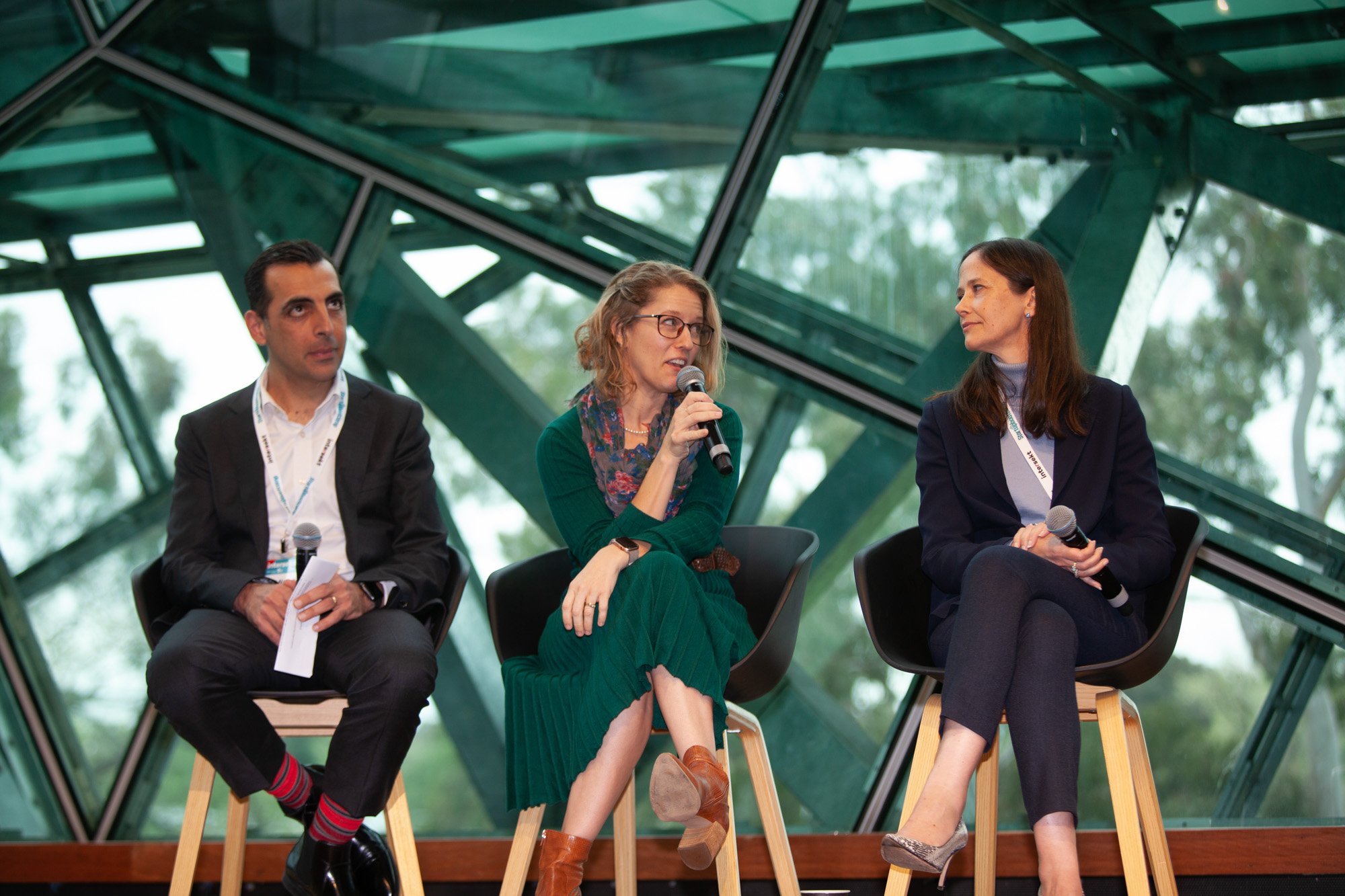
Not every activity involves a submission deadline. Intersekt’s 2026 programme advertised Fintech50: 50 industry pitches in an hour, with each company allotted 30 seconds. It also included investor reverse pitches, putting the people who usually assess the presentations on the other side of the microphone.
The Finnies supply another kind of visibility. The 2026 awards received 321 entries across 22 categories, with a two-round judging process. Zepto won FinTech Organisation of the Year. Hello Clever won three awards, and its co-founder Caroline Tran was named Outstanding Fintech Leader of the Year. The ceremony offers a recognisable occasion for work that customers may never see behind their payment or banking screen.
For a prospective member, the useful question is which of these jobs needs doing. A company confronting a shared regulatory obstacle has a reason to contribute evidence. A team seeking partners has a reason to prepare for introductions. Someone expecting membership alone to produce customers will still have a sales problem. FinTech Australia’s story suggests a more demanding bargain: pool the work that benefits from scale, then show up ready to use it.
Find your way into the conversation
Explore FinTech Australia, policy submissions and research and reports. Follow LinkedIn, X or Instagram. Browse the Intersekt 2022 session recordings on YouTube.
Watch: how FinTech Australia took shape Alliance interview with Rehan D’Almeida and Tori Rudolph · YouTube ↗