A founder handing over the chief executive’s job makes an interesting comparison shopper. For years, Lance Goodman had asked Australians to reconsider arrangements they had grown used to. In August 2025, he announced a change of his own: Emma Fawcett would become Compare Club’s CEO, and he would move into a dedicated strategy role. The business would keep its co-founder. Someone else would take the chief executive’s chair.
There was no grand farewell in his announcement. Goodman described the new job as a chance to concentrate on the company’s next phase of growth and welcomed Fawcett, who was due to start on August 25. It was a practical rearrangement of responsibilities. For a company built around helping people review their choices, the symbolism was unusually tidy.
Compare Club occupies a less glamorous corner of Australian business than the ones usually reserved for founder mythology. Its territory includes electricity bills, mortgages and car finance. These are purchases that can remain untouched for years, partly because reviewing them is work. Nobody has ever improved a dinner party by announcing that they have finally located their electricity tariff.
Goodman’s career has come to revolve around making that uninviting job manageable. He helped build a business that connects online comparison with people who can explain the options and move a transaction along. The human work matters: a price on a screen still leaves a customer with a decision, a form and several excellent reasons to do it tomorrow.
Two businesses, one unfinished job
The group took its present shape in 2017, when Alternative Media and ChooseWell combined. Alternative Media brought digital lead generation. ChooseWell brought a brokerage operation. Goodman and Andrew Davis became the co-founders associated with the combined business. The arrangement joined the ability to attract an interested customer with the ability to help that customer complete a purchase.
It is an origin story with more commercial plumbing than garage romance. A marketing operation can find someone who wants to save money. A sales and service operation can work through the circumstances that make one product suitable and another awkward. Putting those capabilities together makes the connection between an enquiry and a completed transaction part of the same business.
Goodman’s earlier professional record includes engineering, consulting and learning businesses. He studied industrial engineering at the University of the Witwatersrand and worked at Accenture before later leading Alternative Media. That sequence puts his comparison-business work after experience in other kinds of organisations. It does not require a childhood prophecy about household bills to make sense.
The result was a company with a broad household remit. Its energy service, for example, offers to compare plans and take care of the application. That is a concrete promise about administration. Finding an alternative and arranging the move are separate pieces of work; customers have good reason to care about the second.
The car loan leaves the showroom
By November 2021, Goodman was explaining a partnership with CarClarity that would add car-finance options from more than 30 lenders. It extended Compare Club’s reach into a purchase where the financing offered at the point of sale could shape the whole decision. The proposed alternative was to bring more borrowing options into view before a buyer committed.
Goodman described the partnership as another way to help Australians navigate complicated financial choices and reduce major household expenses. The language was expansive; the practical example was pleasingly ordinary. A person buying a car needs the car and the financing to make sense together. A persuasive conversation about the vehicle does not automatically settle the borrowing question.
A photograph from the announcement puts Goodman beside Davis, with a city skyline behind them. Goodman stands on the left, arms folded; Davis wears glasses and a blue jacket. It is a useful picture of a business commonly encountered through a website: two people behind an operation whose daily work happens through many other people’s conversations.
Partnerships also show the limits of the lone-founder story. CarClarity brought lending capability and relationships of its own. Compare Club supplied another route to customers. Goodman's role involved connecting businesses that could do different parts of a job. The customer saw more options; behind that convenience sat an agreement between organisations.
A different kind of deal in 2022
The next major transaction concerned Compare Club itself. In October 2022, Next Capital’s investment was reported at more than A$100 million. The company had previously pursued a stock-market listing and instead took the private-capital route. The change put a new investor beside the founders and management as they planned the next stage.
Transaction adviser Mark Lewkovitz congratulated Davis and Goodman on the partnership and pointed back to the five years since they had merged their businesses. Investor material described the combination of data-led marketing with an operation able to convert enquiries into sales. Those were the capabilities buyers were examining, well beyond the appearance of a comparison website.
Another early investor, Les Szekely, publicly congratulated Goodman, Davis and Jonathan Leane, and said he would remain a director and shareholder. The connections around Goodman’s business included colleagues, advisers and investors who had participated at different stages. A company can carry a founder’s ideas while accumulating quite a crowd around the table.
For Goodman, the deal marked a change in the setting in which he worked. There was a new capital partner and a business assembled over years. The reported transaction figure belongs to that corporate story. The more revealing question for a profile is what he wanted the organisation to do with its next opportunity.
- 2017Businesses combine
- 2022Next Capital partnership
- 2025CEO handover
The meeting about tomorrow’s bills
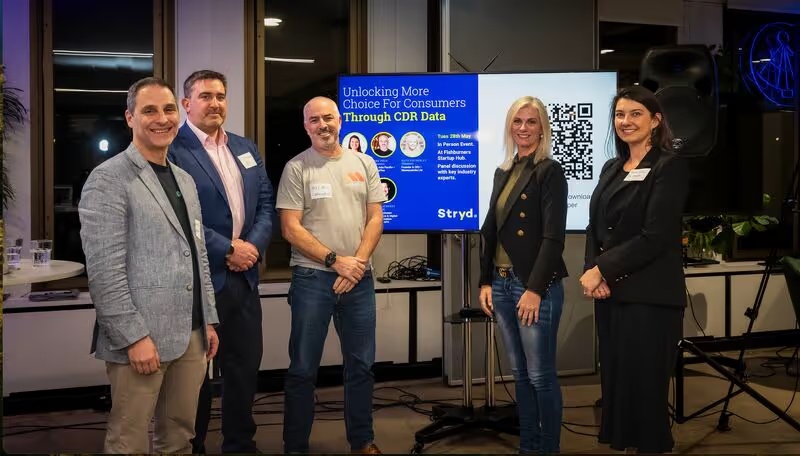
One answer emerged at a Sydney panel on May 28, 2024. Goodman joined Ruth Hatherley, Mike Page and Sam McCready for a discussion moderated by Annie Kane about consumer data and open banking. The subject could easily have vanished into technical vocabulary. Goodman described a household use for it: “to help people manage their bills”.
His interest was in assistance that continued over time. With a customer’s situation changing, a service might identify a reason to reconsider several products rather than wait for a fresh enquiry about one. He also raised the possibility of lenders using properly categorised data to assess a borrower and make offers more quickly. These were ambitions for how the process could develop.
There is a recognisable change of emphasis here. A comparison begins when somebody decides to look. Ongoing assistance would have to notice when looking becomes useful. That puts greater weight on the relationship after the first transaction. The attractive part for a busy household is obvious: fewer recurring jobs demanding a place on the calendar.
The panel’s setting also captures Goodman’s position among other operators. Brokers, lenders and technology providers all had pieces of the problem in front of them. He argued for public education about the benefits of open banking. An unfamiliar system has to earn attention through a result a person can understand. Household administration is already quite capable of producing mysteries without assistance.
“to help people manage their bills”
Lance Goodman on open banking, May 2024
The courtesy of a smooth handover
In 2025, Fawcett’s arrival gave that longer-term thinking a new leadership arrangement. Goodman continued in strategy while she took responsibility as CEO. Her appointment announcement described a business backed by Next Capital and credited its founder’s leadership. It gave the change a specific date and a clear division of responsibilities.
A year later, Fawcett publicly thanked Goodman for helping make the transition smooth. It is a small detail, but a telling one in a founder’s career. Starting a business and helping a successor lead it call for different contributions. Her acknowledgement supplies a view from the other side of the handover, beyond Goodman’s own announcement of enthusiasm.
The subsequent company direction provides context for his earlier interest in recurring help. In September 2026, Compare Club appointed Benoit Garnaud to lead product and technology and Bobby Singh to an AI and technology advisory role. Its stated plans included more proactive bill monitoring and alerts through Club+, with people remaining accountable for guidance.
The full ambition was still being developed. Fawcett described a future in which the company could watch for overpayment in the background, while acknowledging that the entire vision was not yet available. That direction resembles the ongoing assistance Goodman had discussed in 2024. It would be premature to treat the resemblance as a completed result, or to assign those later appointments to him.
A useful reason to stay
Goodman’s public professional life returns to a fairly consistent subject: making complicated household choices easier to handle. His company biography emphasises that people are busy. It is an unromantic observation, and a consequential one. A service designed for people with unlimited spare time would be solving a different problem.
The work contains a tension worth keeping in view. A comparison service needs transactions to sustain a business, while a customer needs a suitable outcome. Compare Club’s energy comparisons operate within a network of providers. The quality of the available options, the explanation and the application process all contribute to whether the visit was worthwhile.
Goodman now works on strategy at the company he helped assemble. The career has moved through combination, expansion, investment and succession. Its most interesting continuity is the everyday decision at the other end: a person wondering whether an existing arrangement still deserves their money, and whether changing it will consume their afternoon.
His own change of role leaves him close to that question while giving another executive room to run the organisation. There is something apt about a comparison-business founder reviewing his job and choosing a different arrangement. A household bill is rarely anyone’s idea of a good story. Building a career around making it less of a nuisance gives it a human plot.
Follow the conversation
Explore Goodman’s LinkedIn profile, his company biography and published commentary.