A car is a remarkably expensive machine to send on an errand for a few gallons of liquid. In 2015, Scott Hempy and his wife Kylie were driving between San Francisco and Los Angeles when the fuel gauge sank toward empty. They joked about the way aircraft refuel in midair. Why, Kylie wondered, couldn't gasoline come to a parked car? It was the sort of question that sounds frivolous until someone builds the truck.
The short version
- Filld sent trained drivers in small fuel trucks to cars parked at homes, offices and fleet lots.
- Customers booked through an app and paid a local-market fuel price plus a delivery fee, reported at roughly $3 to $9 by 2018.
- Its notable customers included Bentley, Volvo and car-sharing fleets; local fire rules proved as important as its software.
- Founder Scott Hempy later said Filld served thousands of customers in 14 US and Canadian cities before its technology and team moved to another company.
Hempy took the idea to Christopher Aubuchon, a managing director at the venture firm where he worked. They researched whether the service was lawful, left their jobs and co-founded Filld. Crawford Ifland and Jake Allbaugh joined the original team. The first Bay Area deliveries began in April 2016. For the customer, the proposition was almost comic in its simplicity: tell Filld where the car is, choose a time, leave the fuel flap accessible and go about the day. A driver comes with the pump. The customer need not come outside.
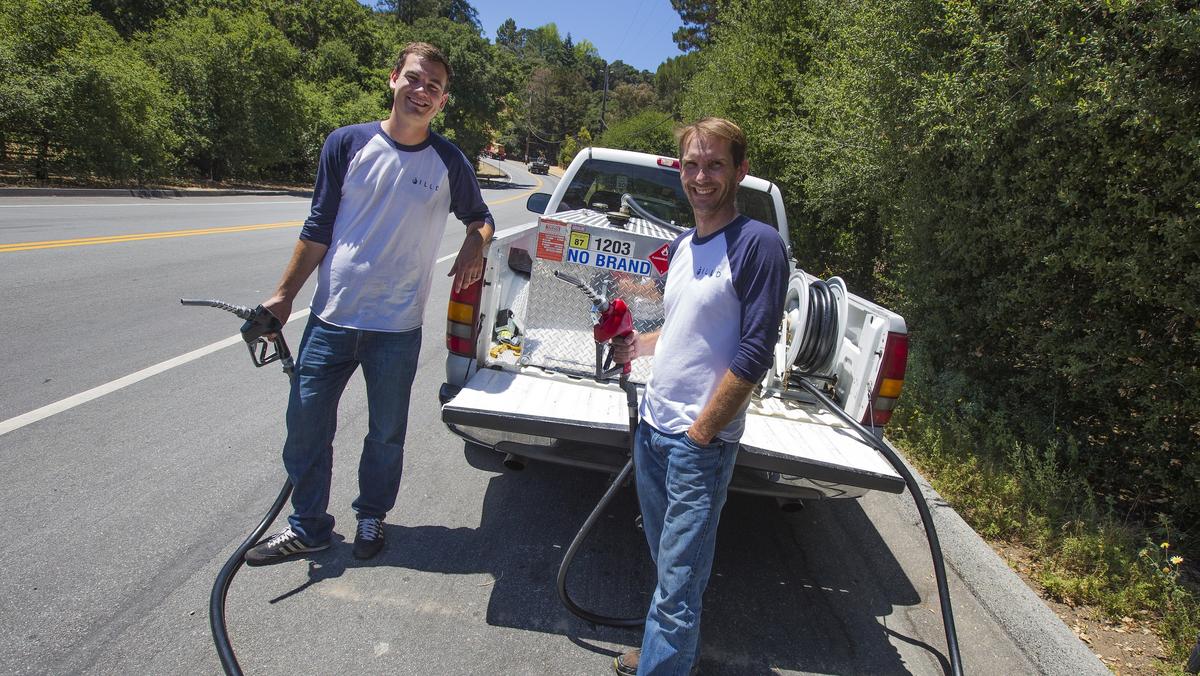
The luxury was an ordinary Tuesday
Filld's original customer was anyone who disliked the interruption of a gas station. That sounds like everyone, but an annoyance is not automatically a business. The company needed people willing to pay a modest premium to erase that stop. Its early pricing used nearby station prices as a reference, then added a delivery fee. In its 2016 Bentley announcement, Filld described a typical fee of about $3. By 2018, reported fees varied from $3 to $9 depending on the delivery window.
The mechanics were less glamorous than the phone screen. Filld bought fuel from wholesalers, put it in specially equipped trucks and sent commercially licensed, trained drivers through dense areas of parked cars. The fuel had to be handled safely, measured correctly and delivered under local rules. The company was selling minutes back to drivers, but it was buying those minutes with trucks, labor, insurance, fuel inventory and route planning.
One order, four moves
The contrast with an ordinary station is instructive. A station waits for customers to arrive; Filld carried the station's most important function to them. A fixed station spreads its costs across motorists passing through all day. Filld needed enough orders close together for a truck and driver to earn their keep. That made route density, rather than app downloads, the number to watch.
When the car became the customer
The neatest expression of Filld's ambition appeared in a Bentley Flying Spur. In July 2016, a participating car placed an automated fuel order. The pilot was designed to send Filld a signal when the tank fell below a quarter full. A driver could locate the car, open the fuel flap and fill it while the owner watched the order on a phone. The clever bit was not that a wealthy driver could afford delivered gasoline. It was that the driver could forget about gasoline altogether.
“Our vision has always been to make our service invisible.”Chris Aubuchon, Filld co-founder and CTO, 2016
Volvo later put Filld inside its connected-car concierge offering in San Francisco and Seattle. Car-sharing operators presented another, less theatrical reason to call. A rental car that begins the morning low on gas has to be taken out of circulation for a refill. If a fueling truck visits several cars overnight, the fleet starts work ready to rent. Filld reported relationships with Daimler's car2go, BMW ReachNow and Sixt; Enterprise Rent-A-Car also appeared among its named customers. These were not merely prestige logos. They were concentrations of parked vehicles.
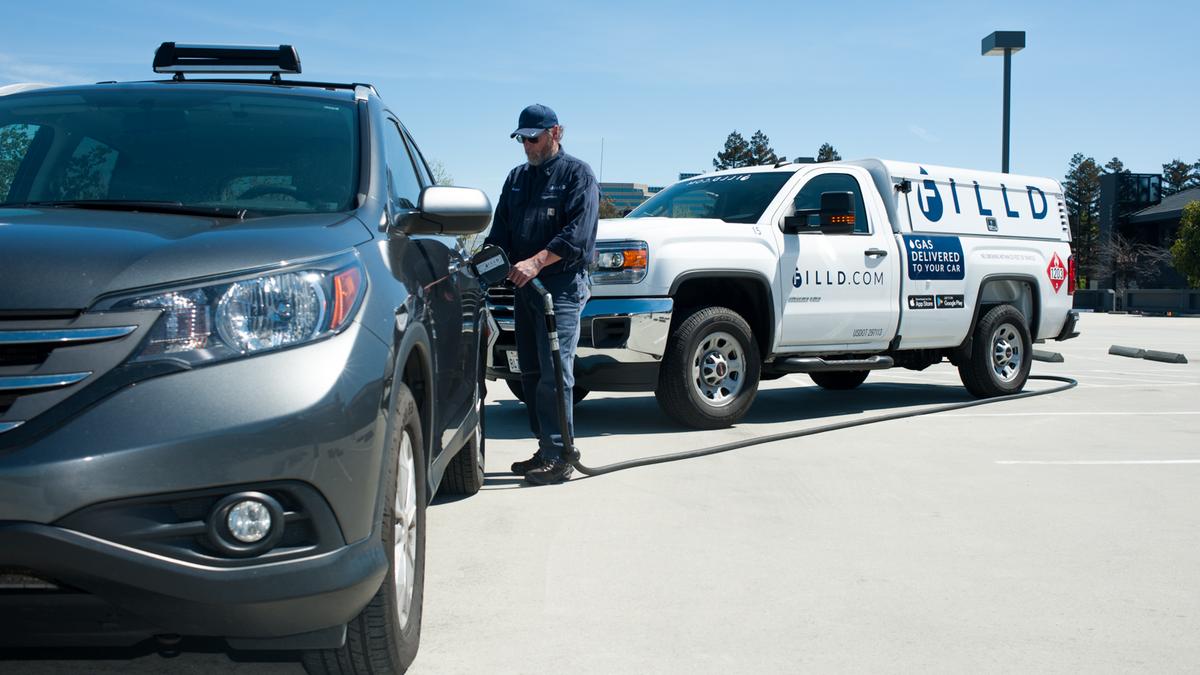
A fleet contract is a map
Filld's 2018 expansion plan made that logic explicit. The company said it would enter a metropolitan area with large commercial and fleet services, then open consumer delivery there. In Washington, D.C., it was already fueling partners such as car2go before announcing a wider consumer offering. A fleet gave a truck a cluster of predictable stops and gave a new city's operation a reason to exist before households adopted the service one by one.
Investors paid for that possibility. Filld raised $3.25 million in a 2015 seed round, $9.65 million in a 2017 Series A led by Shea Ventures and $15 million in a 2018 Series B co-led by fuel marketer Parkland and Calibrate Ventures. Those three announced equity rounds total $27.9 million. Parkland brought more than a cheque: its US president joined Filld's board, and the company spoke of operating expertise and fuel supply relationships. Software could organize a route. An established fuel business knew what had to be inside the truck.
A saved stop, purchased one tank at a time. Convenience had to justify the fee.
Many parked vehicles, a repeat schedule and less time taking cars to a pump.
Filld was one of several companies moving fuel to vehicles; Booster and Yoshi were among the alternatives. Its particular wager joined consumer convenience, connected-car automation and fleet servicing. That gave it more possible customers, but also more types of stop to coordinate. Its LinkedIn description later emphasized software and hardware for mobile-fueling companies, a reminder that the business was as much dispatch and equipment as an icon on a home screen.
The city has a say in where the pump goes
Seattle provided a sharp lesson. After a pilot began, the fire marshal ordered Filld in July 2018 to stop mobile fueling until it obtained an operational permit for handling flammable liquids. The company suspended its on-demand service there and negotiated with officials. The sticking point was on-street fueling. A car-sharing vehicle may be parked on a public street, not in a private lot; moving every vehicle to a permitted lot would hollow out the service the fleet had bought.
This was more specific than a generic complaint about regulation. Booster, which focused on fueling in parking lots, faced a different path in Seattle. Filld wanted to follow cars wherever they legally parked. Its counsel said that without street access, the company could not offer the same benefit to car-sharing operators. The map of interested customers and the map of permitted fueling locations did not overlap neatly.
The company's future-facing language included alternative fuels and even mobile charging. Its demonstrated operation, however, was gasoline delivery. That distinction matters. A truck that can serve one kind of energy does not automatically solve the equipment, safety and dwell-time requirements of another. Filld's achievement was to make an old fuel retail chore behave like a scheduled service, not to make the physical work vanish.
What stayed after the trucks
In a 2022 post, Hempy said that after a difficult period, Filld's board had decided the previous summer to find another home for its technology and team. He did not name the company. He did offer a measure of the journey: thousands of customers in 14 cities across the United States and Canada, and more than 250 people who worked on Filld over its life. A website still describes the service model and tells visitors to confirm local activation before ordering; the history is clearer than any claim of universal present availability.
For anyone building a physical delivery business, the useful lesson is plain enough to fit on a dispatch sheet. Start where many customers are parked together. Price the stop as carefully as the product. Learn the permit boundary before drawing the route. And ask whether the customer's real purchase is the commodity or the time no longer spent acquiring it. Filld answered that last question well. Its difficulty was making every other answer work city by city, truck by truck, gallon by gallon.