A car is perfectly comfortable crossing a border. Its mobile connection is less adventurous. A vehicle built for one market may travel into another network, another billing regime, another set of rules. The driver expects the map to load and the emergency button to work. Behind those simple expectations is a small bureaucratic epic. Globetouch's business was to make the epic disappear.
Founded in 2012 and based in San Ramon, California, the company assembled global cellular access and the software to manage it. Its customers were automakers, mobile operators and enterprises deploying connected devices. The pitch was practical: integrate once with Globetouch, then use its operator ecosystem and control software to provision, monitor and bill connections across markets. In a 2017 company release, Globetouch said that ecosystem reached more than 400 network operations in over 180 countries.
The short version
- What it sold: global mobile connectivity plus a white-label platform for device and service management.
- Who bought it: automakers, telecom operators and IoT enterprises; GM's OnStar was a named 2017 collaboration.
- What changed: in February 2020, Globetouch became Airlinq and widened its pitch from connections to digital-service ecosystems.
The least glamorous part of a clever car
Consider the promise of a connected vehicle. It can report a fault, receive an update, summon help, stream music or sell a new feature after purchase. Each service begins with a signal. Yet a manufacturer cannot assume that one carrier agreement, one SIM arrangement or one backend will serve every destination where its cars are sold. A handset can be replaced in two years. A vehicle may be on the road for a decade or more. Its connectivity choices must be managed long after the launch presentation is over.
Globetouch occupied that awkward space between carmaker and carrier. Its GControl platform was described as an open control layer. GConnect and CloudSIM addressed the connectivity side, while the company's white-label platform let a manufacturer put its own name on the experience. The company also offered device management and the machinery for services such as infotainment, safety and utilities inside the vehicle. It was an infrastructure supplier: most drivers were never meant to know it existed.
The coverage figures were Globetouch's 2017 claims; they describe its operator ecosystem, not the number of direct customers.
One interface for a very crowded room
The cleanest example came in July 2017. Globetouch and Verizon Telematics announced plans for upgraded network solutions supporting General Motors as OnStar expanded globally. Globetouch said it would integrate GControl with OnStar to help deliver connectivity and regulatory compliance. Verizon Telematics brought its network experience and scale. The automaker would get a single point of integration rather than having to assemble every local relationship itself.
That was Globetouch's difference from buying connectivity one country at a time. The company aggregated operators and wrapped the messy operations in a control center. A carmaker still had to design the customer service, the vehicle electronics and the data policies. Globetouch aimed to make the network layer behave like a service the carmaker could direct, instead of a pile of separate carrier accounts.
The diagram is a simplified account of the model described in the 2017 OnStar announcement.
Globetouch named Daimler, Volvo and Reliance Jio among the companies served by its connected-car platform when it announced the Airlinq rebrand. Those names describe the reach of its commercial relationships; the public announcements do not disclose their contract values, deployment sizes or exact use cases. Its business model was enterprise platform and connectivity agreements. There was no public menu of per-car prices for the old Globetouch products. The cost to a customer would have depended on the markets, devices, traffic and services covered by a deal.
A company dressed for the invisible
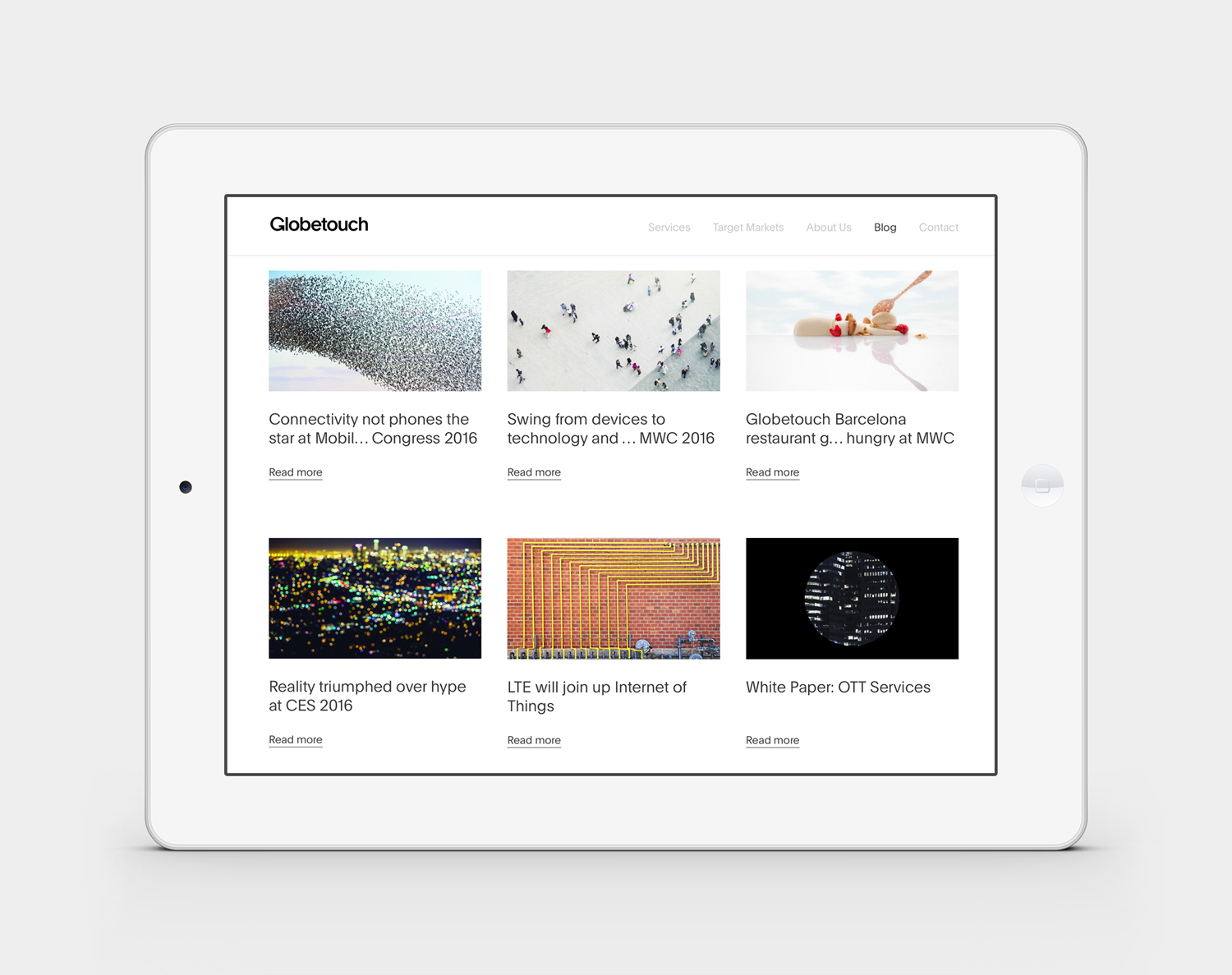
There is a charming mismatch in Globetouch's 2016 brand identity. Design studio Bunch made a vivid blue wordmark and a visual system inspired in part by migratory birds. Its G was tilted to echo the earth's axis. There were printed pieces and packaging for a business whose best work would leave no physical trace. The aesthetic was expansive; the operational job was to keep the quiet things quiet.

The company was expanding technically, too. Globetouch's CloudSIM was shortlisted for an Asian Mobile Award, according to industry reporting in 2016. It acquired the IoT analytics company Teramatrix in 2017 and, later that year, Netsnapper, a security and privacy software company. Those moves suggested a growing concern: a global connection alone was no longer the whole sale. Customers would need to analyze the data, secure the service and decide what to offer after the device connected.
The money followed that ambition. Globetouch raised a reported $40 million Series C in November 2017, backed by a group that included Verizon Ventures, Zeev Ventures, Hermes Growth Partners, Impact Venture Capital and Spark Telecom Ventures. Investor Shackleton Ventures later reported a $150 million pre-money valuation for that round. The funding was meant to extend its connected-car ecosystem and support work in other IoT markets. It is a large sum for solving a problem the motorist is supposed to overlook.
Then the name changed
The first idea had a limit: a connection is only the beginning of a connected product. By February 2020, the company had decided its name should speak to a wider job. Globetouch announced that it would become Airlinq. Its own description shifted from global connectivity toward what it called ecosystem enablement: a platform for services, data, edge capabilities and monetization around connected assets. The company pointed to cars, but also autonomous pods and drones.
The successor's current product map still carries the original logic. Autolinq addresses connected vehicles; Mobilinq handles IoT connectivity management; Marketlinq is a marketplace for enterprise connectivity solutions; Utilinq applies the platform to utilities. Airlinq has since advertised tools for eSIM management, analytics, billing and automation. In March 2026, it announced a global IoT partnership with NTT DOCOMO BUSINESS. The legacy is therefore a change of scope, not a disappearance of the network problem.
Globetouch is worth studying because it chose its customer carefully. A driver does not buy a control plane. An automaker responsible for millions of cars might. The company gave that buyer one integration, a white-label front end and an operator network behind it. The useful idea to copy is the consolidation of repeated, ugly work: find the task every customer must do in every new market, then make it governable from one place.
There are limits to that lesson. This model makes sense when a product is shipped into several countries, connectivity lasts for years and the buyer has enough scale to justify a platform contract. A small local fleet, or a device that needs only one domestic network, may be better served by a direct carrier arrangement. Nor can a control layer erase weak coverage or local law. It can only give an operator a clearer way to deal with them. That, for a company working behind a dashboard, was quite an ambitious promise.