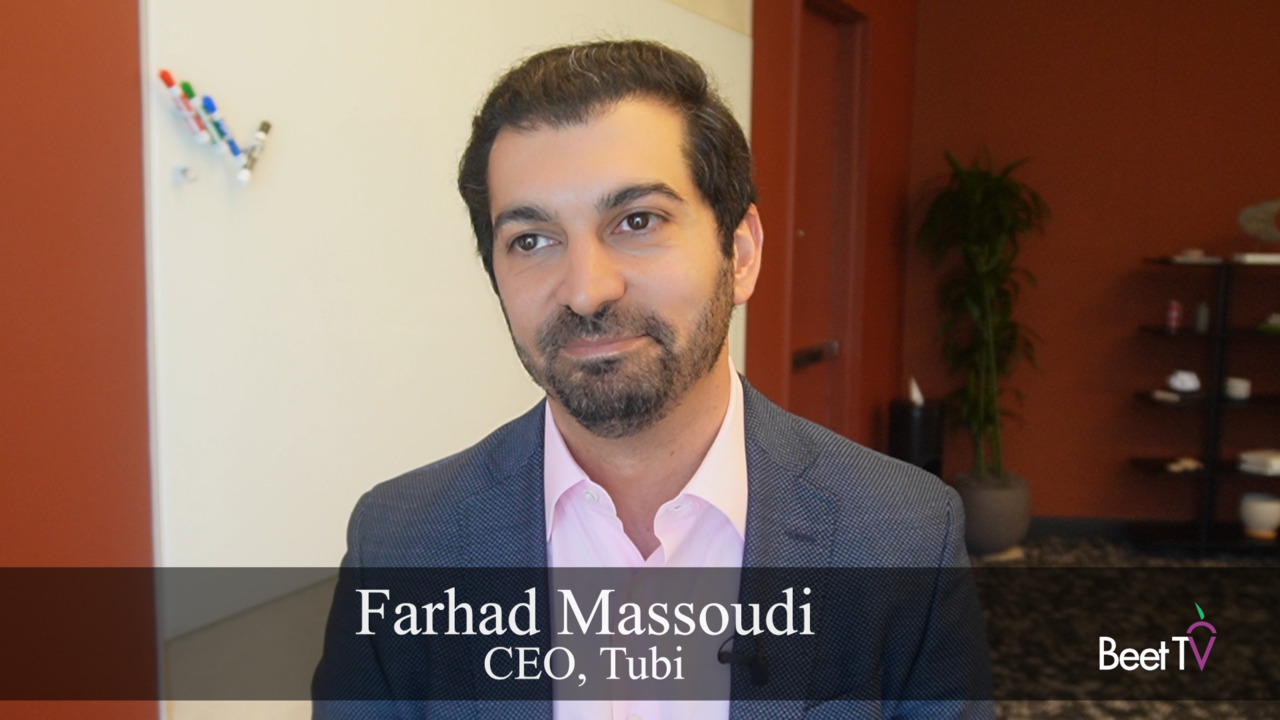
Before Farhad Massoudi persuaded Hollywood to give away its movies, he tried to persuade a friend to keep his money. His former college roommate wanted to invest in the business that would become Tubi. Massoudi knew how easily the check could disappear. He had little experience in the television and movie trade. The friend invested anyway. In the familiar startup story, this is where the music swells. In Massoudi’s version, there was still a great deal of explaining to do.
The proposition sounded simple: put movies and television on the internet, let people watch for free, and sell advertising. Simple propositions have a habit of becoming complicated in conference rooms. Someone must license the films. Someone must find the viewers. Someone must convince an advertiser that an audience watching an unfashionable movie is worth reaching. Massoudi’s career became an extended attempt to make those three groups agree.
He co-founded Tubi with Thomas Ahn Hicks, launching the service in 2014. By March 2020, Fox had announced an agreement to buy it for approximately $440 million in net cash. Massoudi continued as CEO until 2023. Those dates describe a company’s progress. The more interesting story sits between them: an engineer learning that the people holding the checkbooks and the people holding the remote might want very different things.
A television business, approached sideways
Massoudi grew up in Iran before moving to the United States. At the University of California, Berkeley, he studied electrical engineering and computer science. His public LinkedIn profile lists his Berkeley years as 2002 to 2005. The combination matters to the story without requiring a tidy immigrant parable. He arrived at entertainment through software, carrying questions about distribution, discovery and advertising rather than a script he wanted someone to produce.
His first business in this sequence was AdRise, founded in 2011. It helped publishers build and monetize streaming applications. Massoudi expected television channels to become television apps, bringing an enormous advertising market into a different technological setting. Instead of beginning with a consumer brand, he began by supplying the machinery that other businesses could use.
That approach gave him a close view of the difficulty. Helping an established media company put video on a connected device did not automatically turn it into an effective technology business. Creative judgment, licensing relationships and software decisions had to work together. Massoudi concluded that the opportunity he wanted required a service of his own. AdRise became the incubator for Tubi, and the supplier stepped into the audience’s living room.
The early financing was modest. He described raising roughly $400,000 from friends and family, followed by a venture round of about $2 million to $2.5 million. He also remembered how the objections evolved. First, television’s existing bundle seemed too powerful to disturb. When subscription streaming demonstrated that people would change their habits, the argument shifted toward subscriptions. Free television still needed its own hearing.
“it was really hard to raise money for it”
Farhad Massoudi, recalling the early fundraising
The catalog had a different opinion
A large library introduces an awkward question. If there are thousands of films available, how does anyone find tonight’s film? Browsing can become its own dreary form of entertainment. The meal ends, the television comes on, and thirty minutes later the household has reviewed an impressive quantity of rectangles. Nobody has watched anything.
Massoudi described that very problem in 2018, explaining Tubi’s content personalization engine. The goal was to shorten the journey from opening the app to watching something. Machine learning would use viewing behavior to improve recommendations. He said viewers were returning more frequently and watching longer after the system’s introduction. The library and the recommendations were meant to help each other: more choice supplied more opportunities to learn what people actually enjoyed.
He also supported organizing content around partners’ brands through TubiChannels. A viewer who liked one company’s shows could explore its dedicated page. That was a practical concession to human browsing habits. People sometimes want a recommendation; sometimes they want the shelf where the familiar things live. The software could accommodate both.
- 01License broadlyMore titles, more tastes
- 02Help people find a filmPersonalized discovery
- 03Sell the viewing timeAdvertising pays the bill
- 04Learn and buy againViewing informs the catalog
A conceptual explanation of the model, not a financial forecast.
The consequence was a different way of buying entertainment. By 2019, Massoudi was describing a process that began with a broad collection, learned from consumption, and used that information to guide further acquisitions. A film did not need to be the topic of everyone’s Monday conversation to earn a place. It needed viewers who wanted it and a cost that made sense.
This distinction can sound bloodless when described as the “long tail.” At home it is rather personal. The film you remember from years ago, the genre your friends never mention, the series you will cheerfully watch again: each falls outside someone else’s idea of essential television. Collect enough such preferences and the leftovers begin to look like dinner.
Hollywood still had to pick up the phone
None of this made relationships optional. A recommendation engine cannot recommend a movie the company has no right to show. Massoudi needed Hollywood partners as much as he needed engineers. In 2017, Tubi hired Adam Lewinson as its first chief content officer. Lewinson brought experience at Fox, Disney and Sony’s Crackle; he would open a Los Angeles office and oversee content strategy and acquisitions.
At the time of that appointment, Tubi reported more than 200 content partners, including Lionsgate, MGM and Paramount, and more than 7,500 titles available each month. The business was taking an engineering argument into an industry built on relationships. Lewinson’s arrival gave that argument a colleague who knew the other side of the table.
It is tempting to describe Massoudi as an outsider who simply ignored Hollywood. His hiring choices tell a more useful story. He wanted the catalog to be informed by what people watched, and he wanted people with the experience to obtain that catalog. The work involved translation in both directions. Data had to become a licensing decision. A licensing decision had to become a satisfying evening.
Free also required restraint. In February 2019, he described an advertising load of four to six minutes per hour, roughly a third of network television’s load by his comparison at the time. That figure belongs to that period, rather than being a promise about every stream today. It shows the balance he was trying to strike: enough advertising to support the service, with enough uninterrupted viewing to keep someone there.
Approximate net cash consideration announced by Fox for Tubi. A company transaction value, not Massoudi’s personal proceeds.
After the sale, the rules moved
Fox’s announcement in March 2020 put numbers around the audience Massoudi’s team had assembled. Viewers were spending more than 160 million hours a month on Tubi. The service offered over 20,000 titles from more than 250 content partners. Fox planned to keep it operating independently and add the benefit of its advertising and distribution relationships.
Massoudi stayed. Selling a company meant learning how to run it inside another company, a different assignment from persuading people that it ought to exist. He later described the experience of growing within a larger organization as valuable. The acquisition supplied resources and connections; it also placed the founder’s habits inside a broader set of priorities.
One early conviction proved less permanent than its wording suggested. In 2018 and 2019, Massoudi argued against original programming for free streaming businesses. Expensive productions could absorb money that might otherwise buy a much broader library. His argument had the plain appeal of someone watching the budget: why gamble heavily on a handful of titles when the catalog could spread the risk?
By March 2021, Fox was discussing originals for Tubi. Its finance chief, Steve Tomsic, emphasized cost and genres that already performed well on the service. This was a change during Massoudi’s tenure, and it belongs in his story. The new parent had different resources. The guiding question about audience demand could survive even as the answer to who should make the films changed.
Founders are often asked to supply a permanent philosophy, suitable for a conference slide and preferably no longer than a sentence. Businesses have the discourtesy to keep moving. Tubi’s shift toward originals makes Massoudi’s record more interesting than an account in which every early declaration stays correct forever. He built a model with constraints, then worked through a period in which some of those constraints changed.
2011AdRise begins
2014Tubi launches
2020Fox acquisition
2023CEO transition
2024Swift appointment
Another seat at the table
In April 2023, Fox announced the formation of Tubi Media Group under Paul Cheesbrough. Massoudi would remain through a transition ending in June. Anjali Sud subsequently took over Tubi’s leadership. The company’s later results belong to her team as well as to the foundation he helped build: in June 2025, Tubi announced it had exceeded 100 million monthly active users.
Massoudi’s next publicly announced appointment came in July 2024, when he joined Swift Ventures as an entrepreneur in residence. There was an existing relationship behind the move. Swift’s Brett Wilson had joined Tubi’s board in 2017; he and Massoudi had originally known each other as advertising technology entrepreneurs. The founder was returning to a familiar conversation from a different chair.
At Swift, Massoudi said he wanted to share what he had learned, mentor other founders and keep learning himself. He stressed that building a company can take longer than expected. After years spent asking people to support his own idea, he was making time for people trying to explain theirs. It is a quieter ambition than launching a streaming service, but it has an obvious connection to that first friend’s check.
Outside the business, his interests have ordinary, pleasing specificity. In a 2023 questionnaire, he chose tennis over pickleball, named the Golden State Warriors as his favorite team and picked Cape Town as his favorite place visited. His last watched television series was Ted Lasso. Asked whether he preferred podcasts, radio or audiobooks, he selected audiobooks. Even a streaming founder reserves the right to close his eyes.
He has also cycled in Italy with investor Howard Lindzon, who describes their shared interests in media and comedy. The two talked publicly about streaming again in December 2025. Massoudi remains interested in the relationship between platforms, data and what people choose to watch. That question has followed him from AdRise through Tubi and into conversations after his departure.
The appealing part of his story is the space he made for preferences that failed to impress a meeting room. A business could take them seriously without asking every viewer to acquire the same taste. Massoudi spent years making that proposition workable. Somewhere, someone gets to watch the film they wanted all along, without first justifying it to anybody. A modest pleasure, with a considerable amount of work behind it.
Keep the conversation going
- Tubi - streaming service
- Farhad Massoudi on LinkedIn
- Farhad Massoudi on X
- Watch: 2019 conversation with Ashkan Karbasfrooshan
- Watch: the long-tail interview, June 2023
- Listen: the AdRise-to-Tubi story, October 2019
- Read: personalization and TubiChannels, November 2018
- Read: fundraising recollections, July 2021
- Read: the 2019 advertising model
- Read: Adam Lewinson’s appointment, October 2017
- Read: Fox’s acquisition announcement, March 2020
- Read: the move toward originals, March 2021
- Read: the CEO transition, April 2023
- Read: the Swift appointment, July 2024
- Read: Massoudi’s 2023 personal questionnaire
- Watch / listen: Trends With Friends, December 2025
- Read: Tubi’s June 2025 audience milestone
- Read: the September 2026 retrospective
- Read: Tubi’s September 2026 audience update
- Explore: Code.org’s Farsi education supporters