The internet usually announces a problem with a spinning wheel. Somewhere behind that tiny insult is a much less tidy world: a connector has collected dust, a splice is losing light, a radio is misaligned, or a transceiver behaves beautifully until traffic gets serious. EXFO makes the instruments and software that tell engineers which one it is. The company occupies the uncelebrated checkpoint between “we built the network” and “the network actually works.”
From its headquarters in Quebec City, EXFO sells portable fiber testers, modular field platforms, RF analyzers, lab systems, photonic-chip automation, cloud result management and remote monitoring. Its users include the technicians certifying a new fiber-to-the-home line, the manufacturer validating an optical component, the mobile operator hunting interference, and the hyperscaler trying to keep thousands of high-speed links from becoming thousands of individual mysteries.
The result is an unusual business: part rugged hardware maker, part optical laboratory, part workflow-software company and part global calibration shop. EXFO says more than 95 percent of the world's top communications service providers use its products. It also serves contractors, equipment makers, governments, research institutions and data centers in more than 120 countries.
A balcony thesis with a very small budget
Germain Lamonde founded EXFO in 1985 after studying engineering physics and optics. The reported opening capital was $100. Fiber was not yet the default nervous system of modern life, but Lamonde believed it would be. He later recalled writing an ambition to become the world leader in optical testing while sitting on the balcony of his student apartment. It sounds grand in retrospect. At the time, the first products were decidedly plain: a power meter and a light source.
That plainness was the point. Early optical tools could demand specialist knowledge at precisely the moment fiber needed to escape the laboratory. EXFO designed instruments that field workers could use. Its early customers included incumbent telephone companies in Canada, the United States and Europe. The company was not inventing fiber; it was reducing the cost of knowing whether fiber had been installed correctly.

“It's great to have an innovative idea, but it doesn't mean anything if you don't translate it into market share - and quickly.”Germain Lamonde, founder
That observation explains much of the next four decades. EXFO repeatedly packaged expert measurements into portable, automated workflows. It introduced handheld loss testing in the early 1990s, a modular optical platform in 1996, combined optical and protocol testing, then built a full portfolio for the fiber-to-the-home buildout. In 2011, iOLM turned the squiggles of an OTDR trace into a guided view of events along a fiber link. The deep technology remained; the technician saw a clearer answer.
What fails first?
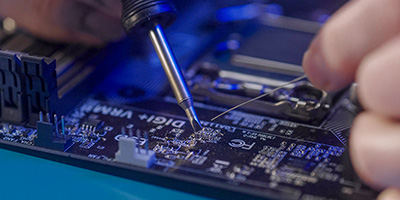
Usually, something physical and embarrassingly small. Connector contamination is a common source of optical trouble. Repeated connections wear instrument ports. A splice adds too much loss. Polarity is reversed in a multi-fiber cable. On a wireless site, an antenna can be misaligned or the RF environment can contain interference. Higher in the stack, timing slips, packets disappear or a service misses its promised latency.
EXFO's breadth is useful because failures do not respect product categories. A contractor may begin with visual inspection, measure optical loss, run an OTDR trace, validate Ethernet throughput and upload the result for a project manager. A lab may test a photonic integrated circuit, then a transceiver, then an end-to-end 1.6-terabit link. The competitive claim is less “our meter is clever” than “we can follow the evidence from component to live network.”
The alternative is not merely another test brand. It is sending a senior expert to every site, accepting manual spreadsheets and USB keys, or waiting for subscribers to report a fault. Competitors such as VIAVI, Keysight, Anritsu, Spirent, Yokogawa, VeEX and Fluke Networks attack parts of the same problem. EXFO's position is strongest where optical depth, field usability and a connected workflow matter together.
The price of certainty
EXFO generally sells by quote, which is normal for configurable professional equipment but makes casual comparison difficult. Instruments, modules, software options and service plans add up. Some practitioners describe premium test gear as expensive. The economic argument is that the relevant comparison is not another handheld gadget. It is a failed activation, a second truck roll, an idle construction crew, rejected production yield or data-center downtime.
The company gets paid several ways: outright sales of instruments and platforms; licenses or subscriptions for result management and automation; calibration and repair; extended warranties; training; and professional services. This mix matters because measurement equipment is not trustworthy forever. Calibration creates a recurring relationship, while cloud software makes a field result visible to supervisors and customers rather than leaving it trapped on a device.
Public-company filings offer one historical marker: EXFO reported US$265.6 million in revenue for fiscal 2020. Current revenue is not disclosed. A 2024-2025 sustainability report puts the global workforce at nearly 1,400, lower than the roughly 1,900 figure often carried by commercial databases. The difference is a useful warning: EXFO today is a private company, and old financial snapshots should not be mistaken for a current cap table.
Broadening, buying, then cutting back
EXFO spent years expanding beyond physical instruments. Acquisitions added wireless test, network topology, mobile analytics and service assurance. Yenista Optics, bought for US$11.1 million in 2017, strengthened high-end optical laboratory testing. Astellia added mobile-network performance and subscriber analytics in 2018. EHVA, acquired in 2022, brought automation for testing photonic integrated circuits.
The ambition was end-to-end visibility, from physical layer to application. It was strategically logical and operationally demanding. Hardware sold to field crews and enterprise software sold into an operator's operations center have different sales cycles, development rhythms and support burdens. In November 2025, EXFO sold its Adaptive Service Assurance division to Teleo Capital. The buyer created NumoData; EXFO kept a minority stake, and then-CEO Philippe Morin joined its board.
The sale is the clearest evidence of what changed the company's mind. EXFO said it wanted to deepen its focus on test-and-measurement innovation for the AI-driven expansion of fiber. This was not an abandonment of software - EXFO Exchange, automation and instrument intelligence still matter - but a pruning of a broad telecom-analytics ambition. The company that had spent years climbing the network stack chose to put more weight back near the photons.
The AI boom reaches the cable tray
AI infrastructure changes the scale of the testing problem. The familiar story is compute and electricity. The less familiar one is communication: accelerators must exchange enormous volumes of data, racks must connect across halls, and data centers must connect across campuses, cities and subsea routes. Every jump increases fiber count, connector density and speed. A flaw that was tolerable at a lower rate may become a blocker at 800G or 1.6T.
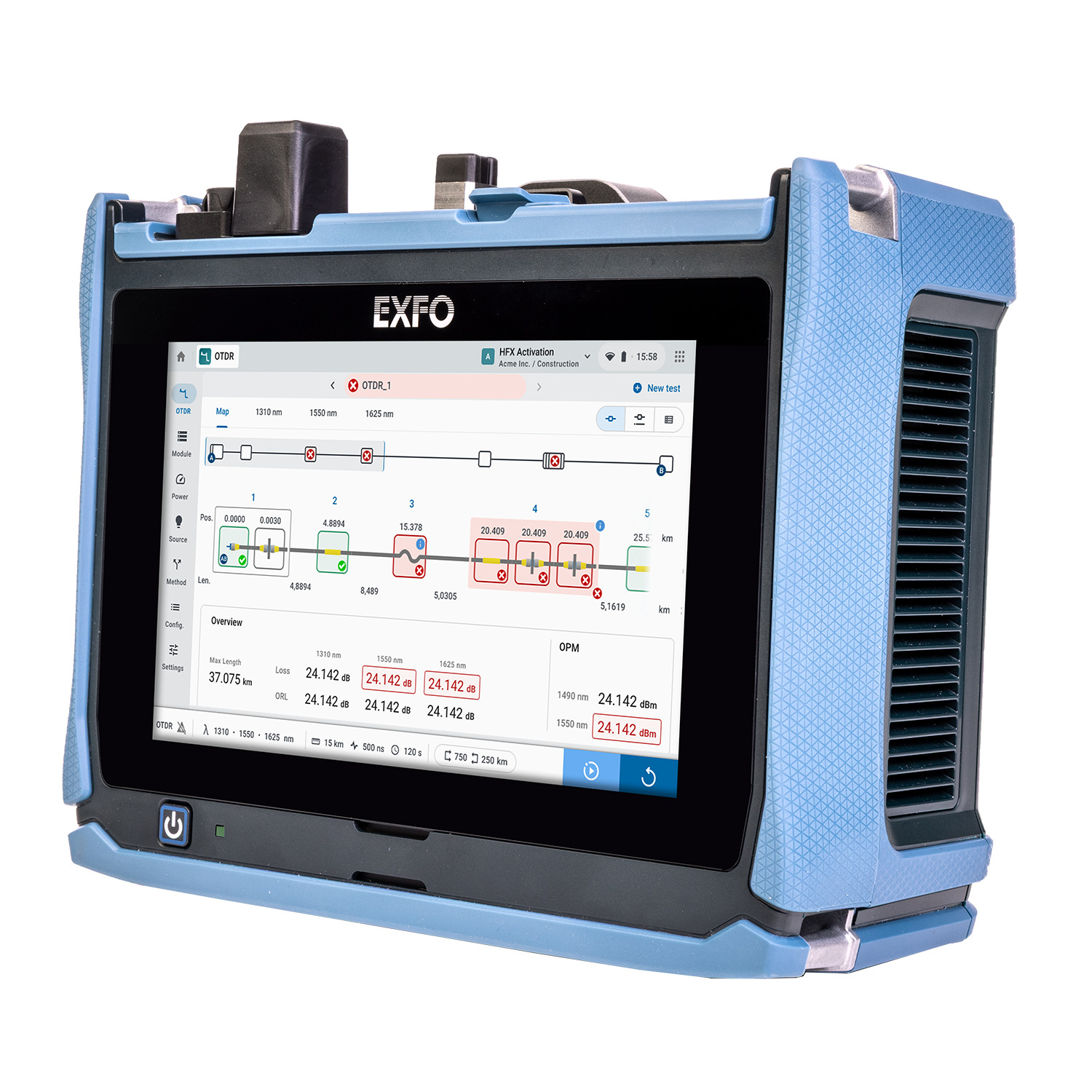
EXFO's 2026 releases show the new center of gravity. Its PXM and LXM tools test duplex and multi-fiber links; newer variants address native 24-fiber certification. The BA-1600-OSFP is a dual-port bit analyzer for 1.6T transceivers and interconnects, with up to 3.2T of total capacity. It measures bit and block errors, examines forward-error correction and supports automated workflows across lab, factory and live environments.
The machine's real trick is not the large number printed on the panel. Ultra-low error rates can take hours or days to prove by simply waiting for errors. EXFO uses block-error monitoring and FEC analysis to reach a defensible answer faster. At these speeds, test time is part of manufacturing capacity. A better measurement method can free the production line as surely as another machine.
What can a builder copy?
Start with one high-consequence uncertainty. Make the expert measurement usable by a non-expert. Save the evidence automatically. Then follow the customer's workflow in both directions - upstream into design and manufacturing, downstream into maintenance. EXFO did not begin by promising “end-to-end.” It earned the right to expand from a meter that solved one concrete problem.
The conditions of the bet
EXFO works best when errors are costly, measurements require expertise, assets live for years and customers need traceable proof. Regulated networks, large fiber builds, high-speed labs and multi-site operators fit that pattern. A broad installed base also creates an advantage: technicians know the interface, organizations have approved procedures, and calibration records matter.
When does the playbook fail? When the measurement is low stakes, commodity hardware is good enough, buyers do not value traceability, or a software-only observer can infer the answer without touching the physical layer. It also weakens when a company expands faster than its sales channels and product teams can integrate. EXFO's service-assurance divestiture is a reminder that adjacency is not the same as coherence.
Culture has to carry some of that complexity. EXFO lists teamwork, innovation, customer focus, empowerment, and people and community as its values. It offers hybrid work, an annual culture week, wellness and volunteering programs, and - where available - four weeks of work from anywhere. The language is familiar corporate fare, but one internal signal is more telling: employees in a company survey identified intricate problems as a prime motivator. That is a useful hiring filter for a business where dust can invalidate a link and an “eye diagram” is a normal Tuesday.
Lamonde took EXFO public in 2000 and led it back into private ownership in 2021. The transaction paid US$6.25 per subordinate voting share after a public contest involving rival VIAVI. Lamonde's explanation was personal and blunt: “I am a builder, not a seller.” In 2026, EXFO again lists him as founder, CEO and executive chairman. The title stack makes the governance obvious. This remains a founder's company.
Its larger lesson is equally obvious. Infrastructure fortunes are often built where glamour runs out. EXFO does not sell the video call, the 5G application or the AI model. It sells the answer to a prior question: can the network carry them reliably? Forty years ago, that answer came from a light source and a meter. Today it may require 3.2 terabits of test capacity. The job has not changed nearly as much as the number.
Go deeper
Explore EXFO's current products, watch demonstrations or follow the company's technical updates.