Imagine a checkout that refuses to finish. The application team checks its servers. Healthy. The cloud provider’s status page is green. Somewhere, a customer presses the button again. Every component has an alibi; the customer has an empty shopping bag. It is a hypothetical scene, but it explains the very real business Catchpoint has spent years building.
The company monitors the journey between a user and a digital service. That journey passes through networks, name servers, content delivery systems and other people’s software. A fault in any of them can become your complaint to answer. Catchpoint sells a way to work out where the trouble lives, preferably before the complaints arrive.
- What it does: tests websites, APIs and networks from outside the application, alongside real user monitoring.
- Who buys: enterprise operations, reliability and web teams with customers or employees spread across locations.
- The distinction: where a test runs, and which provider carries it, matter as much as what it tests.
- The new chapter: LogicMonitor completed its acquisition of Catchpoint in December 2025.
The founders stayed with the problem
Catchpoint’s founders met at DoubleClick: Mehdi Daoudi, Dritan Suljoti, J. Scotte Barkan and Veronica Ellis. In their 2021 recollection, planning began during a week in Daoudi’s Los Angeles garage in July 2008. A New York apartment became the first proper office. The garage was a short engagement; the monitoring problem proved rather more durable.
There was an opportunity to pursue something else. Daoudi recalled a venture capital firm suggesting in 2010 that they build an ad-serving company. Given their background, the proposal made sense. They declined. Google, Edgecast, FreeWheel and [24]7 were their first four customers, and the founders said all four remained customers when that interview took place.
“We haven’t changed our mission since day one.”
Mehdi Daoudi, co-founder · 2021

That persistence has a technical explanation. In its account of its synthetic-monitoring roots, Catchpoint describes tools that could detect trouble without adequately locating its cause. Detecting a slow page is useful. Knowing whether to call your developer, DNS supplier or network provider is considerably more useful at two in the morning.
A location is part of the diagnosis
Synthetic monitoring sends a programmed visitor to try an interaction: fetch a page, call an API, follow a transaction. Because that visitor can return on a schedule, teams can compare results across time and places without waiting for a human to encounter the problem. Catchpoint’s infrastructure makes those places a central part of the product.
Its node documentation distinguishes backbone connections, consumer last-mile networks, wireless networks and agents deployed within an enterprise. A test from a major data center answers a different question from a test carried by a mobile network. Internal agents help distinguish an application problem from the noise introduced by the public Internet.
The company currently advertises more than 3,000 global intelligent agents. That is a coverage claim, rather than a promise that every customer journey has a perfect double. The useful question for a buyer is narrower: do the available locations and providers resemble the people whose experience you need to protect?
User: choose test locations and connections that resemble the audience you serve.
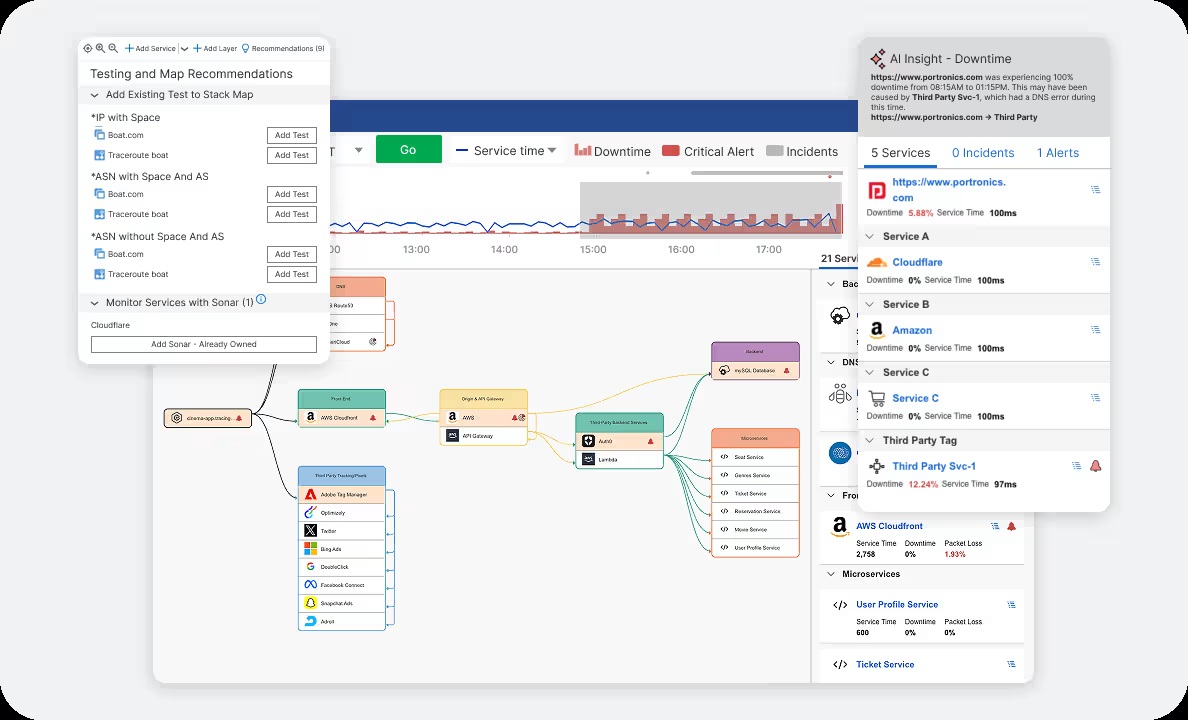
Simplified teaching diagram. Real requests may traverse additional services and take different paths.Catchpoint’s Internet Stack Map supplies another view: services, their relationships, test results and incidents on one dependency map. The map helps a team move from a symptom to a likely failing dependency. AI-generated root-cause suggestions are part of that view; they still merit investigation.
Tapad wanted to see the browser
The advertising technology company Tapad provides a concrete buying story. Its tags run on customers’ digital properties. Endpoint checks did not explain how those tags behaved inside an end user’s browser. In its published customer account, Tapad also describes considering Google Cloud checks, which did not provide the JavaScript execution it needed.
An internal build was another option. The team decided the effort would be too large. Catchpoint’s browser-based synthetic tests offered a way to validate products, examine performance outliers and test during customer onboarding without requiring customers to generate traffic first.
What changed the team’s mind was the need to exercise the code where it actually ran, combined with the estimated complexity of building that capability. This is a company-published case study, not a controlled comparison. Even so, its lesson is portable: before choosing a monitor, identify the behavior your existing checks cannot observe.
WebPageTest joins the longer journey
Catchpoint announced its agreement to acquire WebPageTest in September 2020. At the time, it said the service supported more than a million users a month. WebPageTest gives performance engineers waterfalls and filmstrips: evidence of what loaded, in what order, and what the page looked like along the way.
The October 2025 platform expansion added a broader continuous-monitoring context, including scheduled tests, alerts and shared dashboards. The attraction is understandable. A front-end engineer examining a slow page and an operations engineer examining a troublesome dependency can work from connected evidence.
Real User Monitoring adds observations from actual sessions. The documentation describes website instrumentation with a JavaScript tag and tools for filtering performance data. Session Replay, announced in September 2025, adds playback of browser interactions correlated with waterfalls. Synthetic tests supply repeatable questions; real sessions show what people actually encountered. Neither view contains the whole customer experience by itself.
What the monitoring bill buys
Catchpoint operates as enterprise subscription software, with professional services and onboarding alongside the platform. Its expertise includes browser testing, DNS, Internet routing, network reachability and incident analysis. The services offering includes help setting up tests, dashboards, alerts and integrations. Buying monitoring also means deciding what deserves attention.
AppAssure’s published starting price for the first year, for one application.
Published October 2024. Coverage is bounded; current pricing and scope require a quote.That figure comes from Catchpoint’s AppAssure introduction, which describes application-focused packages with setup and onboarding. It is useful precisely because it has boundaries: an application, selected tests, locations and monitored services. Enterprise node documentation separately describes both point-based usage and flat monthly licensing. A quote only becomes comparable when those choices are explicit.
There are alternatives. Cisco ThousandEyes competes for Internet and network visibility; broader observability vendors offer overlapping synthetic and digital experience tools. Catchpoint itself positions its platform alongside Datadog and Dynatrace. The buying decision turns on the missing evidence in your current stack, rather than how many dashboards you can accumulate.
Five seconds, and a larger parent
Heartbeat Monitoring, announced in November 2025, offers checks as frequent as five seconds. Its initial deployment options included cloud and enterprise agents. The target is the brief disruption that can fall between conventional checks. Faster sampling reduces that gap; it does not make every incident preventable.
On December 2, 2025, LogicMonitor completed its acquisition. Bloomberg reported a price of more than $250 million in cash. The deal brings infrastructure monitoring together with Catchpoint’s Internet perspective. Gartner’s public assessment cautioned that the result depends on the depth and speed of technical integration. An acquisition announcement is a beginning, not proof that every workflow has converged.
Start with one journey
The idea a reader can copy is modest. Pick one important transaction. Identify the services it depends on. Test it from representative connections. Compare those repeatable tests with actual user data. Decide who will investigate when the results diverge.
It takes judgment. A scripted visitor cannot explore every unexpected path a human takes. A location that misses your audience may reassure you for the wrong reason. An alert without an owner merely makes a noise. And evidence about an external provider does not give you control over it; you still need a response, a workaround or a supplier conversation.
Catchpoint’s useful proposition is that you can measure beyond the boundary of what you own. The customer already experiences everything beyond that boundary. Your monitoring ought to make the trip too.
Take a closer look
Catchpoint website · Run a WebPageTest · Company blog · Newsroom
LinkedIn · X · Facebook · GitHub
WATCH THE TOOLS AT WORKInternet Stack Map introduction on YouTube ↗
Catchpoint Tracing demo ↗
Map Your Internet Stack webinar ↗
Catchpoint’s YouTube channel ↗