At Sonoma in September 2016, Evan Slavik had a rather immediate family matter to attend to. His father, Jim, was approaching on the race circuit. Evan held his line; Jim passed at Turn 3a. Later, the elder Slavik described his pride in his son, who had spent the weekend gaining experience in a Zoro Racing car. It is a small scene, but an appealing one: two generations of a business family, briefly occupied with something considerably more urgent than a board agenda.
There is no need to turn the corner into a management parable. Racing supplies enough entertainment on its own. Still, the episode gives a human scale to a career now associated with enormous parcels of land, construction schedules and investment decisions. A development plan can cover thousands of acres. A family encounter can occupy a few seconds.
Slavik is now chairman and chief executive officer of Mark IV Capital, the Newport Beach investment firm his family helped establish. He became CEO in 2023 and chairman in 2026. One of the projects associated with his leadership, Victory Logistics District in Fernley, Nevada, covers 4,300 acres. Its future is being assembled through buildings, power planning, land transactions and a railway connection. A person can drive a lap quickly. The industrial landscape requires a different arrangement with time.
A family business, with a construction education
The Mark IV story starts well before Evan’s arrival. In the 1930s, Elmer O. Slavik ran a printing company and offered to print a catalog for industrial supplier W. W. Grainger in return for equity. The exchange connected the family to a business whose products belonged to the working world: equipment, maintenance and the everyday necessities of keeping things operating.
In 1974, Elmer R. and Donald Slavik, assisted by Elmer’s son James, started Mark IV Properties as a way to diversify. Real estate became a business of its own. The company later adopted the Mark IV Capital name as its investment activities widened into private equity. The family history contains a useful change of scale, from a printed catalog to properties and investments held across decades.
Evan, James’s son, grew up in Irvine. His professional background includes commercial construction management at Snyder Langston, delivering different kinds of projects throughout Southern California. He earned an undergraduate degree at the University of Southern California, followed by graduate degrees in real estate development and business administration. That combination put construction, property and business on the same educational map.
He joined Mark IV in 2012. By 2019, he was serving as president of real estate. He became a company director in 2021. His path through the firm therefore preceded the chief executive title by more than a decade. Construction management was part of the record before the family succession became the headline.
When he took over as CEO in 2023, he succeeded the retiring Paul Cate, who had led the business for 24 years. Slavik credited Cate with building the operational and financial foundation for its next chapter. Family businesses have surnames on their histories, but they also have colleagues who spend long stretches making those histories possible. His acknowledgment gave that continuity a name.
The acreage comes with a calendar
Victory Logistics District gives Slavik’s approach its most visible geography. Mark IV acquired the 4,300-acre site in July 2019. In 2021, it launched construction on the first phase. Redwood Materials subsequently leased the 815,215-square-foot initial building for incoming battery components used in its recycling operation. Here was a specific tenant, with a specific use, inside an industrial plan that could otherwise be difficult to picture.
Further distribution buildings followed. In February 2024, construction partner PREMIER Design + Build announced substantial completion of buildings B, C and D2, totaling more than a million square feet. Their practical details included clear heights ranging from 36 to 40 feet and rows of dock positions. Architecture in this setting earns its keep through the work that can happen inside it.
Slavik’s own 2024 account of the project described almost two million square feet completed, with the next emphasis on master planning and infrastructure for future distribution, manufacturing and data-center space. The distinction matters. Completed space is a physical milestone. A future development program is a sequence of decisions still to be made and work still to be done.
“We are taking a long-term approach to our real estate.”
Evan Slavik, 2023
Acreage is an impressive number to put on a presentation. It also creates obligations. Every proposed use has to connect to a larger system. A tenant needs access, utilities and a building that suits its operation. A later phase depends on earlier choices. A master plan is only as useful as the coordination that allows an actual business to occupy its next address.
That is why the project’s gradual development is central to Slavik’s story. The scale encourages a long view, while each phase demands a near view. Someone must keep both in focus. The photograph of a finished warehouse and the map of future sites belong to the same project, but they describe different moments in its life.
Land area, completed buildings and future uses describe different measures of progress.
The cloud has a power bill
In 2025, Microsoft acquired 300 acres at Victory. The transaction added a different kind of business prospect to the development’s public story. Distribution space moves goods. Data centers support the systems that move information. Both occupy real ground, even if the language of digital infrastructure sometimes makes the second activity sound weightless.
Slavik’s explanation was refreshingly physical. Asked about the difference between data centers and more conventional property types, he identified power. His discussion included plans for on-site energy generation. Those plans described an approach to meeting future demand; the land sale itself was the completed transaction.
“Power is the most significant difference.”
Evan Slavik, 2025
The comment brings the conversation down to earth. A building’s square footage alone cannot explain what a data-center project requires. Its electricity needs change the problem a developer has to solve. An attractive site and an available parcel are pieces of the answer. Energy delivery belongs beside them.
For Slavik, the shift expands the range of uses that Victory might accommodate. It also complicates the work of planning. A place intended for several kinds of industrial activity has to make room for their different requirements. The future occupants may share a district without sharing an identical checklist.
A railway earns its ceremony
On August 20, 2026, Mark IV marked another completed piece of that system with a Silver Spike Ceremony. Victory’s industrial rail spur connected the district to the national rail network. Slavik delivered remarks alongside colleague Rick Nelson, Congressman Mark Amodei and Nevada economic-development official Tom Burns. The guest list reflected the number of interests that converge when a private project becomes regional infrastructure.
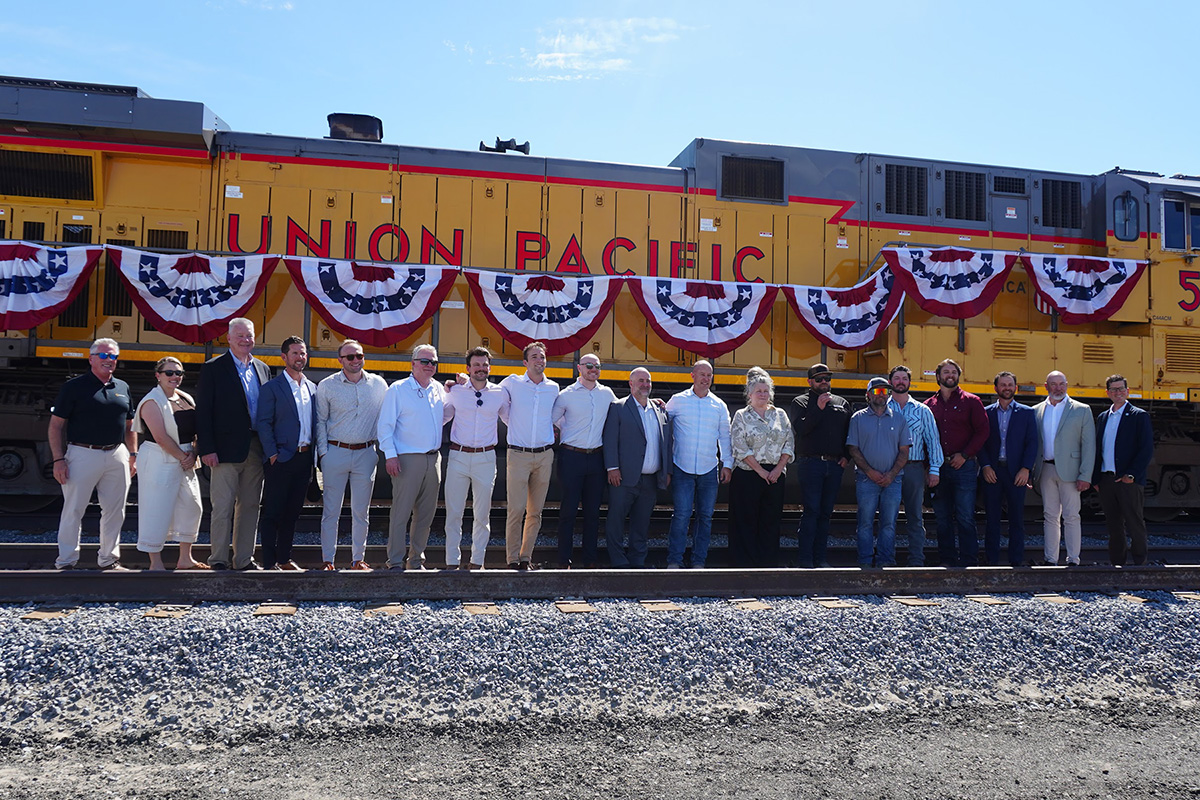
The new connection comprises more than a mile of Union Pacific track, with three run-around tracks serving 100 acres of rail-ready industrial land. The specifications are less theatrical than the ceremony, but more revealing. They describe what the connection can support. Rail access gives potential industrial users another way to move freight alongside highway transportation.
Slavik framed the addition as part of the effort to attract manufacturers and support employment in the region. The completed rail link is one concrete result; the businesses and careers he hopes it will attract are the next part of the story. Ceremonies are allowed a flourish. The work that follows still has to fill the tracks with a purpose.

The people required to fill the space
Slavik’s public account of development also extends to the people who might work there. In 2024, Mark IV joined an initiative with SkillUp Coalition and Western Nevada College to connect employers, training and job seekers in Northern Nevada. He spoke about the need to bring skilled workers into the businesses for which the company was building space.
That relationship is easy to overlook when the discussion revolves around acreage. Buildings provide capacity. Employers need people who can use it. Training and job connections introduce another timetable, one shaped by individual circumstances rather than construction progress. The collaboration placed those timetables in the same conversation.
His institutional commitments include the Board of Trustees of Harbor Day School and the board of USC’s Tavakoli Center for Real Estate. These are specific connections to education, alongside his executive work. In Fernley, Mark IV also established a regional office at Victory, bringing a local working base to a project managed by a company headquartered in Newport Beach.
A different kind of district in Texas
Slavik’s responsibilities stretch beyond the Nevada desert. In Round Rock, Texas, Mark IV is developing The District, a mixed-use project on land acquired from Dell. An $86 million construction loan supports its initial phase, with BDT & MSD Partners providing the loan and an Apollo affiliate participating. The financing is attached to a development phase, rather than a valuation of the company or its chief executive.
The program includes 316 residences above approximately 23,000 square feet of ground-floor retail, as well as a food-and-beverage plaza. This is a different arrangement of daily life from a logistics district. Homes, shops and places to eat have to work together at street level. The common task is still to turn a large plan into a sequence that people can actually use.
Mark IV celebrated its fiftieth anniversary in 2024. Slavik thanked the people who had contributed to its history and the celebration. Two years later, he added the chairmanship to his role. His public record now moves between generations of a family company and phases of developments whose full shape will emerge over time.
The Sonoma moment remains a useful place to leave him. His father was proud of how he held his line. In the business, the route is longer, and there are more people to bring along. The next visible milestone might be a building, a new tenant or another piece of infrastructure. Slavik’s stated long view gives those individual steps somewhere to go.