Rain is an awkward business partner for a car wash. It arrives without an appointment, discourages customers and offers no apology. At a September 2023 council meeting in Bensalem, Pennsylvania, Trevor Sperry was asked whether a proposed wash would close in bad weather. His answer concerned the employees: they would come in, do other work indoors and get paid. ↗
The exchange is a useful place to begin with Sperry, co-founder and CEO of Olympus Pines. A conversation about land development had reached the daily question of who carries the cost when business slows. A financial model can put weather in a sensitivity table. A worker meets it on a schedule.
That small distinction runs through his business story. He has worked in banking, government and management consulting. He now helps develop and operate retail businesses, including Tommy’s Express car washes. The interesting part is how those earlier worlds meet a place where customers expect a clean car and employees expect a dependable working life.
Three institutions, then a business of his own
Sperry began his career at J.P. Morgan, then became an aide to the chairman of the Senate Committee on Finance. He later worked as a management consultant at Boston Consulting Group. His education includes BYU’s finance program, an MBA from MIT and an MPA from the Harvard Kennedy School. ↗
The sequence places him at three different distances from a business. A banker works with money and its allocation. A congressional aide works near the rules governing economic activity. A consultant advises organizations on their decisions. Running a company brings those decisions down to an address, a team and an operating day.
For Sperry, that address can be a commercial corridor rather than a glass office tower. The work still involves finance and strategy, but a development proposal also has to account for a driveway. A good spreadsheet cannot persuade a car to fit where there is no room.
Within the Olympus Pines management team described for PPR’s Opportunity Fund I, Sperry’s remit is strategy and finance. His co-founder, Michael Cianelli, is assigned operations and marketing. Cianelli’s background includes Navy fighter aviation, Apple’s supply chain and iPhone marketing, and industry partnerships at Boom Supersonic. Together, they bring financial planning and operating experience to the same enterprise. ↗
A career path behind the cash register
Sperry’s interest in retail work has a personal beginning. He described an older brother who worked hard in retail but could not get promoted. He went back to school seeking a way to create better jobs. He and Cianelli considered several industries before choosing car washes as a place to pursue that aim. ↗
This is a more revealing origin than a fondness for immaculate vehicles. It puts advancement at the center of the enterprise. A job can be busy, useful and demanding while offering very little room to move. Building a company around that problem requires attention to what happens after somebody is hired.
In March 2023, discussing a planned Manassas location, Sperry described Olympus Pines as a company offering employees ownership in its locations. The project was expected to create more than 15 jobs. The ownership statement was part of his explanation of what the company would bring to the city. ↗
Ownership is a consequential word in a discussion of hourly work. It asks the reader to think about the employee’s relationship to the business over time. The useful questions become practical ones: how participation works, how a person develops and how responsibility grows. A mission becomes interesting when it reaches the employment agreement.
“offers all employees ownership in our locations”
Trevor Sperry · Manassas, 2023 ↗
The parking lot has questions
In December 2022, Sperry discussed a proposed car wash in Phoenixville, Pennsylvania, on a tract beside a former Kmart. He explained the glass building and a system for recycling water beneath it. Residents raised traffic concerns. A local coffeehouse owner also asked about a traffic study and the impact of another coffee shop proposed for the property. ↗
It is a familiar collision of perspectives. A developer sees a new use for a site. A neighbor sees the route home. An existing business sees another competitor. None of those views disappears because a project has an investor. The meeting gives each concern a chair.
Charleston brought a different test. In June 2023, Sperry was among the presenters for a proposed Tommy’s wash in West Ashley. He explained that the building footprint and operating layout were standardized, while materials and exterior facades allowed more flexibility. The design review board denied the conceptual application, voting seven to zero. ↗
That result belongs in the story alongside the financing announcements. A repeatable operating layout has commercial value; a neighborhood has a visual character of its own. In that meeting, the proposed adaptation did not satisfy the board. Expansion required another encounter with the design, rather than a straight line from investment to opening.
Sperry’s role in these discussions makes the word operator tangible. He is explaining the business at the point where it touches a town. Capital may travel easily between markets. Buildings, queues and neighbors stay put.
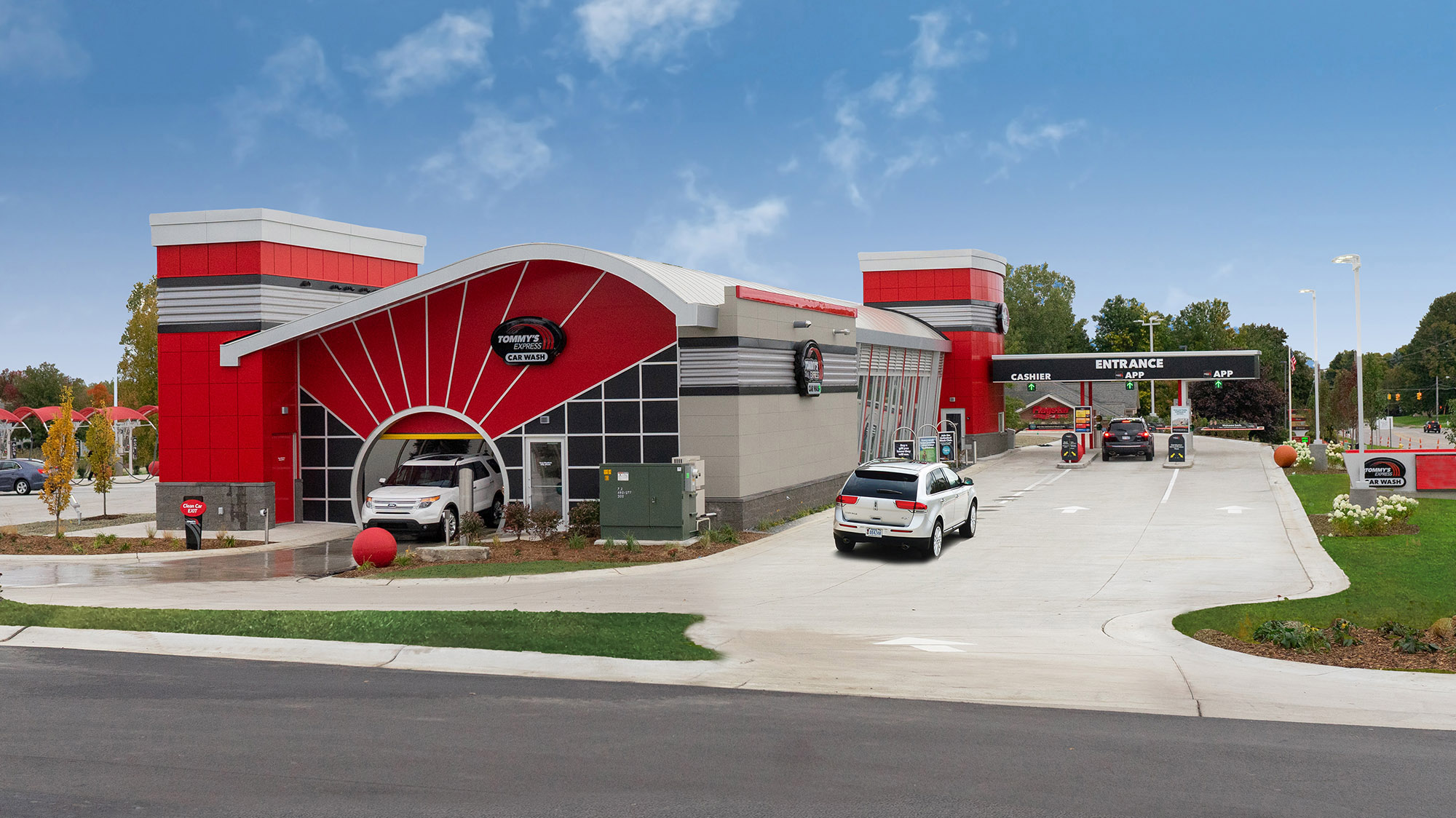
A car wash with several balance sheets
Olympus Pines organizes its work around retail development, acquisition and management. Those activities describe different stages of involvement: creating a place to trade, buying into an existing business and managing what happens there. For its CEO, the scope extends beyond selecting an investment. ↗
Tommy’s Express is the brand featured in Olympus Pines’ retail portfolio. A franchise gives an operator an established identity and operating format. The examples in Pennsylvania and South Carolina show where that format meets the particularities of a site: access, neighboring uses, exterior design and the flow of vehicles. ↗
Think of the business as a set of promises made to different people. Investors need the use of capital to make sense. Customers need the service to work. Employees need a reason to stay and develop. A town needs the proposed use to fit. Each promise can be discussed separately, but the operating company has to keep them in the same building.
This is the appeal of looking closely at an ordinary service business. The product is easy to recognize. The organization behind it is less visible. Finance, training, customer service and property development all sit behind a transaction that a customer may remember only as a few minutes in a tunnel.
The money arrives with a longer to-do list
On February 9, 2024, Olympus Pines announced a $105 million financing package consisting of debt and equity. Keystone National Group and the Real Asset Investor led the round. The company identified development projects in the greater Washington and Philadelphia areas, Charleston and San Antonio, with the capital intended to support expansion and operations. ↗
Debt and equity are worth keeping distinct, even when they share a headline. The announcement described a combined capital package. Its purpose was to give the business more capacity to develop and operate across markets. That increases the amount of work the organization must coordinate as well as the resources available to it.
In their joint statement, Sperry and Cianelli thanked their partners and connected customer and investor value with the long-term development of employees. The language joined the commercial ambition to the people expected to carry it out. Both subjects appeared in the same announcement. ↗
By October 2026, the company’s website displayed $400 million in capital deployed, more than 300 jobs created and more than 60 transactions closed. It gave 2020 as its founding year. These are company-reported figures across the business; they describe capital use, employment creation and deal activity, rather than Sperry’s personal wealth. ↗
The three figures also count different things. A transaction is an event. Capital deployed measures money put to work. A job implies an ongoing relationship with a person. Reading them together suggests the range of responsibilities attached to growth, without pretending that one number can stand in for the others.
A colleague, a dad joke, a five-minute slot
Andrew Towne, an Olympus Pines business partner, has described Sperry and Cianelli as humble colleagues with shared values and goals. He spoke about enjoying their meetings and the chance to help shape a young firm’s hiring, culture and processes. It is a colleague’s account of working with them, focused on everyday collaboration. ↗
Sperry’s public LinkedIn activity includes a lighter announcement: he had been voted number one dad for the third year running. The joke borrows the language of professional recognition and relocates the judging panel to home. Its charm lies in the modest size of the electorate. ↗
That glimpse is useful without turning it into a theory of his personality. A founder can speak seriously about finance and still enjoy the ceremony of an entirely unofficial award. The joke supplies a little air around a biography otherwise full of institutions, titles and operating responsibilities.
The March 2026 Beverly Hills Investor Summit agenda listed Sperry for a five-minute session titled “Scaling an Institutional Platform to $100M+ in Revenue.” The listing identifies his speaking topic; it does not independently establish Olympus Pines’ revenue. It places him in a conversation about building an organization large enough to operate at institutional scale. ↗
Five minutes is an efficient allocation for a subject that can consume years. The question beneath it is how an enterprise keeps its working habits as it becomes larger. Hiring, delegation and standards have to travel alongside the capital. Otherwise growth produces more locations without producing an organization that can manage them.
What the weather reveals
The most useful way to follow Sperry’s story is to keep those two scales in view. There is the scale of investment: financing, transactions and geographic expansion. There is the scale of a working day: the shift, the customer, the manager and the prospect of moving ahead. Olympus Pines’ stated ambition brings them together.
A company can announce its intentions in a paragraph. Employees encounter those intentions through many smaller decisions. Who gets trained? Who takes on responsibility? What happens when customer demand falls? Those questions give the ambition a form that people can actually experience.
The Bensalem exchange offers one such decision. Bad weather reduced the reason for customers to visit. Sperry said there would still be work for employees to do indoors. In a story involving large sums and several institutions, a rainy day supplies a remarkably plain measure: whether the person on the schedule still has a paid day.