On July 8, 2014, Frank Loverro had a practical point to make to a room of pension investors in New Mexico. When Kelso called money for an investment, its partners supplied capital alongside the outside investors. When a business was sold, money went back to investors transaction by transaction. A discussion about private equity had arrived at the part where somebody actually writes a cheque.
It is a useful place to begin with Loverro. He had already spent more than twenty years at Kelso, the New York investment firm he joined in 1993. He was speaking about the mechanics of a partnership in which he worked. The explanation connected the people selecting businesses with the people financing them. In an industry rich in presentations, a capital call has the advantage of being rather difficult to mistake for a compliment.
Today, Loverro is Kelso’s co-chief executive officer, a member of its management committee and an investment partner. His route to that position runs through one firm, several kinds of business and a growing collection of responsibilities. The interesting question is what happens when an investor stays long enough to live with the institutional habits he helps carry forward.
The committee voted six to zero to forward a recommendation for a commitment of up to $60 million to Kelso’s ninth fund. After the discussion, its chair thanked the firm for including a glossary. There is something reassuring about that small administrative detail. Even a room entrusted with pension money benefits from having the vocabulary explained. Loverro’s description of capital moving into and out of investments belonged to the same practical task: making an arrangement understandable to the people being asked to join it. The partnership needed a decision from them, and they needed a clear account of what participation meant.
The years between joining and leading
Before Kelso came First Boston. Loverro spent three years in its private equity investment and high yield finance groups. The two disciplines sit close to the same problem: how a business is financed, and what its operations can support. One looks at ownership; the other brings debt into the picture. Both require an investor to think beyond the attractiveness of a company’s products.
He received a bachelor’s degree in economics with distinction from the University of Virginia in 1991. Two years later, he joined Kelso. The dates put his university education and early finance work near the beginning of a career that would become unusually easy to follow on a calendar. There is one long institutional line, with new responsibilities appearing along it.
He became a managing director in 2004 and joined the management committee in 2013. In 2016, he became co-CEO. Twenty-three years separated arrival from the chief executive title. That interval matters to the story: the eventual leader had worked inside the partnership well before he was responsible for helping lead it.
Length of service cannot tell us whether any particular investment was wise. It can tell us something about exposure to consequences. A colleague who remains through successive funds is around when earlier choices become operating results, when a management relationship needs attention, and when an optimistic plan encounters a less cooperative market. The calendar provides continuity; judgment still has to do the work.
The owner at the other end of the table
Kelso’s ownership philosophy predates Loverro. Louis Kelso, the inventor of the Employee Stock Ownership Plan, argued for shared equity ownership among employees, managers and shareholders. The firm carries that inheritance into its account of how it invests. Loverro entered an organization with an existing idea about who should participate in ownership.
That distinction is important. He did not found Kelso. His career is about working within, and eventually helping lead, an established partnership. Founding stories tend to get the attention because they come with a clean opening scene. Maintaining an institution is less tidy. It requires people to keep making decisions after the founding principle has become familiar enough to sound obvious.
At the 2014 pension meeting, Loverro linked Kelso’s accumulated experience and continuing relationships to its ability to find opportunities in a competitive market. His argument gave tenure an economic purpose. Knowing an industry and knowing the people inside it could help a firm see possibilities that a broad market view might miss. The claim was about using memory, rather than simply possessing it.
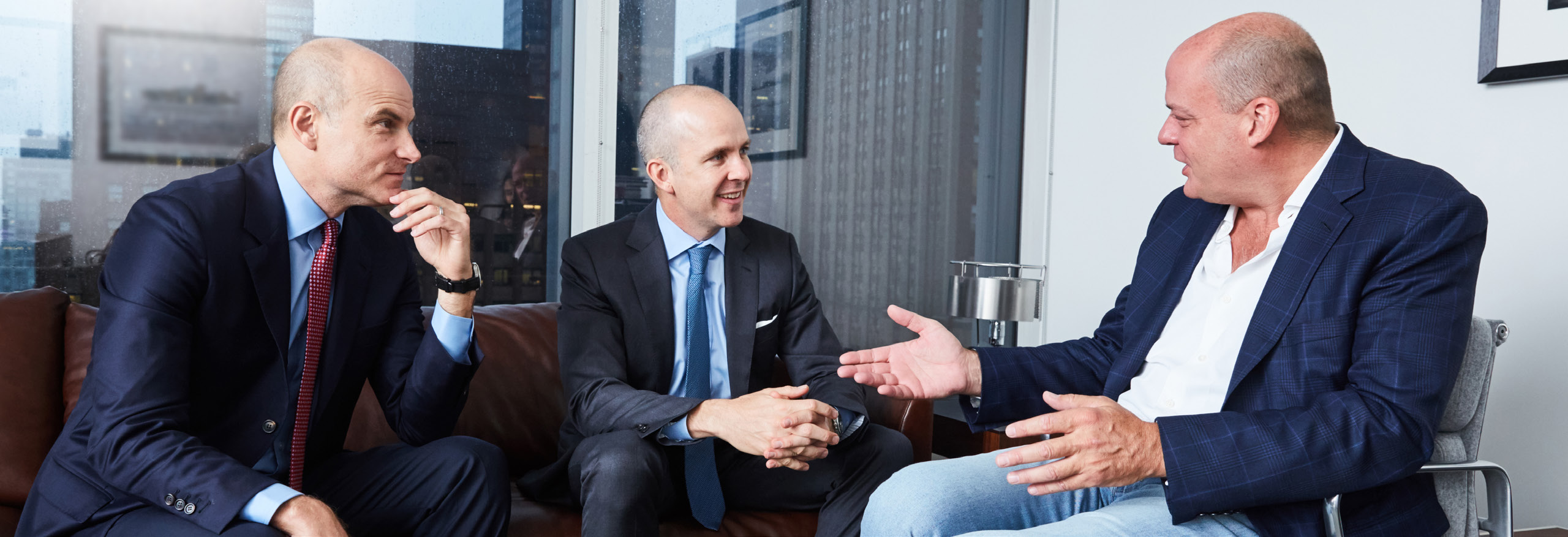
The photograph gives the idea a human scale. Loverro sits beside Sandy Osborne while Forrest Wylie gestures across the group. A photograph cannot disclose what was said, or prove the quality of a partnership. It can show the people attached to the abstractions. Here, the investment business has faces, chairs and a conversation, instead of another diagram with arrows pointing upwards.
A cheque inside the headline number
In October 2023, Kelso announced the closing of Fund XI with $3.25 billion in commitments. More than $400 million came from its partners and employees, representing over 12% of the fund. The headline figure described the vehicle’s size. The commitment within it described how much of that vehicle the people at Kelso were helping finance themselves.
Total capital commitments
More than 12% of the total
Personal investment does not make a business immune to mistakes. It puts some of the decision makers’ capital at risk alongside their clients’. That is a narrower, more useful proposition. It gives ownership a financial consequence without pretending to settle every question about incentives, operating performance or the timing of a sale.
“We are deeply grateful for the support from investors”Chris Collins and Frank Loverro, joint statement, October 2023
The statement was shared with Chris Collins, Loverro’s fellow co-CEO. Collins joined Kelso in 2001 and co-leads its financial services practice. His earlier route included Stonington Partners and business school at Stanford. Two career paths meet in the same executive role, bringing different experience into a firm organized around investment partnerships.
Later in 2023, Kelso announced the pair as keynote speakers for a Sahar Global Summits fireside conversation on general partner ownership and economics. It was an apt subject for executives whose firm’s fundraising figures include substantial employee participation. Ownership can occupy an entire conference discussion. It also has to survive the much shorter instruction to transfer the money.
Terminals, pipelines and the work after the purchase
Loverro’s board history includes Buckeye Partners, Tallgrass Energy, Ajax Resources, Delphin Shipping and Eagle Bulk Shipping. He currently serves as a director of Zenith Energy. This is a set of businesses connected to physical movement: fuel, cargo and the infrastructure through which commerce travels. The names place part of his work close to operating assets.
Kelso’s investment in Ajax dates to 2015. The company focused on oil and gas development in the Permian Basin. Zenith, an investment dating to 2017, operates, builds and acquires terminals and related infrastructure across North America. These assignments sit at different points in the energy business. Production and storage bring distinct operating questions to an investor’s desk.
He is also listed among the Kelso team associated with KAR Auction Services. That investment offers a compact example of a repeat relationship: Brian Clingen had been CFO of Universal Outdoor, an earlier Kelso business, before working with the firm on vehicle auctions. The connection carried experience from one company into another assignment.
KAR combined ADESA and Insurance Auto Auctions in 2007 and went public in December 2009. The episode shows why the period after a purchase deserves attention. Combining businesses involves decisions about leadership, operations and the work of integration. A transaction creates an ownership structure; the following years determine what that structure can accomplish. Loverro’s place was within a team, and the story belongs to that team and its managers.
The institutions beyond the investment committee
His University of Virginia connection continued after the economics degree. Loverro is an emeritus trustee of its College Foundation and co-chairs the foundation’s New York Regional Board. The relationship has moved from receiving an education to helping sustain the institution that provided it. It adds another long line to his biography, running alongside the one at Kelso.
He is also a trustee of Greenwich Country Day School and Prep for Prep. A public board biography places his home in Greenwich with his wife, Kristina, and their three daughters. The school and university commitments give the career a setting beyond the office, without requiring a theory about his private motivations. They are responsibilities he has publicly taken on.
In June 2026, Kristina and Frank Loverro were among the event chairs for Prep for Prep’s Lilac Ball. The gathering raised $4.7 million for the organization’s programming and honored both Frank Bynum and Kelso. Loverro’s role was one part of a much larger effort. The event brought students, families, alumni and supporters together around educational opportunity.
There is a temptation to fit every activity in an investor’s life into the language of returns. A school trusteeship deserves better than that. Its purpose has its own terms. What links these commitments to the professional chronology is the presence of institutions that continue beyond a single occasion, and of people who accept a role in keeping them going.
Loverro’s story comes back to the distinction he described in 2014: the person making the investment decision also participates in financing it. Since joining Kelso, he has moved from early investment work into shared leadership while remaining inside the same partnership. Staying has given him a long view of that arrangement. The cheque gives it a price.