Howard Hoffen has a credit on Glengarry Glen Ross. For someone who has spent decades investing in businesses, helping bring David Mamet’s play about salesmen to Broadway is an entertaining addition to the résumé. Finance supplies enough dialogue of its own. Here, at least, someone else had already written the script.
His name appears with Lynne and Marvin Garelick among the producers of the 2025 revival. Sandra and Howard Hoffen also co-produced Gypsy, which opened in December 2024. One production concerns selling. The other concerns ambition, performance and a mother’s determination to get her children before an audience. Neither is an obvious companion to an engineering degree.
Yet they make an inviting place to begin. Hoffen is chairman and chief executive of Metalmark Capital, the New York investment firm he helped establish in 2004. His working life reaches back to Morgan Stanley in 1985. Beyond that long financial chapter are theatre credits, music education, university commitments and a painting donated to a public museum.
Look across those activities and a recurring feature becomes visible: his name appears beside other names. Colleagues at a new firm. Fellow directors. Co-producers. Sandra Hoffen on a scholarship and an artwork. Collaboration offers a way to read this career, provided we keep the particular people and projects in view.
1985: an engineer enters Wall Street
Hoffen graduated from Columbia’s engineering school in the class of 1985. He also earned an MBA from Harvard Business School. Engineering is an interesting starting point for an investor whose later board service would extend into energy and industrial businesses. It supplies a concrete detail before the financial titles begin.
In 1985, he joined Morgan Stanley. A year later, he moved into Morgan Stanley Capital Partners. The distinction matters. His history at the bank and his history in its private equity operation begin in adjacent years, rather than collapsing neatly into a single founding date.
He eventually oversaw Morgan Stanley’s private equity businesses, including Capital Partners, Venture Partners and Global Emerging Markets. He also served on the management committee of Morgan Stanley Investment Management. From 2001 to 2004, he was chairman and chief executive of Morgan Stanley Capital Partners.
That progression gave him a long apprenticeship inside an institution before he helped create a separate one. By 2004, he had been at Morgan Stanley for nineteen years. The next step involved an established group of investment professionals and funds already in existence. The new firm would begin with working relationships, obligations and an investment history.
Columbia Engineering graduate
Morgan Stanley
Morgan Stanley
Capital Partners
Chairman & CEO
of MSCP
Metalmark
takes shape
New firm, familiar colleagues
The plan for Metalmark was unusually explicit about continuity. A team led by Hoffen, with senior colleagues including Eric Fry and Michael Hoffman, would establish an independent firm to manage Morgan Stanley Capital Partners IV and certain related funds through a sub-advisory arrangement. Morgan Stanley would remain involved in the funds while the new organisation performed its assigned investment role.
It is a useful distinction between a new business and a blank sheet of paper. Metalmark’s formation separated a team from a bank without making the accumulated work disappear. For Hoffen, becoming a founder meant carrying an existing practice into a different organisational setting.
There were further changes. Metalmark became part of Citi in 2008. In December 2013, the firm announced that it was no longer a Citi affiliate, following an agreement prompted by new regulatory requirements. Citi retained its limited partner interests in Metalmark Capital Partners II. Metalmark continued making the operational and investment decisions.
At that moment, Hoffen chose to emphasise the length of the working relationships. “My colleagues and I have worked together for more than 20 years,” he said. The sentence gives the transition a human timescale. Two decades is long enough for colleagues to have worked through several versions of the same business.
“My colleagues and I have worked together for more than 20 years”
Howard Hoffen, December 2013
The following year, Lexington Partners agreed to acquire most of Citi’s fund commitment. Again, there was a change around the investment vehicle rather than a wholesale replacement of the people running it. The sequence is a reminder that a firm’s ownership, its funds’ investors and its management team are related but distinct parts of the story.
The founder still has a name
Today, Metalmark describes its focus as growth equity for founder-owned businesses in the middle market, primarily companies with growth objectives in North America. Its approach includes acquisition programmes, active ownership and an executive network. Those are institutional commitments, and they give some substance to the business Hoffen leads.
A founder-owned company brings a particular relationship into an investment discussion. Someone has built the organisation and may still feel personally attached to its culture, employees and future. Metalmark’s stated approach recognises the importance of that history. An investor arriving with capital also arrives in the middle of somebody else’s story.
The firm’s work can include helping strengthen an executive team, assessing financing options and supporting acquisitions. Buying another business is only one part of the process. Negotiation, financing and integration all sit within the firm’s description of what it helps portfolio companies do.
That makes the phrase active ownership worth unpacking. It implies a continuing role after the transaction, with decisions about people, operations and expansion still ahead. The closing dinner may be pleasant. It is an awkward place to declare the work finished.
Hoffen’s own directorships give this approach a practical setting. His current Metalmark biography includes EnerSys, Monarch Midstream, Northeast Natural Energy, PetroSantander, PTW Energy Services, Renewable Biofuels and TP Host. These are separate businesses with separate boards. The list places him within the continuing work of corporate oversight.
A chair can move
One episode from 2007 captures the difference between keeping a title and keeping a relationship. Renegy asked Hoffen to resign from its board to help satisfy Nasdaq listing requirements for a proposed business combination involving Catalytica Energy Systems and renewable energy operations.
The issue concerned how shares managed under Metalmark’s Morgan Stanley sub-advisory arrangement would count towards the public float. His resignation would permit those shares to be included in the calculation. He agreed, with plans to serve as a special adviser to the board and chief executive after the combination closed.
Hoffen said he looked forward to continuing to advise the company. The episode is striking because the formal retreat was intended to help the transaction proceed. Board service sometimes asks for participation through a different mechanism. Here, the requested change had a precise corporate purpose.
Elsewhere, his tenure has been lengthy. Hoffen joined the EnerSys board when the company became publicly traded in July 2004. Its July 2026 proxy lists him as an independent director, with a term scheduled to expire in 2028. Over twenty-two years, the board seat has outlasted several changes in Metalmark’s institutional setting.
The company identifies experience in financial matters, risk management and strategic planning among his qualifications. These are responsibilities that require attention to a business over time. The long date range is meaningful as a record of service; it also gives the story a steady line alongside the more conspicuous corporate transitions.
Music, a blue dress and a scholarship
Hoffen’s other commitments take the story into different rooms. He serves on the board of Playing For Change Foundation, which supports music education. At a November 2024 gathering in Miami Beach, he was photographed with David Hryck, musician and producer Jerry Wonda, and Stacey Glassman Mizener. The event, held with Tiffany & Co., included performances and launched the run-up to the foundation’s 2025 Impact Awards.
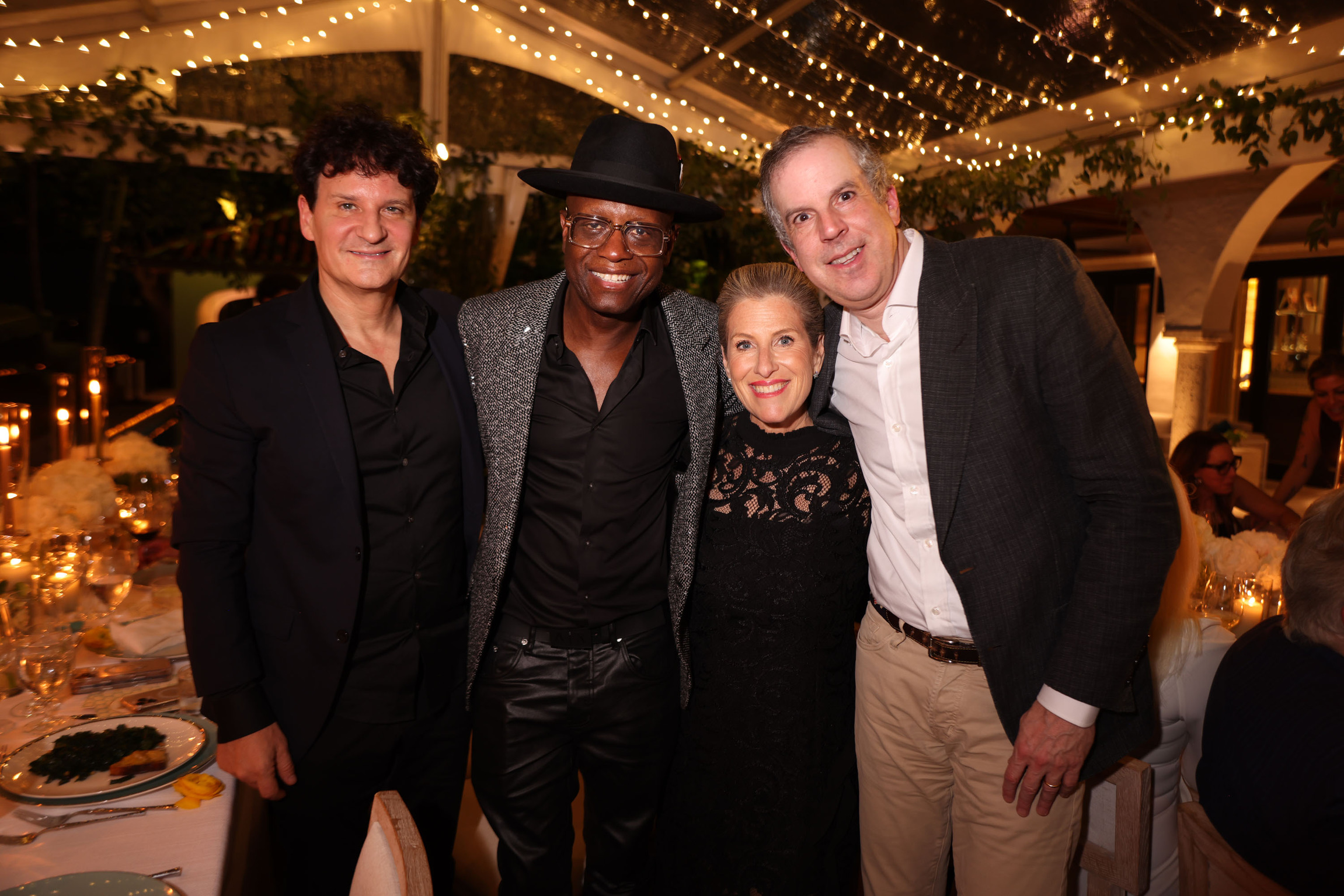
Sandra and Howard Hoffen were among the co-chairs of the March 2025 Impact Awards at the Rubell Museum in Miami. The event honoured the Marley family, Juanes and Anitta. His involvement therefore extends beyond attending an evening: there is the foundation’s board role and the shared responsibility of helping chair a fundraising event.
A quieter arts commitment can be located in a museum collection. In 2022, Sandra and Howard donated Amoako Boafo’s Cobalt Blue Dress, a 2020 oil painting, to the Hirshhorn. It appears in the checklist for the museum’s Revolutions exhibition. The donor credit places their names beside a specific work that has entered a public collection.
There is another enduring institutional connection at Columbia. The Hoffen Family Scholarship Fund was established in 2013 through a gift from Sandra H. Kim Hoffen, Columbia College class of 1987, and Howard, Engineering class of 1985. His involvement with the engineering school also included Board of Visitors service in 2006-2012 and 2015-2021.
The dates tell their own modest story. Graduation was followed by later service and a scholarship gift. The university remains part of the biography long after the degree has become a line on a professional page.
The next programme
Theatre provides a recent continuation. Gypsy received a 2025 Tony nomination for Best Revival of a Musical and won the Drama Desk award for Outstanding Revival of a Musical. Sandra and Howard’s credit sits within the production’s larger group of co-producers. The distinction keeps the achievement in proportion while recognising their participation.
In May 2026, the Hoffens were among the co-chairs of Lincoln Center Theater’s spring gala honouring Susan Downey and Robert Downey Jr. The evening featured a concert presentation of Man of La Mancha at the Vivian Beaumont Theater. Another production, another assembly of people with different parts to play.
It would be easy to treat the theatre credits as an amusing appendix to a financial career. They deserve their own space, alongside the music foundation, museum gift and scholarship. Each describes something Hoffen has helped support in public, with named collaborators and a tangible result.
Metalmark remains the central professional chapter. But a fuller portrait follows the credits beyond the office. A colleague, a director, a co-producer, a donor: the roles change with the setting. The names alongside his help make the story legible. On Broadway, that is what the programme is for.