Before Ted Beneski had companies to improve, he had a soccer team to captain. At Amherst College, he studied economics, played baseball and led the soccer side in his senior year. Decades later, recalling an early career promotion, he singled out two qualities: appetite for the work and “coachability.” The second is a curious credential for someone who would spend much of his life sitting at the head of the table.
A coachable chief executive has to leave room for the possibility that somebody else has a useful answer. In Beneski’s public account of investing, that possibility matters. A company can have a promising market, useful equipment and an intelligent plan, yet still struggle to turn those advantages into results. The question becomes how to help the people running it make the next improvement.
Today, Beneski is CEO and managing partner of Insight Equity, the private equity firm he co-founded in 2002. Its base is Southlake, Texas. The distance between a Massachusetts soccer pitch and a Texas investment office is considerable. The recurring interest in teams makes the journey easier to follow.
A captain learns to listen
Beneski graduated from Amherst in 1978. His route into business began with a training program at Bankers Trust in New York, followed by commercial lending work there and at Shawmut Corporation in Boston. He earned his Harvard MBA in 1985 and joined Bain & Company’s Boston office. In 1990, he co-founded Bain’s Dallas office.
The sequence gave him several ways of looking at a business. A lender has to think about repayment. A consultant has to identify what needs changing. An owner has to live with the consequences. Those are different responsibilities, even when the same company occupies the conversation. Beneski’s career would eventually put all three perspectives within reach.
At Bain, he became a senior partner and advised large companies on subjects including acquisitions, operations, organizational design and growth. His later official biography describes nearly a decade as a senior partner. It is a background that helps explain the scope of his interests: the transaction, the organization behind it, and the practical work that follows.
In 1999, he became a founding principal of Carlyle Management Group, Carlyle’s special situations and turnaround business. Three years later came Insight Equity. Victor Vescovo joined him in founding the firm; Ross Gatlin was another early leader. Their working relationship reached back to Bain’s Dallas office in 1994. The new enterprise had a familiar team behind an unfamiliar name.
The awkward question about profit
Insight’s early proposition was specific: buy businesses that had a viable position in their markets but were performing below their potential. Manufacturing and distribution were important hunting grounds. A difficult operating problem could make a company interesting, provided there was a defensible business underneath it.
The firm closed its first leveraged buyout fund in 2005, attracting $250 million from limited partners, chiefly academic endowments and trusts. General partner capital and partner co-investment brought available capital above $300 million. Before raising that fund, Insight had already invested in companies including the Texas fuel business Direct Fuels.
Consider what makes this sort of work demanding. A large sales figure tells an owner something, but it leaves plenty unanswered. Which products pay their way? Which customers require expensive exceptions? Where does a busy factory actually earn its money? Revenue is an agreeable number at a dinner party. Profit tends to ask less agreeable questions.
In 2010, Beneski described Insight’s Product Line Profitability tool: establish costs and profits for individual products, customer relationships and divisions. Then compare performance across operations and against competitors. It is a practical approach to a deceptively ordinary problem. People can know their businesses intimately while still lacking a clear view of the economics of each part.
The attraction of such detail is that it makes a discussion more precise. “Improve the business” is a wish. Knowing where the margin disappears gives a team something to investigate. A spreadsheet cannot settle every argument, but it can at least persuade the argument to take place in the right room.
The plan needs people
Beneski’s explanation becomes more revealing when he reaches implementation. Technical ability, he said, has to come with the capacity to build relationships with portfolio company managers. A worthwhile idea can remain unused when the people responsible for it do not have a productive partnership with the people proposing it.
“We value those people skills”
Ted Beneski, 2010
That short phrase carries a useful warning for anyone enamored of the elegant presentation. There is usually a person between the slide and the result. That person has deadlines, customers and a working day already full of obligations. Giving them an idea also gives them a job. The quality of that working relationship belongs in the investment calculation.
Insight’s 2010 fundraising announcement made the routine concrete. The firm described developing a value creation plan jointly with management, then meeting at least monthly to address implementation and consider further improvements. The announcement covered $525 million in new funds. Behind the headline number sat an altogether less glamorous unit of progress: the next meeting.
The language suits Beneski’s career. He had spent years examining businesses before becoming an investor in them. Ownership added responsibility to the diagnosis. The useful test of a recommendation became whether it could survive contact with the people expected to put it into practice.
A jersey, forty years later
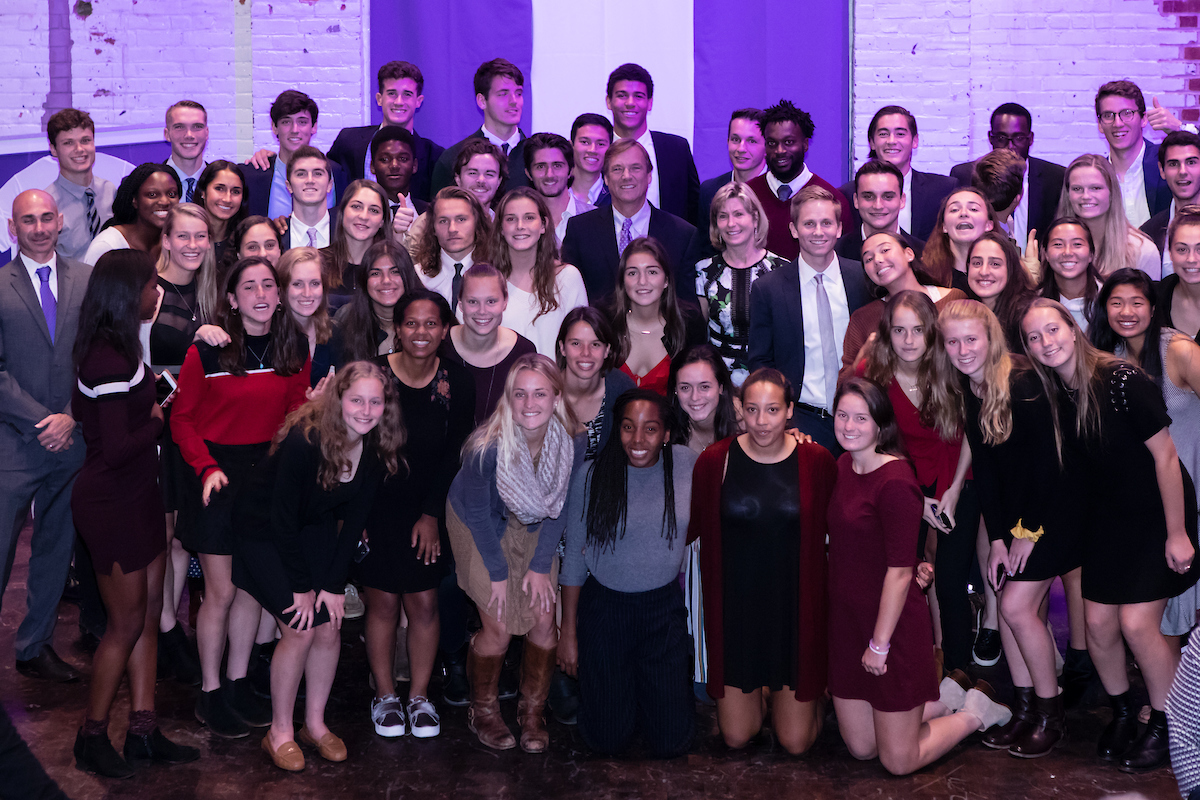
In October 2018, Ted and Laurie Beneski returned to Amherst for a reception celebrating the naming of its men’s and women’s soccer programs in their honor. Players presented them with a commemorative jersey. College president Biddy Martin, coaches and trustees joined the occasion. Forty years after his graduation, the former captain was back among the teams.
His name also appears on a different kind of campus institution. Amherst’s earth sciences building and natural history museum were named for the couple in 2011. The museum houses more than 200,000 objects, including a substantial dinosaur footprint collection, and connects its collections with classrooms and laboratories. A soccer jersey and a fossil collection make an unusually broad pair of calling cards.
The connection to education extends beyond the college. The Suffield Foundation for Excellent Schools records support through the Ted and Laurie Beneski Foundation, including a $1.6 million turf field at Suffield High School and $15 million toward Amherst’s earth sciences building and museum. These are places where future students can do something: play, examine, practice, learn.
An entrance worth remembering
Trinity University entered the family story through sons Jeffrey, a 2011 graduate, and David, a 2014 graduate. Ted and Laurie joined its Parent Council and co-chaired it in 2012. Their support included scholarships, the Center for the Sciences and Innovation, and the president’s discretionary fund. A parental connection developed into continuing work for the institution.
In 2022, they gave Trinity $3 million for a new main entrance from Hildebrand Avenue. It became Beneski Parkway. Their explanation was personal: they wanted others to experience the welcome they had felt when first arriving in 2007. A road can sound like a curious object of philanthropy until one remembers how much of college begins with finding the way in.

At the August 26 grand opening, guests traveled up the winding parkway by golf cart. Speeches took place beneath its road sign, and Ted and Laurie cut the ribbon. The physical project connected the campus with City Vista apartments and created an identifiable arrival point. It gave their wish for a welcome a route, a crossing and a sign.
Beneski later chaired Trinity’s board. In May 2026, the trustees unanimously approved an extension of president Vanessa Beasley’s contract through 2031. He publicly backed her leadership and ability to carry out the university’s plans. His own chair term ended that May; Trinity announced in June that he would remain on the board for three more years.
The work continues in 2026
At Insight, the year brought another set of operating businesses into view. In February, the firm acquired IKI Manufacturing, an aerosol manufacturer founded in 1955 and based in Edgerton, Wisconsin. Its work includes formulation, blending, filling, packaging and logistics. These are the everyday processes behind products that arrive looking effortlessly finished.
In April, Insight sold Houston-based CSAT Solutions to Verdant Solutions. Beneski described a partnership that had broadened the repair company’s customer base, improved operations and added AI server repair to its services. The announcement gives a current example of the work he has discussed for years: change what a company can do, alongside the people already doing it.
July brought the promotion of David Beneski and TJ Stone to principal. Ted pointed to contributions across portfolio businesses, including Easy Way, Atmos Technologies and Emerald Transformers. On October 8, Insight announced an investment in Richardson-based Alwood, whose supply chain services cover design, engineering, sourcing and quality assurance for aluminum-intensive products.
The businesses differ; the attention to how they operate persists. There are products to make, customers to serve and managers to work with. That gives a career in private equity a texture its financial totals alone cannot convey.
A small joke at the lectern
Beneski’s May 2026 commencement appearance at Trinity offered another view of him. The university awarded 587 degrees across two ceremonies. Addressing the graduates, he made the obvious joke available to a speaker named Ted: “It’s a genuine Ted talk.” Then he encouraged optimism about their futures and appreciation for those who had come before them.
For all the board titles, fund closings and company names, that scene belongs with the soccer jersey. It places him among people preparing to do something next. The former captain has spent a long career looking at what a business might become. On a college stage, the same question has younger faces, fewer spreadsheets, and an audience understandably eager to get on with it.