Ethan Escowitz wears the argument on his face. In a photograph accompanying his latest venture, the sunglasses are made from a composite that uses almond shells. A straw hat sits above them; blue lenses reflect the scene in front of him. The shell, usually the part you hurry past on your way to the almond, has acquired a second career.
It is a good introduction to a founder whose work keeps returning to the same practical curiosity: what else could this material become? At ARRIS Composites, which he co-founded in 2017, the material was continuous carbon fiber. At Artefact, where he is co-founder and CEO, agricultural co-products are part of the proposition. Between the two sits a demanding occupation: persuading a new manufacturing idea to behave like a business.
The printer before the factory
Escowitz’s education took an indirect route to the factory floor. He shifted from mechanical studies to geology and earned a BS in Geology at the University of Vermont. His early work at Ricoh, the printer manufacturer, introduced him to technical products and business development. Eventually, he became interested in the relationship between product design and the technologies used to manufacture it.
A printer is an oddly appropriate place to begin. It turns an instruction into a physical result. Manufacturing asks that question with a larger vocabulary of materials, shapes and tolerances. Escowitz’s career would come to occupy the space between a designer’s intention and the equipment capable of realizing it.
He describes beginning work with his first 3D-printing company around 2009. The field offered new possibilities, along with expectations that would prove uneven. His later professional biography lists a collection of jobs familiar to hardware founders: product developer, business developer, marketer, inventor, fundraiser and operator. The business card could have used a foldout.
By January 2017, he was leaving AREVO after two years. His public farewell thanked the colleagues he had worked with and the friend, Kunal, who introduced him to the founding team. He wished the company success and announced his next adventure. There was affection in the departure. There was also another manufacturing problem waiting.
A garage with industrial ambitions
ARRIS began with Escowitz, Riley Reese and Erick Davidson. Its early work moved from Escowitz’s garage into the personal machine shop of Carl Bass, Autodesk’s former CEO. Bass became an adviser and investor. A borrowed corner of somebody else’s workshop is a modest address for a business concerned with changing how products are made.
The shop offered a concrete setting for the idea. An early automotive part was developed with a University of California, Berkeley Masters of Engineering team for the electric Shelby Cobra conversions Bass was working on. Here were students, an experienced industry figure and founders gathered around a part with an actual destination.
That matters in Escowitz’s story because his interest rests on the interaction between manufacturing and product design. A new process becomes more persuasive when somebody can point to the object it enables. The workshop supplied that kind of conversation: dimensions, materials, a vehicle, a job to be done.
A fiber needs directions
ARRIS’s manufacturing idea became Additive Molding. It combines additive techniques with molding to make aligned continuous-fiber composite parts. The alignment is central: where fibers go, and how they run through a structure, affects what the finished part can do. The factory has to preserve that intention while making something repeatable.
Escowitz is named as inventor on US patent 10,807,319, titled Aligned fiber reinforced molding, granted in October 2020. The title is sober enough to belong in a filing cabinet. It also names the central preoccupation: arrange the reinforcement, then make the object.
His explanation of the technology avoids treating every manufacturing method as a contestant in a winner-takes-all tournament. ARRIS used plastic, composite and metal additive manufacturing when those methods suited a task. Some work still belonged on CNC machines. A factory benefits from having more than one answer.
“There are different tools for different jobs.”
Ethan Escowitz, 2020
He also acknowledged a less photogenic obstacle: teaching engineers and designers how to use a new process, identifying appropriate applications and getting products qualified. A promising material sample does not conduct those conversations for you. Industrial adoption includes people learning how to ask for something they previously could not order.
Seventeen pieces, one useful argument
The Skydio X2 drone offered a specific demonstration. Its earlier assembly combined two carbon-composite plates, a glass-fiber-composite plate, four aluminum brackets and ten fasteners. ARRIS consolidated those seventeen pieces into one component. Skydio reported a 25 percent weight reduction.
The different materials served different functions. Carbon fiber supplied structural performance in the forward region. Glass fiber over the top allowed the GPS antenna beneath it to receive signals. The resulting component had to do several jobs in several places. Choosing a single material for everything would have missed the point of the design.
For a founder talking about manufacturing possibilities, this is a helpful object. The customer can describe the benefit. The part count can be counted. The weight comparison concerns this component, rather than a sweeping promise about every product carbon fiber might touch. Specificity gives an ambitious idea somewhere firm to stand.
The money had a job to do
ARRIS announced a $10 million Series A in 2019, followed by a $48.5 million Series B in 2020. Escowitz’s explanation of the latter round centered on production capacity and engineering collaboration. Early customers had qualified the technology; the company needed resources to handle their higher-volume orders and work with the next group evaluating it.
Taiwania Capital brought manufacturing experience relevant to consumer electronics. Escowitz described its introduction through NEA and the fit between the organizations. Raising money in this account meant adding expertise as well as capital. A manufacturing company has to know where its next production capability will come from.
The $88.5 million Series C announced in 2021 came with US manufacturing, an overseas mass-production facility and named customer projects. Those included Skydio and an Airbus research effort involving cabin brackets. These were different applications with different requirements, a reminder that a process platform earns its usefulness one product program at a time.
Funding figures make tidy milestones. Their practical consequences are less tidy: equipment, engineering work, production systems, customer requirements. The interest in Escowitz’s career lies in that translation. Money enters as a round number. The work has to emerge as parts that somebody else can use.
The title changes; the work carries on
On June 29, 2022, ARRIS announced that Reese would become CEO, taking day-to-day leadership. The announcement identified Escowitz as a board member and former CEO. ARRIS’s company overview published in its 2026 downloads continues to list him as co-founder and board member. His place in the story changed from running the company to remaining part of its governance.
Subsequent manufacturing milestones belong to the team under that leadership. In March 2023, ARRIS announced a Malaysian contract-manufacturing partner and capacity of more than one million parts a year. In November, it highlighted its technology partnership with Brooks Running on continuous-fiber-reinforced plates for running shoes.
The business he helped start was finding further uses for its process. A drone structure and a footwear plate demand different things, but both force material choices into a finished product. For Escowitz, the next venture would return to molding with a different set of inputs.
His advice to hardware founders also makes room for restraint. A Product Startup conversation stresses early production, customer feedback and avoiding feature creep. Adding a feature adds work in development and manufacturing. An object can be ambitious without attempting to satisfy every idea that arrived during the meeting.
An orchard enters the bill of materials
Artefact was founded in 2022. Escowitz’s public acknowledgment of a Berkeley Capstone team in 2024 describes it as his second startup to partner with Cal Engineering on early research and development. Robert Fleming, Artefact’s CTO, appears alongside him in the company’s collaborations. The university connection survived the change of company.
In February 2025, Artefact announced work with the Berkeley Center for Green Chemistry on lifecycle analysis of its manufacturing methods and circular materials. That work addressed another product question: what happens when the accounting includes the supply chain and the way the material is made?
The almond-shell partnership followed in May 2026. Artefact and the Almond Board of California announced composite materials for consumer and home products, as well as building and vehicle interiors. Shells historically used for livestock bedding were being proposed as inputs for engineered materials. The opportunity involved an existing agricultural supply chain, rather than a newly invented crop.

The sunglasses bring that proposition back to human scale. A pair of frames asks questions a person can answer: how it looks, how it feels, whether it is something they want to wear. Materials research eventually meets taste. A technically interesting input still needs an appealing object.
The next factory is still a plan
By August 2026, Escowitz was describing a planned production facility in Modesto for the following year, with a target of using about one billion pounds of almond shells annually. The scale is an ambition, rather than a record of existing throughput. It puts the familiar manufacturing question back in front of him: how does a promising material become sustained production?
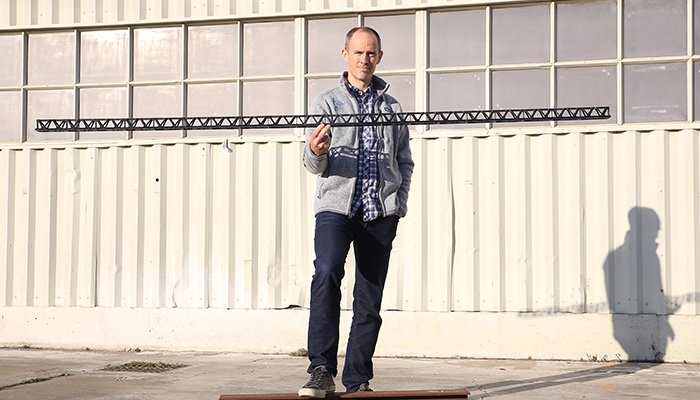
The itinerary now runs from geology to printer products, from additive manufacturing to ARRIS, and onward to agricultural materials. Its continuity is visible in the objects. An eight-foot truss shows how fibers can carry a load. A drone component shows how several functions can share a part. A pair of sunglasses gives an orchard residue a place in everyday use.
Escowitz has spent his career around the decisions that connect those objects to factories. The almond shell is a fitting new participant. It has already done one job perfectly well, protecting an almond. He is interested in what happens when it is given another.
Follow the work
- Artefact website ↗
- ARRIS website ↗
- Ethan on LinkedIn ↗
- Watch: Future of Mobility interview clip ↗
- Listen: Future of Mobility, episode 56 ↗
- Read: the 2020 career conversation ↗
- Read: the June 2022 CEO announcement ↗
- Read: the almond-shell partnership ↗
- Read: the August 2026 factory plans ↗
- Artefact on Instagram ↗
- Artefact on LinkedIn ↗