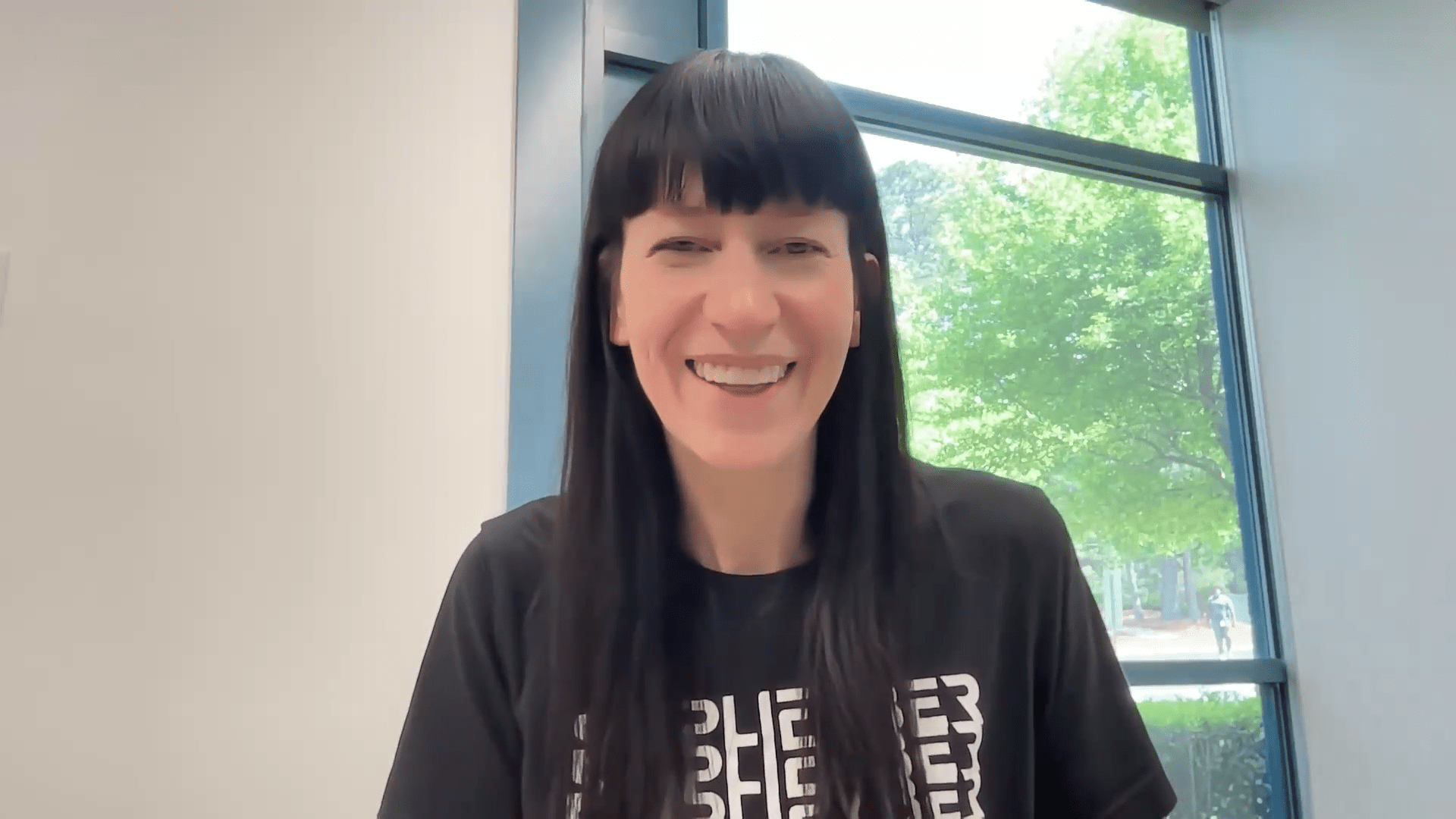
Maria Intscher-Owrang spends her days now thinking about liquid. Not dye, not finish, not treatment - the fiber itself, suspended and formless, before it becomes anything at all. As co-founder and CEO of Simplifyber, she runs a company that takes a cellulose-based mixture of wood pulp, recycled paper, recycled textiles and agricultural fiber, and molds it directly into a finished, shaped part. No spinning. No weaving. No cutting. No sewing. One step where an entire industry has always insisted on several.
This is not where you would expect to find her. For more than two decades, Intscher-Owrang built a career at the center of luxury fashion, holding senior design roles at Alexander McQueen, Calvin Klein, Dirk Bikkembergs and Edun, and serving as VP of Design at Vera Wang. She trained at Central Saint Martins in London, the school that produced McQueen himself, earning her MA in Fashion in the late 1990s. Her work moved through the same ateliers and showrooms that define the upper tier of the industry - the shows, the fittings, the seasonal churn.
In 2021, she co-founded Simplifyber with Phil Cohen, who serves as the company's COO. The premise was blunt: the way clothing and textile-based products get made hasn't fundamentally changed in generations, and the waste built into that process - fabric scraps, water use, emissions from spinning and weaving - is a design problem as much as an engineering one. Having spent twenty years inside the system, she had a closer view than most of exactly where it broke down.
A Liquid, Not a Loom
Simplifyber's process starts as a liquid and ends as a shaped, finished part - a shoe upper, a dashboard panel, a piece of automotive trim. The company calls its proprietary formulation Fybron. Depending on the ratio of cellulose fiber to binder, the same base process can produce something soft and flexible enough for footwear or rigid and durable enough for a car interior.
"That is what we are building toward: not a new material dropped into an old system, but a new system entirely."
Maria Intscher-Owrang, in 360 Magazine
She has described the aspiration in concrete, almost cinematic terms: a factory operator dialing in a specific material profile, pressing go, and receiving a finished, shaped part from a single machine - the material and the geometry forming simultaneously, exactly as specified. It is a picture that owes as much to industrial design thinking as to couture pattern-making, and it is the kind of image that only someone who has stood on both sides of a cutting table would reach for.
"Imagine a factory operator who can dial in a specific material, soft and flexible for a shoe upper or rigid and durable for an automotive interior component, press go, and receive a finished, shaped part from a single machine with no spinning, weaving, or cutting."
Maria Intscher-Owrang, in 360 Magazine
From Seed to Series A
Simplifyber closed a $3.5 million seed round in July 2022, led by At One Ventures, with Techstars, Heritage Group Ventures, The Helm and W Fund among the participants. The company spent the next two years developing and testing its process, working through pilots that included an early footwear collaboration with HP.
The turning point came in September 2024, when Simplifyber's first commercial product - a shoe upper made from its cellulose-based material - appeared on the runway at Paris Fashion Week, in collaboration with the Danish label GANNI for its Spring/Summer 2025 show. The company said the shoe upper's carbon footprint came in roughly 33 times lower than a traditional equivalent. It was proof, delivered in the most fashion-native venue possible, that the technology could produce something a design house would actually put on a runway.
Seven months later, in April 2025, Simplifyber closed a $12 million Series A led by Suzano Ventures - the venture arm of the Brazilian pulp and paper giant Suzano - with participation from At One Ventures, Techstars, Plug and Play Sustainability Fund, One Small Planet and several others. Total funding reached $15.5 million. Around the same time, at Kia's EV Day event in Barcelona, the automaker announced it would use Simplifyber's Fybron material - alongside materials from Bcomp and Biomyc - for the dashboard and door panels of its Concept EV2, an electric SUV expected to reach market in 2026. It made Kia the first automaker to adopt Simplifyber's material, produced at the company's facility in Raleigh, North Carolina.
Two Industries, One Process
What makes Simplifyber's story unusual is the range of its applications. The same underlying liquid-molding process that produced a shoe upper for a Copenhagen fashion label is now being engineered into automotive interior components for a Korean car manufacturer. Intscher-Owrang has framed this versatility as core to the company's pitch: the process isn't tied to one industry's supply chain, but to a fundamentally different way of turning fiber into a finished object.
"Our products begin as natural fibers in a liquid made of wood pulp, recycled paper, recycled textiles and agricultural fiber."
Maria Intscher-Owrang, in 360 Magazine
She has described her own approach to building the company in blunter terms elsewhere - a willingness to challenge how things have always been done rather than iterate cautiously around the edges. It is a posture that tracks with the choice she made in 2021: leaving a stable, high-status career in design for the uncertainty of a materials-science startup, betting that a designer's understanding of process and geometry would matter as much to solving manufacturing waste as an engineer's.
What's Next
Simplifyber's public narrative in 2025 and 2026 has increasingly framed the company's ambitions in industry-wide terms - as a "next-generation materials platform" aimed at a global textile and apparel manufacturing sector valued in the trillions of dollars. The company continues to describe its process as capable of cutting a majority of conventional manufacturing steps and using significantly less labor than spinning-and-weaving methods, positioning Fybron as usable well beyond footwear and automotive interiors.
In interviews, including a May 2026 appearance on the cityCURRENT Show titled "From Vera Wang to Reinventing Manufacturing," Intscher-Owrang has continued to draw a direct line between her design career and her current work: the same eye that once judged how a gown would move on a runway is now trained on how a liquid becomes a finished, wearable part. For a designer who spent twenty years inside the industry's biggest houses, the goal now is less about the next collection and more about changing what happens before a collection ever gets made.
biomaterials
sustainable manufacturing
circularity
textiles
cleantech
automotive materials
founder
fashion