When Elaine Bailey arrived at Escend Technologies in July 2003, the company had the sort of sales number that looks reassuring from the far end of a conference table: a $15 million pipeline. Bailey, a partner at investor Novus Ventures, had three weeks to decide whether the firm deserved more money. She interviewed all 30 employees, spoke with its four manufacturer customers, and examined expense reports and phone records. The promising pipeline, she found, represented only $256,000 in actual prospects. A neat column in a forecast had concealed a less neat business.
- Escend sold software that tracked semiconductor design wins across a fragmented global sales chain.
- In 2003 it had four manufacturer customers, 20 representative firms, and a $650,000 monthly cash burn.
- The turnaround joined a sales audit to customer interviews, a product redesign, and a sharper definition of the buyer's problem.
What happened to the chip?
A component maker could persuade an engineer to put its chip into a new device. That was a design win. But the device might be built months later, by another company, in another country. The contract manufacturer could substitute a cheaper component. The maker that had won the design might not know it had lost the order until the revenue failed to arrive. The sales representative who did the early work and the distributor who fulfilled the order occupied different corners of the same transaction.
Escend's original proposition was to give those corners a shared view. Its software connected component manufacturers with external sales representatives and, later, distributors; it followed opportunities through design, quotation, sampling, and production. The supplied company description calls the applications software as a service and describes links to ERP and supply-chain systems. In practice, the valuable connection was less abstract: tie a selected part to the order that should follow it.
This was Escend's difference from an ordinary customer database. A generic CRM could record a meeting; a conventional ERP could record an order. Escend tried to connect the meeting and the order across companies that did not share an office, an employer, or even a continent. The problem suited electronics, where outsourcing had made the route from design to factory unusually hard to see.
A very expensive mystery
Escend was formed in 1999 around that opportunity. The idea moved through several descriptions: a business-to-business community, a sales information network, then an online customer-resource management system. By mid-2003, the company had burned through about $16 million in venture funding and wanted another $6 million. Sales had stalled. Its monthly burn was $650,000. At its peak it had employed 70 people, including 50 software developers; Bailey found 30 on staff when she arrived.
The product supplied another unpleasant number. Even a small change to its rigid architecture could require up to 200 hours of quality assurance. Customers wanted reports they could tailor and information closer to real time; the application had been built around once-a-day batches. Before Bailey could pitch growth, she had to make a piece of software people could use without waiting through a small archaeological dig each time a feature changed.
The first temptation had been to improve the investor presentation. The board rewrote the executive summary and coached the then CEO. New investors still showed no interest. Bailey's response was more laborious: interview the employees and customers, visit prospective buyers and industry participants, and ask the venture firms that had declined to invest why they had said no. The question underneath every meeting was brutally plain: would anyone buy this, and for what job?
“My reps are talking to my customers every day, but I don't know what they are saying.”A customer need statement reproduced in the Escend case study
Some findings called for direct action. Bailey reduced budgets, consolidated locations, and cut 25 of the 30 staff members. She retained a small core that included customer-support employees she judged to be an asset. The remaining group met frequently and tested assumptions together. Other findings demanded experiments. Escend hired architects to put a web interface around the working core of the application, making reports and other functions easier to change. Enterprise customers tested that approach in September 2003.
The drawing got simpler
The deeper correction came from following the order. Escend learned that its target transaction was global: a component selected in North America, Europe, or Japan could be manufactured in Southeast Asia or China. Its software had to cope with multiple languages, currencies, and points of access. It also had to serve distributors as component makers shifted more selling through them. A 2003 prototype added sample management, pricing and quoting, and shipping-and-debiting functions. These were the mundane details that made a grand promise about “extended relationship management” useful at a desk.
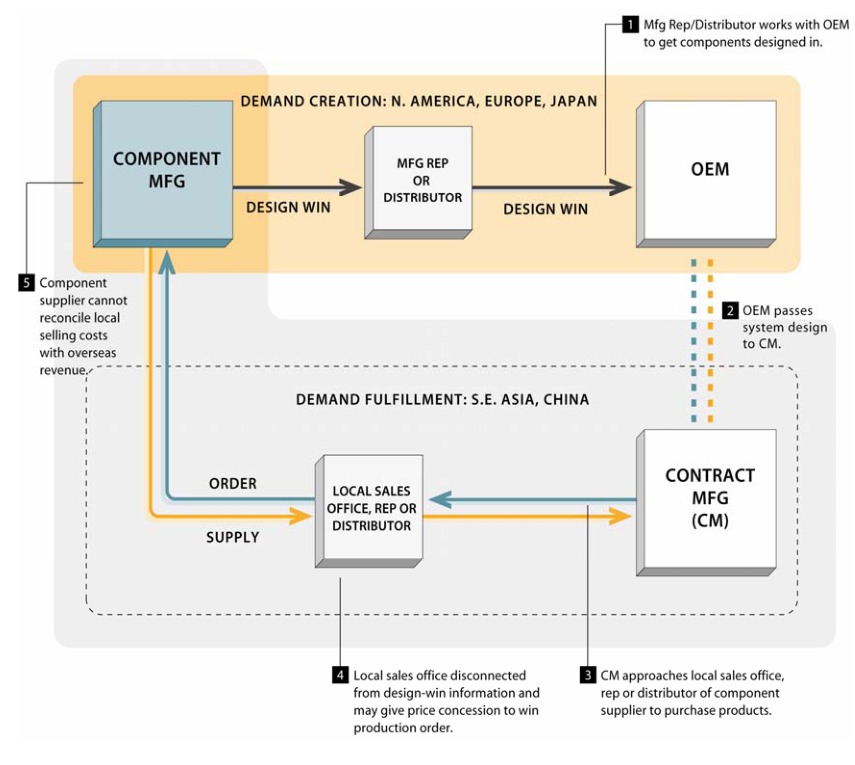
The diagram is a rare view of a software company learning to draw its market. Its earlier map showed a dense web of parties. The 2004 version made the split visible: demand creation on one side and demand fulfilment on the other. It is easier to sell software when the buyer can point to the exact place where money goes missing.
Renesas Technology America provided a concrete example. In 2004 it integrated Escend's design-win software with its SAP ERP system. Its direct and external sales teams could track an opportunity from identification through quotation and samples, then compare that trail with actual orders. Renesas chief operating officer David Schwartz said the link gave the firm visibility into design-win-to-order conversion and better data for forecasting. Zetex Semiconductors also selected Escend's management software that year.
The cost of finding out
Bailey decided after three weeks that the demand was real enough to continue. Novus and NIF Ventures supplied roughly $7 million in August 2003, according to the published case study. Existing investors added $3 million in late 2004. The company's supplied database lists $8.596 million for the August round, so the precise total depends on which account one uses. Neither figure makes this a cheap lesson. The turnaround took a severe cut in staff and another product build while the market remained uncertain.
By March 2005, Escend had released EscendSales, a sector-specific CRM product linking leads and design wins to production orders at outsourced manufacturers. It supported different languages, currencies, and local formats. Daiwa Securities had translated the product for a Japanese effort targeting 12 companies. By June 2005, the case study reported more than 50 companies in the sales pipeline. That was a pipeline figure, not a count of paying customers, and should be read with the same skepticism that began this story.
The episode offers a useful practice to copy: separate the facts you can audit from the assumptions you need to test. Check the calls behind the forecast. Ask customers what happens between the moment they celebrate a win and the moment they book revenue. Then make the product diagram simple enough to show where the handoff fails. Escend's case was unusually well suited to this approach because its buyers faced a costly, repeatable gap across a complicated network. In a simpler market, or where the company cannot influence the handoff, the same software would have little to join.
The peer-reviewed account described Escend as operating in 2007. Its more durable story is the one in the 2004 drawing: the winning chip on the left, the purchase order somewhere on the right, and a company trying to prove that the two belonged together.
Elsewhere on the trail
Escend on LinkedIn · Renesas on its Escend integration · EE Times on the missing design · EscendSales launch coverage