Long before Erik Mirandette worried about the architecture of factory software, he worried about roads. The road running north from Cape Town was 9,000 miles of dirt, mud, borders and guesswork. He and his companions had motorcycles, borrowed money, scheduled stops with nonprofit groups and the elastic confidence of people attempting something that sounds reasonable only after it has been completed. Mirandette called it the wildest thing he could imagine that was still barely doable.
The phrase is as good a key as any to the career that followed. His résumé can look, at first glance, as if several people have been sharing the same name: aid worker in North Africa, pole-vaulter, memoirist, Air Force special agent, venture investor, MIT student, startup operator and industrial podcast host. Yet the changes are less random than they appear. Mirandette keeps moving toward places where the problem is immediate, the context matters and the person nearest the work knows something the distant expert does not.
Today he is Chief Business Officer at Tulip Interfaces, a Somerville company that makes no-code software for frontline operations. Its customers build applications to guide work, collect production data and connect people with machines. The vocabulary is industrial, but Mirandette's governing idea is plain: give the people doing the job the means to improve it.
The road before the road
In high school in Michigan, Mirandette ran middle-distance track and disliked it enough to become inventive. A friend introduced him to pole vaulting. The coaches offered terms: become good at it or return to distance running. He became good quickly, won a state title as a junior and cleared 15 feet. It is a charming origin story for a lifelong habit - when presented with an unappealing route, find a harder one that feels worth taking.
Pole vaulting helped bring the Air Force Academy into view. Mirandette was the first in his family to consider the military, and the Academy's sense of purpose appealed to him. After his sophomore year, in 2003, he stepped away for work with a nonprofit in North Africa. In Melilla, Spain, he assisted refugees from West Africa. After the 2004 earthquake in Al Hoceima, Morocco, he helped with relief and led a multinational reconstruction team.
The scale of need could make any individual effort feel absurdly small. Meals, blankets and shelter did not address the forces that had pushed people into dangerous camps. They still mattered to the person receiving them. Mirandette carried that distinction forward: a response need not be total to be useful.
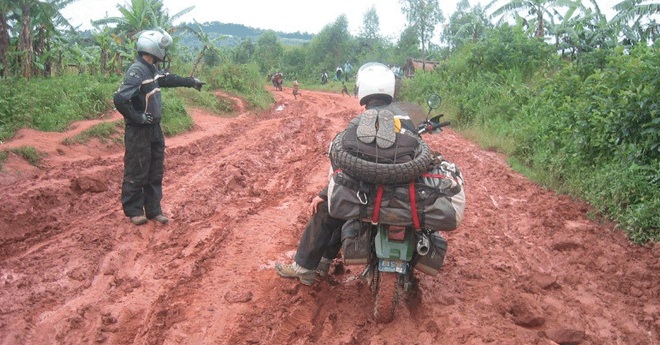
Wanting to understand the countries the refugees had left, he planned an overland journey from South Africa to Egypt. His younger brother Alex wanted in. Erik, the protective older brother, objected for roughly six months before relenting. The trip passed through southern and eastern Africa on dirt bikes and would later become The Only Road North: 9,000 Miles of Dirt and Dreams.
Its ending was not the one any traveler would choose. In April 2005, near the end of the journey, a terrorist bomb exploded in a Cairo marketplace and killed Alex. Mirandette later said he began writing privately because he was the only witness to the man his younger brother had become during the trip. The book, published by Zondervan in 2007, kept the account raw rather than tidying it into an easy moral. Grief is a poor employee of narrative structure. Mirandette respected it enough not to make it one.
Return, with a different purpose
Mirandette returned to the Air Force Academy in 2006 with a sharper reason for being there. His experience in Arabic-speaking North Africa and aptitude for languages pulled him away from an early idea of becoming a fighter pilot and toward intelligence work. After commissioning, he spent more than six years as an officer and special agent, with assignments in the United States, Afghanistan, Japan and Southeast Asia. His service included work in strategic counterintelligence and brought Army and Air Force Commendation Medals.
He left when the distance and time away began to weigh on family life. The next turn was venture capital in his native Grand Rapids. At Start Garden in 2015, he evaluated young companies in a fund unusually attentive to the Midwest's strengths in manufacturing and enterprise business. That year he was also selected as a Tillman Scholar and entered MIT Sloan's MBA program, drawn by a place where engineering could meet commercialization.
In a profile before classes began, he described his ambition as helping commercialize new solutions to old problems. That could have remained a polished business-school sentence. Instead, he joined a small MIT spinout trying to change how work happened inside factories.
Five engineers, three dogs
Mirandette remembers early Tulip as roughly five engineers, three dogs and optimism on the fourth floor of a former chocolate factory. There was no vast sales machine to inherit. He worked on business development, helping find the first 10 or 20 customers and learning what hurt badly enough that a manufacturer might trust an unknown startup to help.
After about a year, he moved across the boundary that often separates promises from consequences. He built the post-sales operation: customer success, professional services, application engineering, support, account management and project management. For roughly four or five years, his domain was what happened after someone said yes.
That sequence explains much of his later product philosophy. In factories, glossy abstraction has a short half-life. A line goes down for a reason. A quality record has to be complete. An operator needs the right instruction before, not after, the shift. The valuable information is often divided between a machine's signal and a worker's observation. Software earns its keep by bringing those worlds together without forcing the operation to impersonate the software.
As Head of Customer Operations and later Head of Product and Ecosystem, Mirandette became a public advocate for composability. The term can sound like something sold by the syllable. His version is practical: instead of waiting for a huge, rigid system to anticipate every future need, let operations teams assemble applications around specific work and change them as the work changes. If a capable Excel or PowerPoint user understands basic logic, Tulip's proposition is that this person should be able to build a useful operational app.
This is not a romantic argument that every worker should become a programmer. It is an argument about where knowledge lives. The operator knows the awkward handoff. The engineer knows why the workaround exists. The supervisor knows which number arrives one shift too late. Citizen development gives that knowledge a route into the system.
Scale without losing the shop floor
Tulip has traveled a considerable distance from the chocolate factory. In January 2026, it announced a $120 million Series D led by Mitsubishi Electric at a $1.3 billion valuation. The company said that during 2025, 43,000 Tulip apps enabled work for 60,000 frontline employees across 1,000 customer sites in 45 countries. It had grown to more than 300 employees and opened offices from Munich and Budapest to Singapore, Tokyo and Tel Aviv.
Mirandette marked the round without mistaking capital for completion. The milestone, he wrote, was fuel for what came next. As Chief Business Officer, he now works where product, partnerships, customers and market direction meet. It is the kind of title broad enough to become foggy. His earlier jobs give it ballast. He has sold the promise, managed the delivery and led part of the product.
He also hosts Augmented Ops, where conversations range from computer vision and industrial data architecture to luxury craftsmanship, NASCAR and defense production. The guest list varies, but the tension repeats: industrial systems must become smarter without treating people as inconvenient legacy hardware.
Artificial intelligence has raised the stakes of that tension. Tulip describes its approach as human-first: AI should help operators turn context and data into action, not remove the people who understand the operation. Mirandette's own advice is even less glamorous. Spend less attention on the technology itself, he has argued, and more on understanding the process and selecting the right problem.
That is an operator's answer, and perhaps a traveler’s. A road is never merely a line on a map. It is weather, machinery, judgment and the person standing in the mud pointing toward firmer ground. Mirandette's career has changed countries, institutions and stakes. Its durable belief is that proximity produces knowledge, and knowledge becomes useful when someone is trusted to act on it.
The lesson is smaller than a manifesto and sturdier than one. You do not need to solve the whole world before doing something worthwhile. You do need to notice what is in front of you. In a refugee camp, that might be a blanket. In a factory, it might be an application that catches a defect before it travels. The scale differs. The discipline of usefulness does not.