Before Eric Zipkin made a business of getting people to Nantucket, his wife made a practical observation: if he intended to spend every day at the airport, he should probably get paid. It was useful marital advice. Aviation has many ways of consuming money; finding a way for it to provide an income requires rather more application.
He went to work in charter aviation. The airport habit became a career, then a company founded with his brother David in 2001. But the advice never quite cured him of treating airplanes as something more than assets. Alongside Tradewind Aviation, there would eventually be a wartime transport, an Atlantic crossing, an airport worth keeping open and a floatplane encountered years before he would take its controls.
Zipkin’s working life has an unusual geography. The commercial part is concerned with shortening journeys. The historical part sends him the long way around the North Atlantic. Both require a pilot willing to think about what happens between the attractive idea and the actual landing.
The family business began before the business
His father, Herbert, served in the U.S. Army Signal Corps during World War II. Afterward, he tried college, decided against it and used the remainder of his G.I. Bill benefit to learn to fly. He earned his private pilot’s license in 1951. Airplanes became part of the family’s vocabulary, with a Stearman, a Stinson and Cessnas passing through Herbert’s flying life.
Eric and David learned to fly in college. Eric earned a bachelor’s degree in entrepreneurial management and economics from Wharton; he also attended law school at Pace University. His early business experience included residential and commercial property development in southern New York and an e-commerce venture. At Westchester Air, he worked his way from charter sales into flying, marketing and general management. He had seen the passenger’s request and the operator’s arithmetic from several different desks.
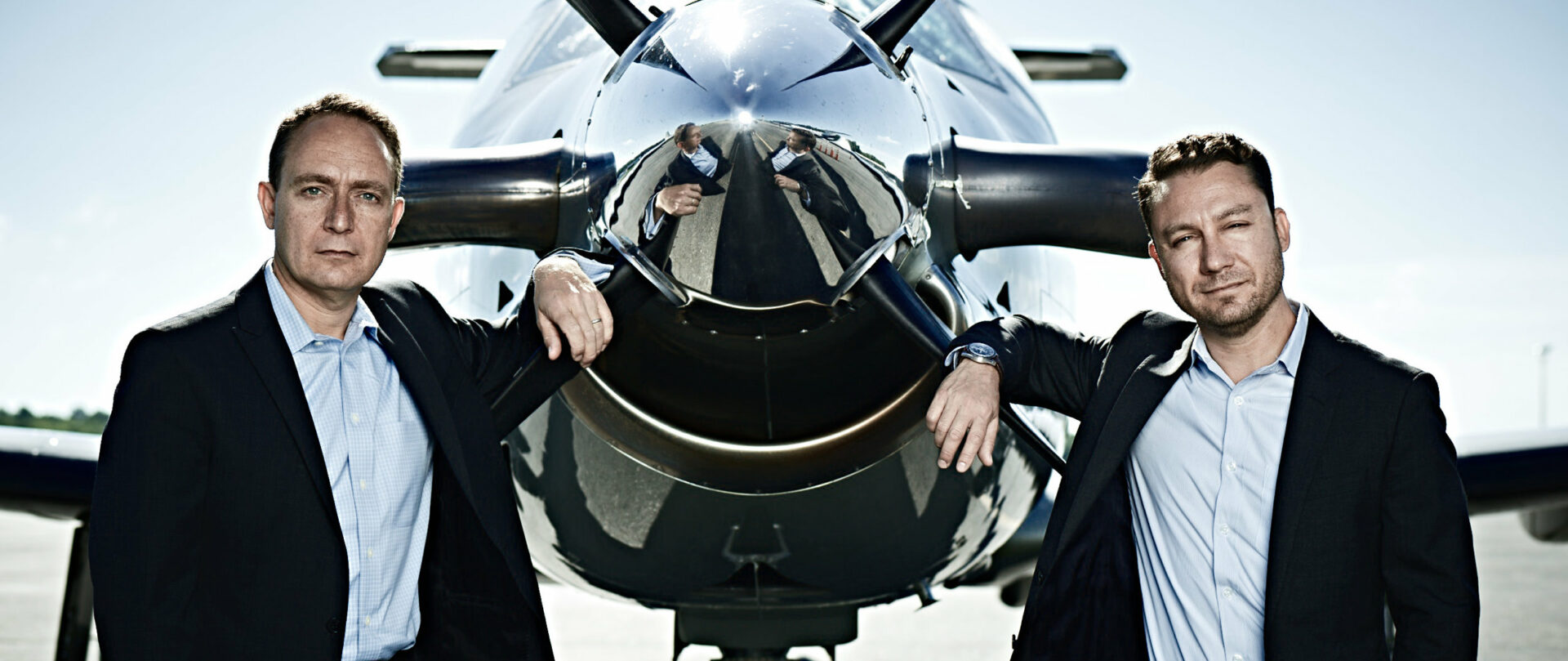
Working with a sibling brought its own running commentary. In 2018, Eric recalled their mother’s continuing surprise that two sons accustomed to rivalry could run a company together. Yet their partnership had a practical foundation: both understood flying, and both had noticed how much room there was to improve a short trip.
A small airplane, a sizeable opening
The initial opportunity lay on routes where a large corporate jet could feel excessive but the alternatives disappointed. A traveler heading from the New York area to an island weekend home still cared about aircraft condition, service and the people in the cockpit. Short distance did not make those expectations disappear. Tradewind’s proposition was to bring more consistent standards to that regional journey.
The company began with a single Cessna Caravan in the aftermath of September 11, 2001. Zipkin’s later account makes the choice sound less like a tidy founding plan than an entrepreneur working with the available facts: insurance constraints changed his options, his freight-flying experience helped make the Caravan insurable, and a repossessed aircraft offered a buying opportunity. The opening depended on preparation, but also on a bank that needed to sell an airplane.
Then customers supplied an important idea. Some wanted only a seat or two and asked whether they could share a flight. The brothers agreed. Scheduled service grew out of that request, allowing passengers to buy individual seats rather than charter an entire aircraft. A question from the customer became part of the operating model.
What if you only needed one seat?
That distinction explains much of Tradewind’s appeal. Someone who values a direct journey may be willing to pay above an ordinary airline fare without wanting the bill for a whole airplane. The market sits between familiar categories, with some of the intimacy of charter and the individual transaction of a scheduled flight.
There was a price to learning how to price it. David later recalled that the brothers initially charged too little for their flights. Private terminals, lounges, parking arrangements and the other pieces of the experience cost money, even when the passenger bought only one seat. Their customers enjoyed the bargain. The company had to learn to account for everything it was promising. That early mistake makes the service proposition more concrete: convenience has expenses attached, and a business needs enough margin to keep delivering it after the introductory enthusiasm wears off.
The spreadsheet has a propeller
In 2003, Tradewind added its first Pilatus PC-12. Zipkin has since acknowledged that he initially doubted its charter prospects. Customers proved more enthusiastic. Being wrong about an airplane can be expensive; this particular error gave the company a useful direction.
The PC-12 became central to his explanation of the business. For the regional distances Tradewind serves, he argues, the aircraft’s operating economics help support the service passengers are buying. A turboprop can offer pressurized comfort without requiring a jet’s cost structure. The airplane is a tool selected for a particular journey, rather than a trophy in search of somewhere to go.
That preference acquired a substantial price tag. In early 2022, Tradewind committed to a $100 million agreement for 20 new PC-12 NGX aircraft. In his 2024 writing, Zipkin described the purchase as a considered investment by a privately controlled business. His case for expansion began with the passenger’s route and worked backward toward the machine.
Infrastructure followed. In 2023, he laid out plans for a 50,000-square-foot hangar complex at Hudson Valley Regional Airport near Poughkeepsie. Its location also put the company near aviation education programs and a wider pool of potential employees. More airplanes would require more space, people and practical support. The glamorous portion of expansion still needed somewhere to park.
The chief executive goes to the shops
In Tradewind’s early days, Zipkin sometimes bought passengers’ requested food and drinks himself before departure. He later used that memory to explain a management problem: a growing company cannot rely on its founder personally making every small thing happen. Hiring capable people only works if they are allowed to exercise judgment.
In 2023, he explained his preference for collaborative leadership. He also described joining new-employee orientation and continuing to fly scheduled operations and conduct pilot checks. For him, the cockpit remained a place to discover how the business actually felt to employees and guests. An executive can receive a report about a flight. A pilot has to experience the flight.
“We have a philosophy of collaboration over delegation.”
Eric Zipkin, 2023
His interest in flying also produced an elaborate group photograph. Zipkin conceived a formation of a dozen Tradewind PC-12s and persuaded Pilatus to support it. A B-25 carried the photographer; the turboprops assembled near Oxford and flew over Long Island Sound. Months of preparation went into the choreography. The result combined marketing with the unmistakable pleasure of getting airplanes together in the sky.
By May 2025, his public conversations also included the careers being built inside the company. An Aviation Careers Podcast appearance covered pilot pathways, the kind of person who might find the work fulfilling and the company’s culture. For an operator that needs trained people as well as aircraft, the next generation’s ambitions belong in the business discussion, alongside the destinations passengers want to reach.
Fifteen airplanes and a much longer journey
A different formation began with disappointment. Zipkin flew the C-47 Placid Lassie to Europe for the seventieth anniversary of D-Day in 2014. Only two American C-47s made that trip. He wanted the next anniversary to bring a larger contingent.
With others, he helped establish the Tunison Foundation, named for Ed Tunison, Placid Lassie’s wartime radio operator. The foundation was created in 2017, following Tunison’s death the previous year. The D-Day Squadron brought aircraft owners, crews and supporters into an effort to get more vintage transports across the ocean for 2019.
Zipkin served as director of air operations and piloted Placid Lassie. The route involved Canada, Greenland and Iceland on the way to Europe. Such a journey turns commemoration into fuel planning, weather decisions, maintenance and coordination. Affection for an old airplane does not exempt it from the demands of an ocean.
Zipkin flies Placid Lassie to the seventieth anniversary.
15 American C-47 variants cross for the seventy-fifth.
Father and son join Placid Lassie’s crossing crew.
Fifteen American aircraft made the 2019 crossing for the D-Day anniversary and associated commemorations. At AirVenture afterward, Zipkin kept the comparison with wartime crews in perspective: modern pilots had the advantage of decades of technological progress. “Our job was made a whole lot easier by 75 years of technology,” he said. The achievement mattered to him without requiring him to borrow the veterans’ courage.
In 2024, his son Luc joined him among Placid Lassie’s crossing pilots. Luc’s account describes the ocean south of Greenland, an elderly airplane moving at about 130 knots, and the modern equipment that made their journey different from its wartime predecessors. Another generation was learning what it took to keep these machines traveling.
An airport, and an old acquaintance
Closer to home, Zipkin and fellow pilot Bill McEnery bought Goodspeed Airport in East Haddam in 2020. Both had kept airplanes there. Their improvements included seaplane access and keeping the airport open through winter, when it had previously closed. Preserving aviation sometimes means getting snow cleared so someone else can fly.
In September 2026, Zipkin discussed another return: piloting a DC-3 floatplane in Maine. He remembered encountering that same aircraft around age nineteen or twenty, after flying north to build hours and discovering that early spring in Maine looked considerably less springlike than Connecticut. Looking for fuel, he met aviation operator Dick Folsom, who showed him the airplane.
Decades later, his combination of DC-3 and floatplane experience helped bring him back to its cockpit. The company founder who once took his wife’s advice about earning money at the airport had acquired another reason to stay there. Some journeys get shorter with experience. Others take years to reach the departure point.
More time in the cockpit
Watch Zipkin explain flying the DC-3: Part one, part two and part three.