Before Tyson Weihs helped put flight planning on an iPad, he learned something about customer service in a restaurant: you have to earn your reputation again at the next table. His father ran restaurants. His mother made art. One parent had customers to feed, the other had work to create and sell. Their son eventually found a profession that required a little of both, with rather more concern about the weather.
Weihs co-founded ForeFlight with Jason Miller and Adam Houghton in 2007. He spent 15 years as CEO, through its acquisition by Boeing in 2019. The familiar corporate outline is accurate enough. It also leaves out the interesting part: how a programmer from a family of independent workers came to care so much about the untidy business of preparing an airplane to go somewhere.
His route into the cockpit included computers, a first business, a disappointing lesson in dealmaking, and a job where the people in charge happened to fly. Aviation arrived through the office door.
A restaurant education, with a keyboard
Weihs remembers learning to walk in one of his father’s restaurants. Later came busing tables, waiting on customers and hosting. He was writing code for the family business in his early teens. The restaurant offered an unusually practical introduction to software: there was a business right there, with people doing work that a useful program might improve.
His father had emigrated from Germany to the United States in 1969 with $600. His mother’s work included painting and calligraphy. Weihs grew up around the effort of making something, presenting it to another person and hoping that person would pay. Creativity and commerce occupied the same household.
The connection to ForeFlight is easy to see, though a menu and an aviation chart have different consequences. An interface presents choices. A customer discovers whether those choices make sense. Someone has to answer when the experience falls short. The polish visible at the front depends on work happening out of sight.
His formal education joined the two sides: finance and computer science at Trinity University, followed by an MBA at Rice. He graduated Phi Beta Kappa from Trinity and earned his MBA with honors. In his case, the person discussing the business could also understand what the programmers were trying to build.
The first exit had a catch
At Trinity, Weihs joined two fellow students to start an e-commerce consultancy in 1998. They helped businesses move online and sold the company the following year. It sounds like a nicely compressed entrepreneurial education: find a market, build something useful, sell it.
The payment was stock. An 18-month lockup kept the founders from selling while the dot-com market performed its expensive disappearing act. Weihs later recalled the shares climbing from $6 to $96 before falling to zero. A successful transaction and a successful financial outcome, he discovered, can be separated by a very large decimal point.
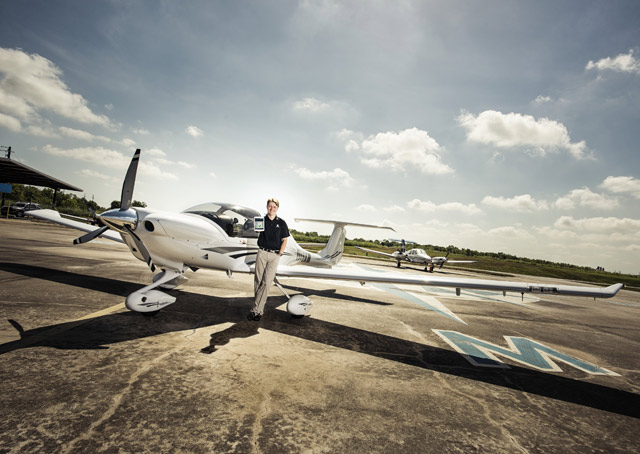
After that came Benefitfocus in Charleston, South Carolina. His colleagues included pilots, and a flight with his boss helped draw him into aviation. Flying lessons followed. By the end of business school in 2006, he had earned his pilot’s license.
The sequence matters. He encountered aviation as a participant, with things to learn and procedures to follow. A flight-planning problem was something he could experience personally, then examine with the habits of a software developer. He did not have to imagine the customer’s frustration from a conference room.
Three Apple arrivals, one opening
Weihs was working on a web project to make aviation weather reports and forecasts easier to check. Miller had developed a desktop application called ForeFlight. They combined their projects, initially thinking about a better airport-information website. Then Apple introduced the iPhone.
That changed their destination. The phone provided a new place to put information a pilot might need away from a desk. The App Store supplied a way to distribute the software. The iPad, arriving in 2010, provided a larger screen. Each development gave the founders another decision to make.
The neatness of those milestones can make the outcome look prearranged. It was less tidy at the time. Weihs has described the early company as a hobby business, and he kept his day job until 2011. The founders were building into a market that was still taking shape, alongside devices whose eventual uses were far from settled.
A new device
A route to pilots
Room for charts
Three changes in the platform. Three chances to rethink the product.
ForeFlight Mobile appeared on the App Store’s opening day in July 2008. Its price attracted attention as the store’s most expensive app. A year later, the company’s birthday report counted tens of thousands of new customers, three major flagship upgrades and hundreds of server updates. The public novelty was an expensive phone app. The less photogenic achievement was keeping the machinery running.
That first-year report also celebrated a volunteer beta-testing team and opportunities to meet customers at aviation gatherings. Even the company’s early accounting mixed software releases with conversations. The people using the product were part of its development, rather than an audience waiting at the end.
Good design has to survive a flight
ForeFlight brought together weather, airport information, charts and planning functions. The usefulness lay partly in their proximity. A pilot could work through related questions within one application, rather than gather separate pieces and reconcile them by hand.
There is a particular kind of design challenge in that work. A screen has limited room; aviation has an ample supply of information. Making everything available is easier than making the next useful thing easy to find. Software can transfer clerical work away from the pilot, but it still has to present the result clearly enough to inspect.
“Every dollar you put in design yields 10 in return.”
Tyson Weihs, 2015
By 2015, ForeFlight’s leadership was scoring prospective features against available developer time, customer growth and retention. The release goal was every six to eight weeks. This gave an apparently restless product a method: ideas competed for time, and the team had to decide which ones deserved it.
Weihs could discuss databases and user experience, then turn around and advocate for the business in public. Those are useful neighboring abilities in a founder. The engineering explains what can be built. The commercial conversation helps determine whether anyone needs it enough to keep paying.
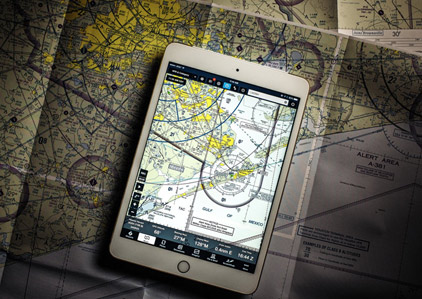
Partnerships made the application more useful, too. ForeFlight worked with Appareo and Sporty’s on the Stratus receiver, bringing portable weather and traffic capabilities into the picture. Collaboration mattered because an app in a cockpit has to coexist with equipment, data providers and established ways of working. A beautiful screen is only one part of the arrangement.
The customer became the buyer
The relationship with Jeppesen offered another example. In 2016, ForeFlight teamed with the Boeing-owned aviation-data business to offer its charts within ForeFlight. They also worked together on commercial flight-deck software. An established charting company and a younger application developer had reasons to become increasingly useful to one another.
On March 6, 2019, Boeing announced that it had completed its acquisition of ForeFlight. The Houston-based company then had approximately 180 employees. The price was not disclosed.
For a pilot, ownership was a less immediate question than what would happen to the application. Weihs spoke publicly about the deal and the continuation of product development. The familiar practical concerns followed the corporate news: would the tools keep improving, and would general aviation still have a place?
The acquisition belonged to the same broad story as the product’s partnerships. ForeFlight had become embedded in an industry with long-established institutions. Weihs’s work now included maintaining those relationships alongside the software. Building something people depend on brings a growing collection of people with whom you must cooperate.
An award, then another set of projects
In 2023, the National Aviation Hall of Fame selected Weihs for its Armstrong Award, recognizing innovation, aviation safety and service. His other honors include membership in the Texas Aviation Hall of Fame and aviation-industry entrepreneurship awards. Recognition came for work done through software, an unusually portable contribution to a business full of very large machines.
His involvement continued beyond the CEO’s office. Weihs joined NBAA’s board in 2021 and was re-elected in October 2025. Its current biography lists him with Makana Holdings Management. He remains an active pilot, with commercial ratings covering single-engine, multi-engine and turbojet aircraft.
Today, his personal website places him in Aspen, Colorado. He is a partner at Airspeed Partners, the investment partnership started by ForeFlight’s co-founders. His board work includes Signature Aviation, Natural Atlas and Surfline, with an advisory role at MITRE’s aviation research center.
He is also building again. AI-assisted engineering occupies his attention, particularly the question of how much a small team can accomplish. Shoot Schedule, a project for the clay-target community, gives that interest a concrete outlet. The subject is different; the habit of turning a personal interest into software is familiar.
There is room for skiing, tennis, fishing and competitive clay shooting, too. The programmer who found aviation through work now has rather a lot of reasons to close the laptop. Still, his current projects suggest that he continues to notice jobs a useful program could do. Somewhere between the customer’s request and the finished experience, there is usually another task waiting.
Keep the conversation going
WATCH & LISTEN
At Oshkosh with Tyson WeihsBetween Two Wings · 2021 · YouTube ↗The Boeing acquisition conversationAOPA · 2019 · YouTube ↗ELSEWHERE
- Personal website ↗
- LinkedIn ↗
- X / Twitter ↗
- ForeFlight ↗
- Take the Long View: full interview ↗
- Texas Business Hall of Fame: Q&A ↗
- AOPA: the 2015 profile ↗
- Plane + Pilot: the early product story ↗
- ForeFlight: its first App Store year ↗
- Boeing: the 2019 acquisition ↗
- NBAA: board biography ↗
- NBAA: Armstrong Award ↗