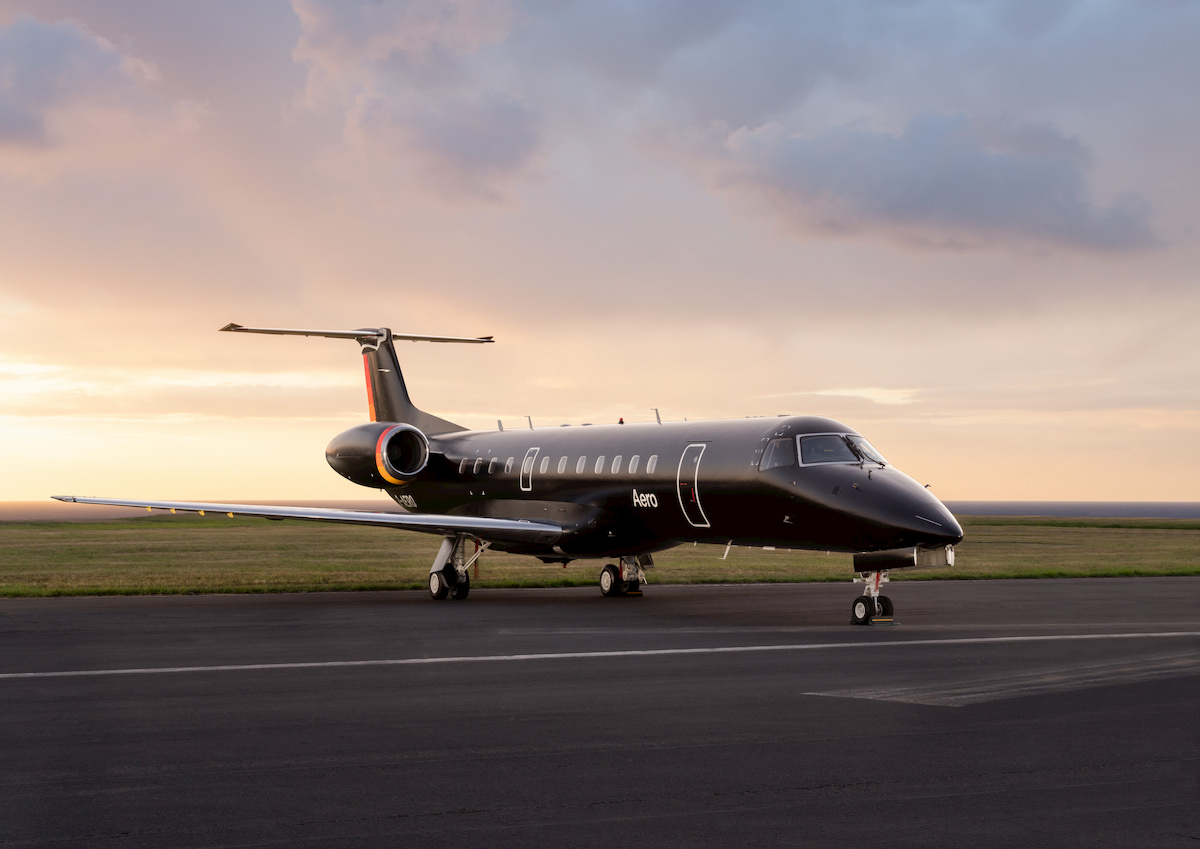
Dispatch from the ramp
A black jet, sixteen seats, and a runway with no crowd
It is a Thursday morning at Van Nuys, and the line for the jet is not a line at all. A handful of people drift through a private terminal, champagne or fresh juice in hand, twenty minutes before wheels-up. There is no boarding group. No middle seat. No shoe removal theater. They walk onto an all-black Embraer, sink into Italian leather, and lift off toward Aspen. This is Aero - and it has spent the better part of a decade arguing that the airport, not the flight, was always the thing we hated.
Aero is a semi-private airline. The phrase sounds like marketing, and partly it is, but it describes something specific: you buy a single seat, the way you would on any airline, except the airplane is a 16-seat business jet flying out of a private terminal. The result sits in a gap most travelers assumed was empty - more civilized than first class, less ruinous than chartering the whole aircraft.
Aero sells the part of private aviation everyone wants - the seat - and quietly skips the part nobody can afford, which is all the other seats.
// The pitch, compressed
The problem they saw
First class got you a wider chair. It did not get you out of the line.
Commercial flying optimized for one number: the cost per seat. Everything else - the security maze, the gate scrum, the 90-minute buffer, the contest for overhead bins - is the price of cramming hundreds of strangers through a single jet bridge. Private charter solves all of it and replaces it with a different problem: you have to buy the whole plane, which is a fine idea if you also enjoy buying whole planes.
Between those two worlds, there was a stretch of nobody's land. A premium-cabin flyer paying real money to Aspen was still standing in the same line as everyone else. The friction wasn't the seat. The friction was the system around it.
The gap between first class and private charter is not an accident of pricing. It is a market that nobody had bothered to build an airline for.
// Why Aero exists
That gap is the central tension of this entire company. Everything Aero builds - the terminals, the 16-seat cabins, the 20-minute arrival window - is an answer to one question: what if the seat stayed roughly affordable, but the airport disappeared?
The founders' bet
It started as software. Then it bought jets.
Aero was conceived in 2019 inside Expa, the startup studio founded by Garrett Camp - the same Garrett Camp who co-founded Uber. The original idea was tidy and very Silicon Valley: build a software layer to make booking private jets simple. The "Uber for jets," more or less. Tidy ideas have a habit of meeting reality, and reality said the experience could not be fixed from the outside. To control the seat, the terminal, the timing and the feel, Aero would have to become an actual airline.
So it did. Camp personally chose the all-black exterior livery, which is either a branding decision or a statement of intent, depending on how cynical you are feeling. The first routes connected Mykonos and Ibiza - two islands not famous for their patience with logistics. In 2021 the company crossed the Atlantic and planted a flagship terminal at Van Nuys in Los Angeles.
The studio
Incubated at Expa, Garrett Camp's startup studio, which still backs and helps design the company.
The pivot
From a booking app to a fully operated semi-private airline running its own fleet and terminals.
The look
An unmistakable all-black livery, hand-picked by Camp, so the planes read as Aero from across the ramp.
You cannot redesign the feeling of flying from a phone screen. At some point you have to own the airplane.
// The bet, in one line
The product
Sixteen seats, suede walls, and a clock that runs backwards
Aero's signature aircraft is an Embraer ERJ-135 - a regional jet most people have flown without affection - stripped out and rebuilt to hold just 16 passengers. The seats are handcrafted Italian leather in a 1-1 layout, which is a polite way of saying no one is ever in the middle. The walls are lined in suede to kill cabin noise. For groups and bespoke trips, the fleet also reaches into larger metal: Gulfstream IV-SP and Embraer Legacy 600 charters.
The real product, though, is the time you don't spend. Show up about 20 minutes before departure. Walk through a private lounge with champagne, fresh juice and light bites. Skip the security choreography. Generous baggage. Fast boarding. The flight to Aspen takes the same number of hours it always did; the day around it gets a few hours back.
Book by the seat
Buy one ticket, not a charter. Strangers share the cabin the civilized way.
Private terminals
Dedicated lounges - champagne, juice, light bites - and a ~20-minute arrival window.
The cabin
16 Italian-leather seats, 1-1 layout, suede walls for quiet. No middle, ever.
Full charter
On-demand whole-aircraft flights on Gulfstream and Legacy jets for groups.
The flight is the same length it always was. Aero only deletes the two ugly hours bolted to either end.
// What you actually buy
The proof
The numbers behind the twenty-minute airport
Skepticism is fair. Semi-private aviation is a graveyard of good intentions, and "luxury that scales" is a sentence that has bankrupted plenty of founders. So look at what's measurable. Aero raised real money from real investors, built a fleet, and parked itself in a price band that genuinely undercuts charter while sitting above commercial first class.
Where Aero sits on price
Relative cost positioning per traveler · illustrative, directional
Aero's published charter rates run roughly $800-$1,000 per flight hour; on peak routes like Aspen, per-seat fares get competitive with first class. Positioning is directional, not a quote.
$135M+
Total funding raised
$300M
Post-Series-B valuation
16
Seats per signature jet
~20 min
Pre-flight arrival
Anyone can promise luxury. The harder trick is promising it at a price a second-home owner will actually pay twice.
// The real test
The customer is not, despite appearances, the billionaire - that person already owns the plane. Aero's traveler is the premium-cabin flyer, the Aspen regular, the person who values the recovered afternoon more than the bragging rights. Backers including AlbaCore, Keyframe, Expa and Capital One Ventures wrote checks on the theory that there are a lot of those people.
The mission
Bringing the magic back to flying, minus the cigarettes
Aero talks about the "golden age of aviation" - that mid-century image of flying as an event rather than an ordeal. The company's stated values are almost stubbornly un-tech: curation over endless selection, authenticity over influence, ease over extravagance. It is a hospitality pitch wearing an airline's clothes.
That framing matters because it sets the ceiling and the floor. Aero is not trying to be the cheapest way to Aspen. It is trying to be the version where the journey is, in its own words, as remarkable as the destination - and where the most luxurious thing on offer is simply not wasting your day.
Things that amuse and inform
- Aero began life as software - the "Uber for jets" - before anyone bought an actual airplane.
- Garrett Camp personally chose the all-black livery, so the fleet is recognizable from across the tarmac.
- Cabin walls are lined in suede - not for looks, but to quiet the jet.
- 1-1 seating means the middle seat does not exist on the signature aircraft.
- Its first two markets were Mykonos and Ibiza, which tells you who it was built for.
The most luxurious amenity Aero offers is not the champagne. It is the afternoon you get back.
// Mission, distilled
Why it matters tomorrow
The runway with no crowd, scaled
Regional flying is the part of aviation everyone forgot to love. Short hops, tired jets, long lines for a 90-minute flight. If Aero is right, the unit of premium travel stops being the whole airplane and becomes, simply, the seat - bought one at a time, flown out of small terminals, on routes the big carriers treat as an afterthought. That is a much larger idea than a luxury brand for Aspen weekends.
The risks are real and worth naming: semi-private economics are unforgiving, leadership has turned over, and "premium that scales" remains an unsolved problem across the industry. Curiosity, not faith, is the right posture here.
But return to that Thursday morning at Van Nuys. The line that isn't a line. The champagne, the leather, the black jet, the twenty minutes. A decade ago that experience required owning an aircraft or knowing someone who did. Aero turned it into a ticket. Whether the model holds at scale is the open question - but the airport, the thing we all actually hated, is the part it already deleted.
Aero did not make flying faster. It made the airport almost disappear - and then sold you a seat to the part that was always worth keeping.
// Last word