Roman Medvedev's first professional advantage was a language. Before he built an international software business, before Salesforce became its focus, his English helped him get a job while he was still at university in Minsk. In 1995, after graduation, that employer sent him to San Francisco. The assignment lasted five months. A subsequent trip brought an offer from an American company, a work visa and a longer stay. A business journey had acquired the inconvenient habit of becoming a life.
He founded VRP Consulting in 1998. The early company worked with C++ and databases, taking the paid assignments available to a small team. There is something refreshing about that beginning. No elaborate retrospective prophecy is required. A programmer knew how to do useful work, customers needed it done, and a company formed around the exchange. The specialization would come later.
Today, Medvedev is VRP's founder, president and CEO. His career also includes co-founding Appinium, where he is listed as CTO and co-founder, and establishing the aviation business VRP Avia. Software services, software products and flying might look like three separate enthusiasms. Read together, they make a more interesting story about someone willing to learn a system from the inside, then rearrange the way people use it.
The assignment that became an address
Medvedev studied at the Belarusian State University of Informatics and Radioelectronics, graduating in 1995. His early work connected him with customers in the United States and Germany. The route to California therefore began with a client relationship rather than a grand announcement about conquering Silicon Valley. An overseas assignment gave him a place to start; subsequent jobs gave him experience before he opened his own company.
The distinction matters. Consulting businesses earn their existence one engagement at a time. A customer must trust that the person arriving with a technical vocabulary can also understand a practical problem. Medvedev's early advantage in English belongs to that commercial story as much as to his biography. Code could get the job done. Conversation could get the job started.
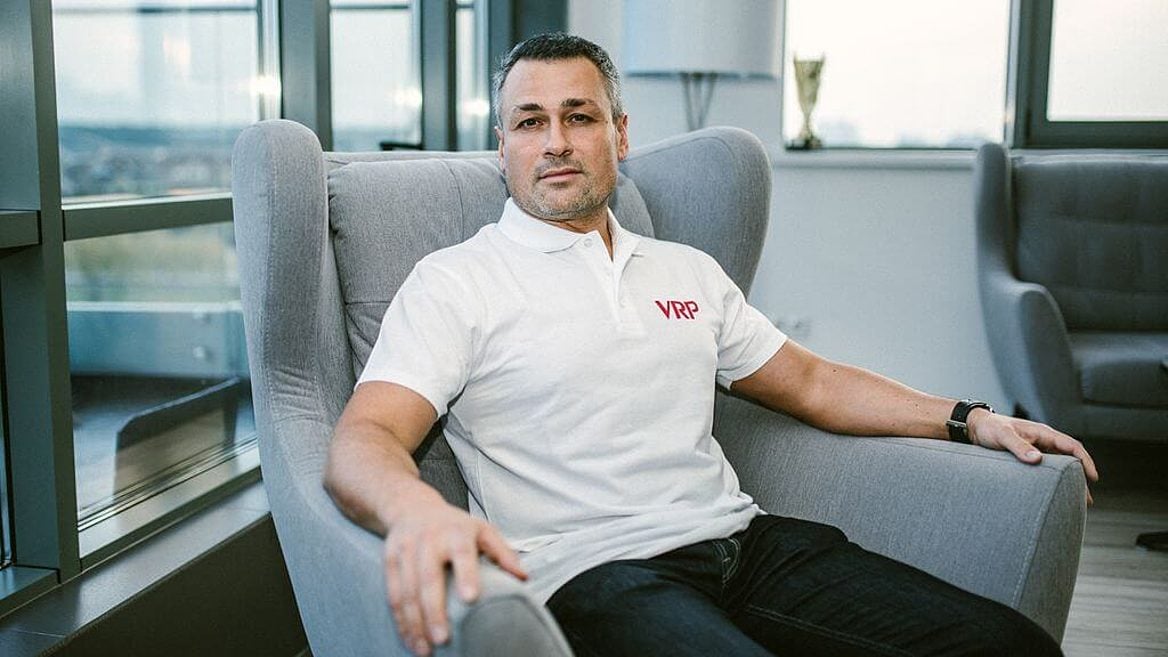
His later professional record spans database development, software architecture and consulting. It includes work for Cisco, the San Francisco Foundation and Marin Community Foundation. Those roles put the eventual company leader close to the mechanics of implementation. Different organizations have different purposes, but each needs software that survives contact with its own people and procedures. That is a useful apprenticeship for someone who will spend years selling technical delivery.
A smaller company meets a larger problem
The collapse of the technology market in 2000 arrived when VRP was still small. Its work and employees were concentrated in America. Medvedev has described that period as the point when the company changed its delivery model, recruiting programmers for offices beyond the United States and pairing regional customer relationships with distributed technical teams. A market shock forced an organizational decision.
The model carried a practical bargain. Clients could retain a nearby relationship while development work drew on a wider pool of people. For a growing consultancy, this made geography part of the design of the business. An office could bring the company closer to a customer; another could supply the people needed to deliver the work. The two jobs did not have to happen in the same room.
Business understanding
Shared delivery capacity
Years later, Medvedev's advice about outsourcing still revolved around those connections. In a 2020 article, he urged buyers to define their needs, examine the breadth of a partner's expertise and look for flexible contracts. He also emphasized spare technical capacity, clear communication, experience with remote work and compatible values. It is a buyer's checklist written by someone who also has to supply the answers.
The spare capacity point is particularly revealing. A client may need fewer people this month and more next month. A consultancy has to absorb those changes without turning every adjustment into a fresh recruitment campaign. Medvedev described moving expertise between accounts and developing employees across different kinds of work. Flexibility, in that account, requires organization behind the scenes. Someone has to make the calendar behave.
A software founder can describe expansion through offices and projects. An employee encounters it through a manager, a handover or the ability to reach a colleague. A customer encounters it when a question receives an answer. That is why Medvedev's repeated attention to communication deserves space beside the milestones. The organizational decisions give the company its reach; the everyday exchanges determine whether that reach is useful. His career began with the ability to cross a language barrier. The business he built has continued to depend on people crossing other kinds of distance.
The decision to get specific
VRP began as a general IT outsourcing company and subsequently concentrated on Salesforce. Its public histories place that transition around the end of the 2000s. The broader direction is clear: a business that once accepted varied programming assignments developed a defined platform specialty. The bet narrowed the technical territory while opening several kinds of work inside it.
There is a useful distinction between implementing a platform for a customer and building a product that other customers will buy. VRP developed capabilities in both. Consulting and integration address an organization's own systems. Product development outsourcing helps independent software vendors create applications for the Salesforce ecosystem. A shared platform connects the work, but the customer's commercial problem changes.
Medvedev has written about that second audience, explaining how an outside product development partner can help software vendors with expertise, delivery capacity and responses to changing requirements. He has also argued for looking beyond the immediate build to the way an application will work for its users. The recurring concern is whether a technical team understands the business surrounding the software.
His Appinium role gives that concern a personal dimension. The company identifies him as CTO and co-founder alongside CEO and co-founder Steve Jacobson. Appinium works with content and learning inside Salesforce. Medvedev's professional life therefore includes the supplier's side of developing software and a founder's stake in a product company. The two perspectives meet at a familiar question: what will people actually do with this?
Buying a relationship, building a presence
In October 2017, VRP announced its acquisition of CodeSWAT and a new UK office. The companies had already worked together as strategic partners. Medvedev explained the combination in terms of bringing Salesforce knowledge together with experience across industries. CodeSWAT's presence in Britain, Scandinavia, Benelux and the DACH markets helped extend the company's European reach.
This was a concrete expression of the delivery model. Technical capacity alone could not do every job involved in winning and keeping international clients. Local presence and industry knowledge had work to do as well. A customer buying an implementation needs more than a distant assurance that capable programmers exist somewhere. Someone must understand the problem, remain accessible and take responsibility when the project becomes complicated.
- 1995A San Francisco assignment after university
- 1998VRP Consulting is founded
- 2014Appinium co-founder and CTO role begins
- 2017CodeSWAT acquisition and UK expansion
- 2020Salesforce Platinum partner status announced
The company's Salesforce Gold partner announcement followed in December 2019, with Platinum announced in December 2020. These are dated milestones in a changing partner program, rather than permanent labels to pin on every year of the company's history. VRP's current biography identifies it as a Summit partner and credits Medvedev's leadership with expansion to more than ten offices and completion of over 2,000 projects.
Those project totals describe a collective effort. They belong to consultants, architects, developers, managers and customers as well as to the founder. Medvedev's part in the story is the sustained choice of what kind of organization would assemble those people. The interesting growth measure is how much of the work could move beyond the founder's own keyboard.
The cost of keeping everything
Medvedev's reflections on managing disruption are unusually attentive to things a leader may have to give up. In 2020 he described stronger financial reserves, readily available financial information and cuts to nonessential expenses. He acknowledged the difficulty of relinquishing an office in which the company had invested. An attractive room can become a surprisingly persuasive argument for continuing to pay for it.
“Putting people first is one of our fundamental commitments.”
Roman Medvedev · 2020
The difficulty lies in making such a commitment operational. His account included difficult conversations with employees and a willingness to change arrangements that no longer fitted the business. It leaves a more demanding portrait than a slogan about resilience would offer. Leadership involves explaining trade-offs to people who will feel them, while making decisions early enough to preserve room for the next one.
Another kind of cockpit
Aviation introduces a different scale of responsibility. Medvedev took private-pilot training in California and later created VRP Avia in Belarus, drawing on the experience of being a student himself. The business combined pilot instruction with sightseeing flights. He has described the satisfaction of flying and an ambition to travel around the world in a single-engine aircraft. That ambition remains a stated plan.
Even the name carried a little business history: VRP came from the founders' names and survived changes in the original partnership. It then travelled from consulting into aviation. Initials are admirably economical luggage.
The pilot and the consultancy founder share a practical problem: deciding what to keep constant and what to change. Customers, teams, platforms and markets do not hold still. Neither does an aircraft. Medvedev's career offers no tidy instruction that every programmer should become an entrepreneur or that every entrepreneur needs a flying school. It offers a more particular observation. He has repeatedly built on work he understood, then changed the arrangement around it. The first move was a five-month assignment. The decisions after it made the story.