The beer mat is an underrated piece of office equipment. It requires no password, tolerates interruptions and imposes a useful limit on the length of a business plan. Before there was a Workhuman, Eric Mosley and his childhood friend Jonathan Hyland were drawing database schemas on beer mats in Dublin’s Bleeding Horse pub. The subject was software architecture. The setting, at least, had already solved the problem of bringing people together.
Hyland would become the company’s tenth employee and, eventually, its chief technology officer. Mosley co-founded the business with Eddie Reynolds in 1999. Known in its early days as GloboGifts, it became Globoforce, then Workhuman. Each name tells you something about the distance travelled: from the gift, to the organisation distributing it, to the person on the receiving end.
That last person has occupied Mosley for more than a quarter of a century. The Workhuman co-founder and CEO has built his career around an apparently modest transaction: one colleague notices another’s contribution and says thank you. He has spent years arguing that companies should take this moment seriously enough to organise around it. Now he wants them to read it more closely.
A Dublin idea, built for elsewhere
Mosley grew up in Tallaght, in Dublin. Money was scarce during his childhood. He has described wanting to escape those circumstances, and the fascination with business that took hold early: even television advertisements prompted questions about what companies were trying to achieve. He studied at Trinity College Dublin and worked as an internet consultant at CSK Software before starting his own company. His education was in electronics, computers and telecommunications engineering. It is an apt background for someone whose business would eventually concern itself with a different sort of connection: the kind between people working inside the same organisation.
He describes business ideas as a persistent feature of his life, beginning when he was young in Ireland. His advice to other entrepreneurs is correspondingly practical: “don’t wait, just start testing.” The important word is testing. In his telling, an initial business plan is a proposal to be revised as experience accumulates. The point of starting is to discover what needs changing.
Workhuman’s development gives that advice some substance. A service concerned with gifts became a platform for recognition, rewards and feedback. Mosley did not leave behind his appetite for new businesses; he found room for it inside the existing one. New products could become the place to try an idea without having to start another company every time curiosity struck.
The enterprise also developed a transatlantic shape, with headquarters in Dublin and Framingham, Massachusetts. Mosley’s public professional profile places him in Greater Boston. That geography helps explain the character of the story: Irish origins, an American business presence and a product designed for organisations whose employees do not all share a building, a currency or a working day.
Who gets to notice?
There is a question of authority tucked inside employee recognition. Who decides that somebody has done good work? The conventional answer gives considerable power to the manager. Mosley’s answer opens the conversation to colleagues. They are present for contributions that a reporting line may never capture. A company can have an elaborate hierarchy and still possess a rather incomplete account of its own working life.
His 2013 book, The Crowdsourced Performance Review, made that argument explicit. Its subject was the use of social recognition to change employee performance management. Crowdsourcing, in this context, means gathering perspectives from the people around an employee. The appeal is understandable: a review should have more to work with than the memory and vantage point of one person.
Subsequent books widened the frame. With Workhuman colleague Derek Irvine, Mosley co-authored The Power of Thanks and Making Work Human. The titles move from a particular management procedure towards a larger concern with everyday behaviour. A review is an event on the calendar. Gratitude can happen on a Tuesday afternoon, before anybody remembers to open the annual form.
Mosley has described a culture framework organised around thanking, talking and celebrating. There is an unembarrassed simplicity to it. His interest lies in making these acts repeatable across an organisation, while preserving the personal meaning that makes them worthwhile. Software can provide an occasion and a mechanism. Somebody still has to notice what another person did.
“don’t wait, just start testing.”
Eric Mosley, on starting a business
When the gathering outgrew the name
Workhuman also became a place where people gathered in person. Its first conference took place in 2015. The event created room for arguments about management and motivation that stretched beyond a product demonstration. By 2019, the conference name had become sufficiently recognisable that Globoforce adopted it as the company’s own.
It is an amusing reversal of the usual corporate arrangement. Businesses generally name an event after themselves and then spend money persuading people to remember it. Here, the gathering supplied the identity. Mosley explained that the Workhuman brand had become bigger than the company’s existing name. The change made the language outside the organisation match the conversation taking place within it.
The rebrand arrived with something more tangible than new stationery. In February 2019, the company opened its expanded Dublin headquarters following a €4 million investment and announced plans for 150 additional jobs over three years. The international business was maintaining a physical commitment to the city where it began. A company selling connection was also buying more space for people to work together.
The next year brought a billion-dollar valuation. By August 2025, when Mosley sat down for a podcast conversation with HR analyst Josh Bersin, Workhuman had more than 7.7 million users. The scale gives his original proposition a different weight. What began with making recognition easier had become a system through which millions of people could describe what they valued in one another’s work.
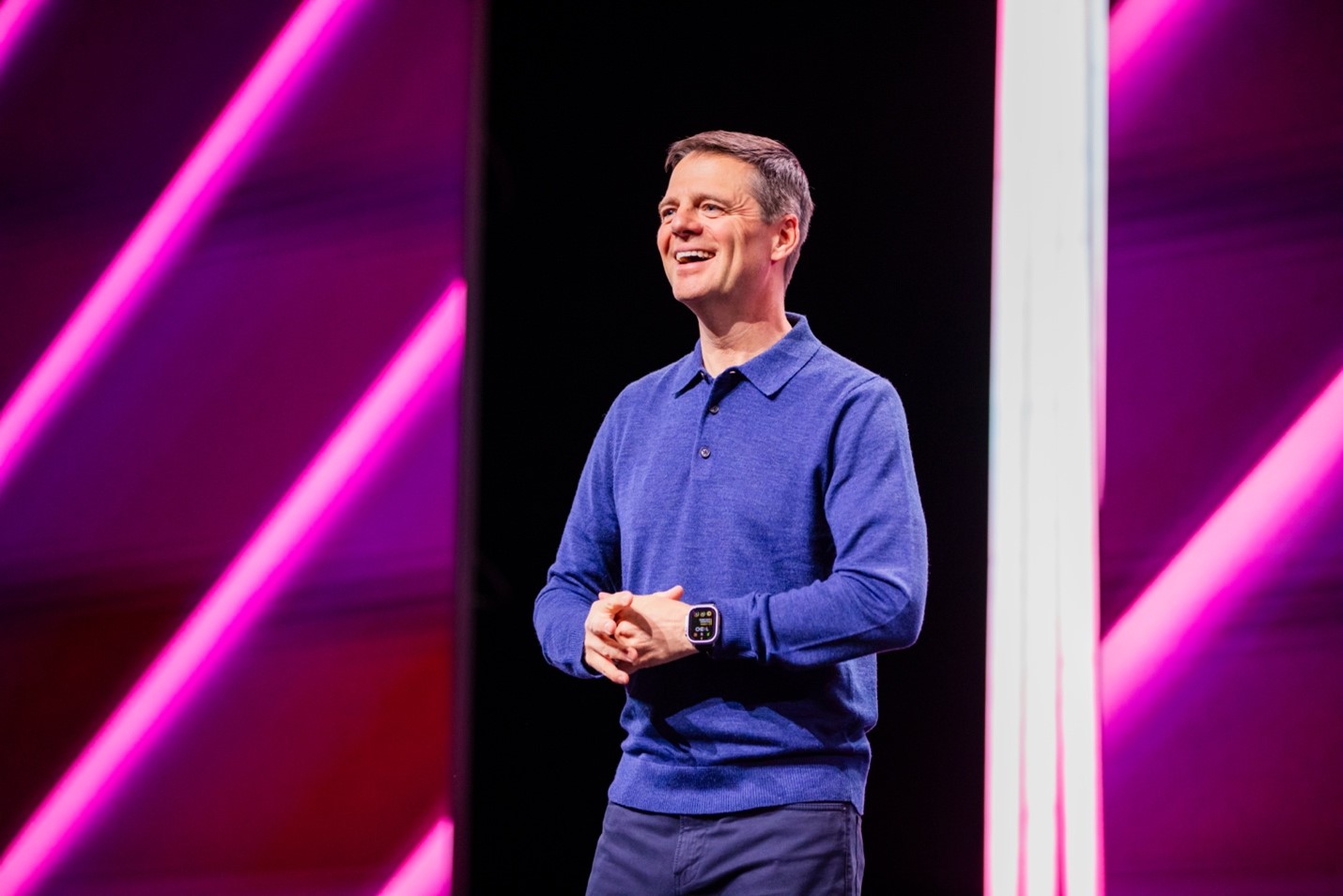
Workhuman users, reported in Josh Bersin’s conversation with Mosley.
The information inside the compliment
Mosley’s more recent work turns on a second reading of those messages. Recognition does something for the recipient. It also describes an activity. The words can identify a skill, a collaboration or a contribution that would otherwise leave little trace in a formal personnel record. An expression of gratitude becomes evidence of how a piece of work happened.
In his 2024 keynote, he unpacked the ingredients: the person giving recognition, the colleague receiving it, the description of the contribution and its relationship to company values. Taken together, these messages can show connections across an organisation. It is a view of the workplace drawn from people acknowledging each other, rather than solely from departments and job titles.
At Workhuman Live in Denver in 2025, he explored a recognition message from the company’s own Spark programme. Comments around an employee’s promotion suggested recurring qualities. Mosley’s argument was that multiple observations, collected over time, could reveal patterns that an isolated compliment could not. He calls the combination of recognition data and AI Human Intelligence.
- 01A colleague noticesA contribution becomes visible.
- 02They describe the workThe message records what mattered.
- 03Patterns accumulateConnections and skills can emerge over time.
He has also brought organisational psychologist Adam Grant into this discussion. Their conversation ahead of the 2025 conference considered how recognition could help people see abilities that had gone unnoticed. Grant pointed to the value for the giver as well as the recipient. Mosley’s recurring interest is in that exchange: a useful piece of information and a relationship being strengthened at the same time.
Still looking for the next chapter
By April 2026, Mosley was applying this reasoning to leadership development. At Workhuman Live in Orlando, he introduced Future Leaders, a product built on the company’s recognition data. Workhuman describes it as a patent-pending AI model intended to identify future senior leaders years before their promotion. That is the company’s claim for the tool; the ambition is to make emerging talent visible earlier.
His argument on that stage was that widely available AI would place renewed importance on the people using it. If competitors can obtain similar tools, the differences between their teams still matter. In that telling, technology increases the value of understanding employees. Recognition becomes part of the effort to see who contributes, who connects others and who may be ready for more responsibility.
The idea has accompanied him into conversations well beyond HR conferences. At Davos in 2025, he appeared with journalist Phillipa Leighton-Jones and McKinsey’s Lareina Yee at the Female Quotient Equity Lounge. The subject now travels between software, leadership and AI. Yet the starting point remains small enough to fit in an ordinary exchange between colleagues.
There is a personal restlessness beneath this long attachment to one company. Mosley has spoken about once imagining that reaching a financial milestone would allow him to relax, then discovering that his drive continued. He seems to have found a business large enough to accommodate that appetite: the same basic human act keeps yielding another question to investigate.
Return to the beer mat and the distance becomes easier to appreciate. A drawing of a database asks where information belongs and how its pieces connect. Mosley is still occupied with connections, now inside the working lives of millions of people. A colleague notices something worth thanking. His company asks what happens next. The person receiving the message, with any luck, gets to enjoy it first.
Keep the conversation going
Explore Mosley’s ideas in his own words and longer conversations.
- Workhuman - company website ↗
- Eric Mosley on LinkedIn ↗ · Twitter / X ↗
- Watch: How Recognition Data Powers AI & Finds Hidden Talent ↗
- Watch: How Recognition Drives Engagement and Retention ↗
- Listen: Making Work Human with Brené Brown ↗
- Listen: Josh Bersin’s conversation with Mosley ↗
- Read: Mosley’s reflections on his Denver keynote ↗
- Read: The Dublin beginnings and Jonathan Hyland’s recollections ↗