In January 2025, Eric Ingram announced that he was leaving the day-to-day work of the company he had founded. Scout Space had sent two payloads to space during his time there. He had spent five years as chief executive and another year as chief strategy officer. Now he would stay on the board, advise the team and let other people run the business. For a founder, that is an unusually practical way to celebrate success: make yourself less necessary.
A company can occupy nearly every available corner of its founder’s life. Ingram’s announcement treated the handover as an achievement in its own right. Philip Hover-Smoot had taken over as CEO in January 2024. A year later, Ingram was ready to leave the employee role too. The ambition remained attached to Scout; his daily schedule no longer had to be. He described the continuing business as a “self-sustaining enterprise.”
There is a neat symmetry here. Scout develops systems that help spacecraft sense what surrounds them and operate with greater autonomy. Its co-founder had reached the human version of that problem: how to build something capable of functioning without your constant intervention. A founder may enjoy being indispensable. The rest of the organisation needs room to become competent without asking him first.
2019-2024, followed by a year in strategy and a continuing board role.
Before orbit, there was a cockpit
Ingram’s route into aerospace included time at the controls of an aircraft. He trained through Able Flight’s class of 2011 and earned a sport pilot certificate. By 2016 he was preparing to move from Houston to Washington, D.C., for an aerospace engineering job at the Federal Aviation Administration’s Office of Commercial Space Transportation. His childhood friend and fellow Able Flight classmate Kevin Crombie was already working there as a safety officer. The space industry, vast in ambition, can be a surprisingly small place to meet an old friend.
He graduated from Old Dominion University in 2013 with a physics degree. His studies also took him to the University of Houston for electrical engineering. He completed coursework and much of his thesis research, then took a job before finishing the degree. In 2023, he was still describing the qualification as unfinished. It is a useful correction to the immaculate biography: a career can advance while a thesis remains stubbornly on the to-do list.
At Deep Space Industries, an asteroid-mining startup, Ingram worked as an engineer designing CubeSat subsystems for testbed missions. That was also where he met Sergio Gallucci, the engineer who would become his Scout co-founder. The relationship preceded the company. They had already worked together on hardware before they set about building a business around seeing more clearly in orbit.
The FAA gave Ingram another view of aerospace. Proposed vehicles and missions had to pass through licensing and evaluation, with engineering choices meeting public responsibility. He led licensing teams and contributed to the agency’s Part 450 regulatory overhaul. That experience supplied a vocabulary a founder would need later: how to discuss technical capabilities with people whose job was to decide whether they could safely be used.
A shutdown opened a door
Scout began in 2019 during the federal government shutdown, when Ingram was furloughed from his FAA job. An interruption in one kind of work became the opening for another. He and Gallucci set out to build sensor-based systems for spacecraft, addressing the growing need to know what was happening around a satellite. Getting a vehicle into orbit was only part of the job. Once there, it still needed useful information about its neighbours.
Ingram initially financed the business himself, drawing on savings and taking on credit card debt. In March 2023, he publicly marked the moment he had finished paying off those cards after about two years of focused repayments. The milestone was personal and distinctly unglamorous. No ribbon was cut. No rocket rose from a launch pad. A balance reached zero, and the founder thought other founders should hear about it.
He used a video-game comparison to explain the experience: each day brought a new level and an unfamiliar boss, requiring skills he had yet to learn. The joke fits the work. An engineering background does not arrive with a built-in understanding of recruiting, financing or customer discovery. The business keeps assigning homework, often without troubling itself to provide a textbook.
“Success takes time and is almost never a straight line.”
Eric Ingram, on financing Scout’s early years
Gallucci later described Scout as essentially a two-person operation until close to its participation in the 2021 Hyperspace Challenge. Prototypes and technical evidence were taking shape. The missing piece was an understanding of how to turn those capabilities into something government customers could actually deploy. The programme helped connect the engineers with users, requirements and routes through the Department of Defense. A promising instrument still needed someone with a reason to use it.
The camera had to catch a ride
That reason arrived in tangible form through Orbit Fab, a company developing refuelling infrastructure for space. Its founder, Daniel Faber, knew Ingram and Gallucci from their earlier work together. Orbit Fab needed cameras for a demonstration mission. Scout needed an opportunity to prove its system in orbit. Familiarity made the conversation possible; a shared engineering problem made it useful.
Scout’s first SCOUT-Vision system launched on June 30, 2021, aboard Orbit Fab’s Tenzing-001 tanker. Its job involved detecting, identifying and modelling objects encountered in orbit. A device that had existed in a small company’s development work was now travelling on somebody else’s spacecraft. That distinction matters in aerospace: the environment where a product must work is inconveniently distant from the office where it is built.
Ingram’s way of explaining the company centred on three verbs: see, learn and act. Sensors collect observations. Software interprets them. The resulting information supports decisions and navigation. Each stage raises its own problem. A camera can deliver an image without making the image useful. Software can classify an object without deciding what a particular mission should do about it. The value sits in the connection between the stages.
with onboard sensors.
with flight software.
and navigation.
In 2022, Ingram described Scout as ultimately a data and service business, even while it was developing its own sensors. That framing helps explain the early choice to place payloads on other spacecraft. A company could contribute useful sensing without having to finance an entire constellation first. Hardware was a way into the market; information was what customers would use. The ambition had to fit inside a business that could keep paying people.
Policy remained part of that business. In April 2022, Ingram was appointed to a two-year term on NOAA’s Advisory Committee on Commercial Remote Sensing. His earlier regulatory experience now travelled in the opposite direction: from reviewing industry proposals to contributing an industry perspective on the rules around them. The work put him between commercial invention and the institutions responsible for its consequences.
A different sort of flight test
During Scout’s early years, Ingram also joined AstroAccess. On October 17, 2021, he flew with its first group of ambassadors aboard a parabolic aircraft. The programme investigated accessibility in spaceflight through practical demonstrations. His tasks concerned mobility, station-keeping and moving between points in microgravity. In the photographs, the setting is a padded aircraft cabin rather than a science-fiction bridge. The work is correspondingly specific: get from here to there, and learn what makes that possible.
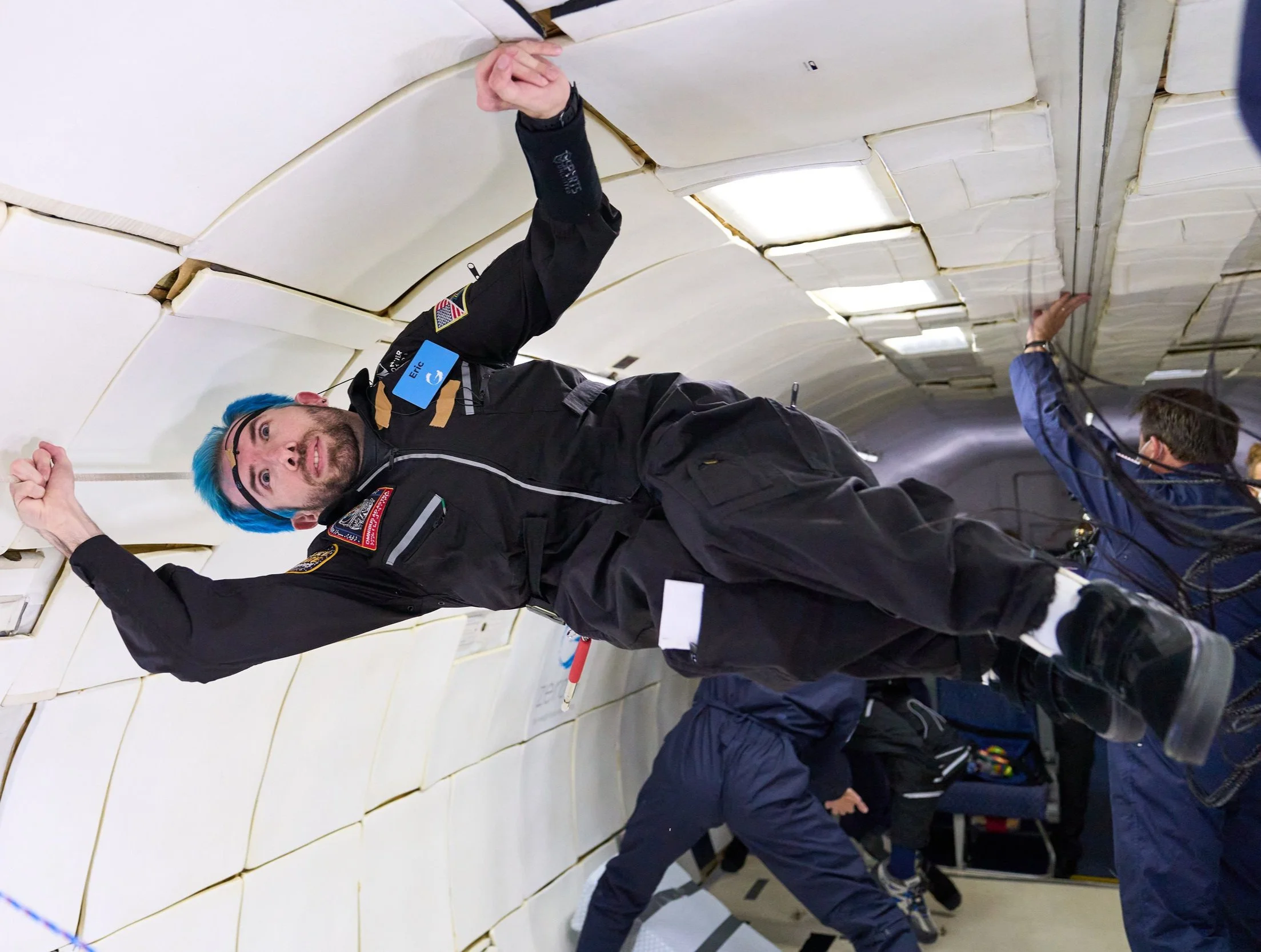
He also participated in AA2, completed in Houston on December 15, 2022. The flight carried fourteen crew members from five countries and included eighteen parabolic manoeuvres. Those are small, bounded experiments inside a much larger aspiration. They give designers something concrete to examine while future vehicles and procedures are still being developed. A claim about who can participate becomes more useful when it comes with a test, observations and a design question someone can answer.
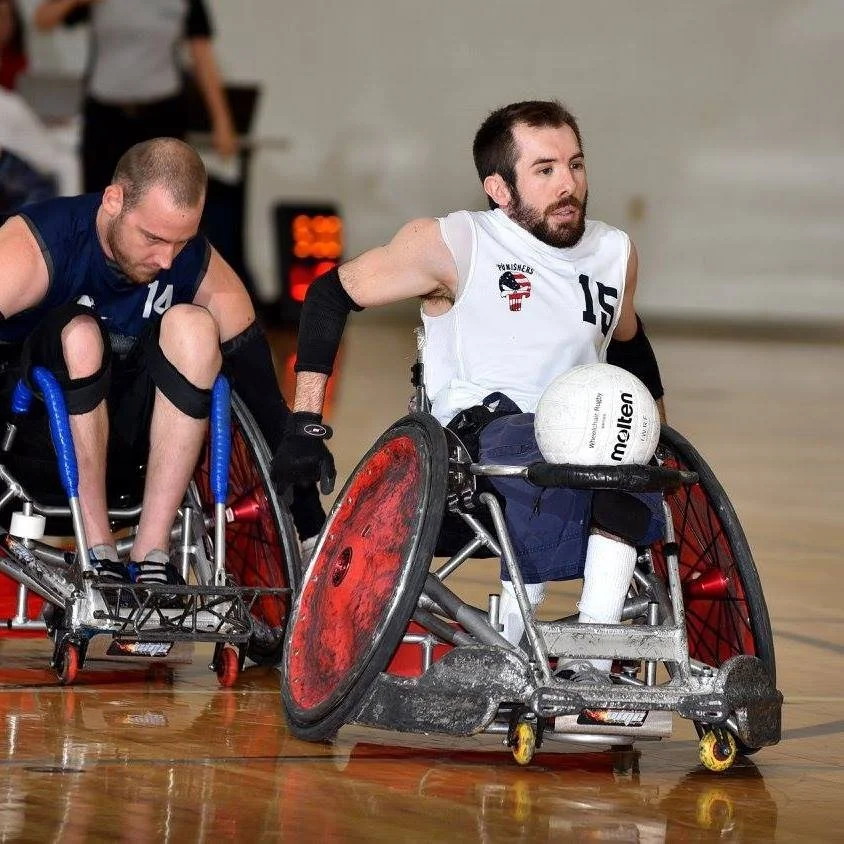
Team sport supplies another part of his working life. Ingram began playing club wheelchair rugby in 2005, spent two periods with the U.S. developmental team and served as president of the United States Wheelchair Rugby Association from 2016 to 2020. The administrative role meant managing the domestic sport, representing it internationally and participating in selection committees. Competing and organising ask different things of a person. One asks what you can do in the next possession; the other asks whether everyone will have a competition to attend.
The founder’s next job
Ingram has since written about three responsibilities he came to see as central to being a startup CEO: communicate the vision, build the team and supply resources. The list is short enough to remember and broad enough to consume a working week. Explaining why the company matters is part of attracting investment and colleagues. Hiring means bringing in people with deeper expertise in their fields. Keeping the enterprise supplied gives those people a chance to do the work.
That perspective now informs Ingram Insights, his consulting and speaking work. He describes helping founders and technical companies with decisions that cross product, business, investment, regulation and leadership. The list resembles his own career. It also explains why he is interested in applying the experience beyond space, including robotics, aviation, advanced manufacturing and energy hardware. Difficult technology does not spare a company from difficult organisational choices.
By May 2026, his life had acquired some welcome room for other pursuits. He was still connected to fraternity friends through a long-running fantasy football league, still playing rugby and looking forward to more flying in a plane he had bought. The space ambition endured alongside these ordinary pleasures. A person can care about the future of civilisation and also care about his fantasy lineup; the calendar is large enough for both.
Scout continues under a different leadership team, with Josiah Gruber now listed as CEO. Ingram remains a co-founder, board member and advisor. That arrangement preserves a connection without requiring him to occupy every decision. The company’s story can continue to develop while his does too. For someone who has spent years thinking about autonomy, there is something satisfying about leaving the controls in capable hands - and finally making time to fly his own plane.