A repair shop can be five minutes away and still be the wrong place to send a damaged car. Its address is easy to find. Whether it has the relevant certification, equipment and room in the workshop is a different question. Between those two kinds of information sits Entegral, a software company whose product is, in effect, a better next decision.
- Insurers and manufacturers use Entegral to manage repair networks and recommend suitable shops.
- Drivers can receive a secure link to choose a repairer and arrange a rental.
- Enterprise Mobility owns the business. GEICO announced a partnership in October 2026.
That sounds modest. Consider the alternative: a claims representative has a customer on the telephone, a list of repairers and several systems holding different pieces of the answer. A qualification might be recorded in one place, a program requirement somewhere else. The customer wants a plan. The representative needs information that can survive contact with an actual workshop.
The repair starts before the repair
Entegral’s Network Management starts with the records. It collects shop qualifications, training, equipment and compliance information, combining third-party verification with a network operator’s own data. Audits and renewal alerts help keep those records useful. This is software for the unglamorous work of knowing whether yesterday’s approved supplier still meets today’s requirements.
Smart Locator puts that information into a shortlist. An insurer configures the criteria and their relative importance: certification, performance, distance or drive time. The system ranks shops, checks availability and passes the selected repairer into existing claims tools through APIs. The ranking is therefore a business decision expressed in software. Someone still has to decide what deserves to count.
Equipment
Compliance
Vehicle needs
Location
Customer choice
Rental transport
Smart Assist gives the customer a corresponding path. A claims representative sends a secure link; the driver can review guided repair options and book a rental. Participating shops supply validated capacity for scheduling. Network Insights, separately documented in Entegral’s portfolio, looks across networks for gaps in geography or capability. Together, the tools address both the immediate assignment and the question of whether the network has enough suitable options.
When Smart Assist launched in North America in October 2022, its announcement named Tractable as the provider of AI damage analysis. That gives the AI a particular job within a larger claims journey. The surrounding coordination matters just as much: a damage assessment becomes more useful when the customer can act on it by choosing a repairer and arranging replacement transport.
A software company with cars to fix
Entegral’s history makes more sense if you start with its parent’s operating problem. Enterprise had rental vehicles, repair relationships and an interest in getting damaged cars moving again. It acquired Cyncast in 2007 and Performance Gateway in 2014. The businesses combined in 2017. In October 2019, Enterprise introduced Entegral as the new name for ARMS Business Solutions.
ARMS, Enterprise’s rental management software, already connected insurers and repair partners. Entegral extended the conversation beyond rental administration. Its inheritance was a set of industry relationships and a parent that could use the software in its own operations. That offers a practical advantage: the business has an internal customer living with the same category of problem it sells to others.
Expertise here means understanding the handoffs as well as writing the code. Entegral’s careers material describes autonomous product teams, collaboration, continuous delivery and a stack including Kubernetes and Google Cloud. Its commercial proposition depends on fitting established workflows. A system that makes claims staff repeatedly abandon their existing tools would undermine much of that proposition.
There are recognizable customers behind those connections. BMW Group UK announced an Accident Support service in 2020, powered by Entegral and CAPS with Enterprise Rent-A-Car. In 2025 conference material, Canadian insurer SGI described using Entegral for repairer communications and accreditation self-declaration. These are different jobs, but each depends on organizing information that would otherwise require repeated checking.
The shop floor joins the conversation
In July 2026, Entegral announced early access to Bodyshop 360’s core management system for repairers in the UK and Ireland. The broader suite includes mobile check-in and lighter job-management tools. The core system adds estimating, repair management, reporting and communication, with integrations including Audatex, GT Global and CAPS. Entegral had moved further into the place where the repair actually happens.
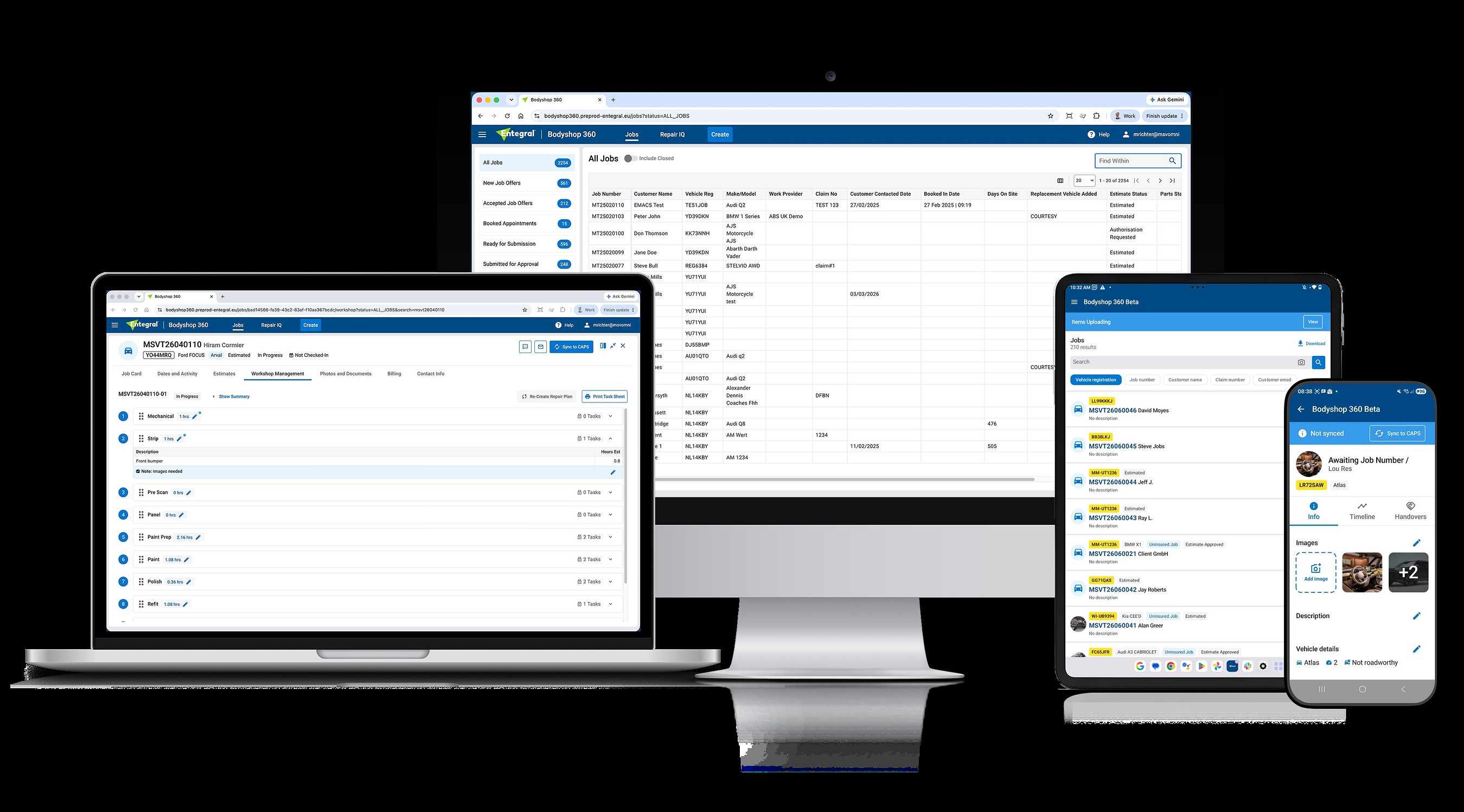
The launch addressed an awkward truth about workplace software: adopting it creates work. Training and setup have to coexist with the day’s repairs. Dent Devils, a trial user named in the announcement, described straightforward setup and flexible training. Its national accounts manager, Andrew Barlow, identified a very specific benefit:
“The biggest benefit has been instant progress updates.”
Andrew Barlow / Dent Devils
The detail is revealing. A status update can look trivial on a feature list. For a person otherwise chasing an email or making another telephone call, it is a task removed. Bodyshop 360’s current product description adds RepairIQ workshop analytics, job cards, technician time tracking and courtesy-car management. The underlying ambition is consistent: make the next action easier by making the current situation visible.
Make the handoff worth automating
On October 22, 2026, GEICO and Entegral announced a partnership covering claim routing, repair coordination and customer communications. It is a concrete example of Entegral’s market position: a technology supplier connecting insurance decisions to repair networks and mobility. Broader claims platforms such as CCC also connect industry participants; buyers need to compare the particular workflow and integration they need.
The business model is enterprise SaaS, with a sales-led buying process. For a buyer, the useful cost calculation includes implementation effort, data upkeep and the time saved on each claim. A sensible evaluation would measure reassignment rates, administrative minutes and appointment reliability before expanding a deployment. A large network alone cannot establish the return.
A useful demonstration would follow one claim all the way through: the information arriving, the recommendation appearing, the customer choosing and the appointment being confirmed. Buyers could then examine an exception, such as a preferred shop with no availability. That would reveal more about the fit than a tour of dashboards, because the value depends on how the parts work together.
There is a lesson here for anyone managing suppliers. Keep qualifications current. Make selection rules explicit. Put recommendations where people already work. These are editorial lessons from the product design, rather than universal promises: inaccurate records or unavailable repair capacity weaken the result. Software can expose those constraints; it cannot conjure a technician or an empty repair bay. Entegral’s opportunity is to make that reality easier to see before somebody sends the car.