The day after somebody dies, the world commits a small administrative insult: it stays open for business. Banks want forms. Subscriptions renew. A funeral needs decisions. An insurance claim needs documents, the estate needs an executor, and every account seems to have invented its own version of proof. Grief may be private, but its paperwork is aggressively public. Empathy built a company in that collision.
Founded in 2020 by Ron Gura and Yonatan Bergman, the New York company began with a guided app for families after a loss. It organizes tasks, explains unfamiliar processes, stores information, offers emotional resources and connects a user with a trained Care Manager. The product has since widened into estate planning, disability leave, caregiving and tools for financial professionals. The common thread is a period when ordinary life turns into project management with consequences.
The second job that arrives with a death
Gura did not arrive at bereavement through a market map. His brother Amir died at eight, leaving him with an early view of what loss did to his mother. Years later, while managing at eBay, he watched an employee grieve a family member and return to work with a stack of logistics still waiting. Gura's useful phrase for the experience is “two jobs when you are at your most vulnerable.” One job is continuing life. The other is dismantling part of someone else's.
He and Bergman already knew how to build together. They met through The Gifts Project, Gura's social-commerce startup, which eBay acquired in 2011. Bergman later built WeWork's engineering organization from a tiny team into a global operation. Their backgrounds explain the original shape of Empathy: consumer software polish applied to a process that usually feels like a government basement.

The app's first promise was deliberately broad. It could create a care plan, explain probate, help close accounts, assist with benefits and funeral arrangements, surface grief exercises and provide a person to message. That breadth is not feature creep. Bereavement is a bundle of unrelated industries experienced as one problem by the family. Lawyers, banks, insurers, funeral homes and therapists each own a slice; nobody naturally owns the handoff.
“Grief is made harder by logistics, and logistics are made harder by grief.”Ron Gura, co-founder and CEO
The first model was the wrong size
Empathy initially launched with a more direct sales model. The app could be downloaded by a family looking for help. That route made intuitive sense and had a nasty flaw: the person most likely to need the product was also least likely to browse, compare plans and begin a new subscription. Bereavement is urgent, infrequent and hard to target without making advertising feel predatory.
The company did not publicly call its consumer start a failure. The revenue mix makes the correction plain. By March 2024, employers and insurers accounted for 99 percent of the business. They solved discovery and payment at once. A life insurer knows when a claim begins. An employer knows when leave is requested. Both already have a trusted channel to the person, and both have reasons to improve a brittle experience.
The distribution move that made the product scale
This is the central business lesson. Empathy did not merely sell a grief app to a large company. It made itself part of claims and benefits infrastructure. New York Life became an early partner. MetLife, Guardian, Prudential, Aflac, Securian and Voya followed in various programs. By 2025, Empathy worked with seven of the ten largest US life insurers. Its reach moved from five million employees and 35 million policyholders in early 2024 to more than 50 million policyholders and nine million employees on the company's current count.
What the customer actually buys
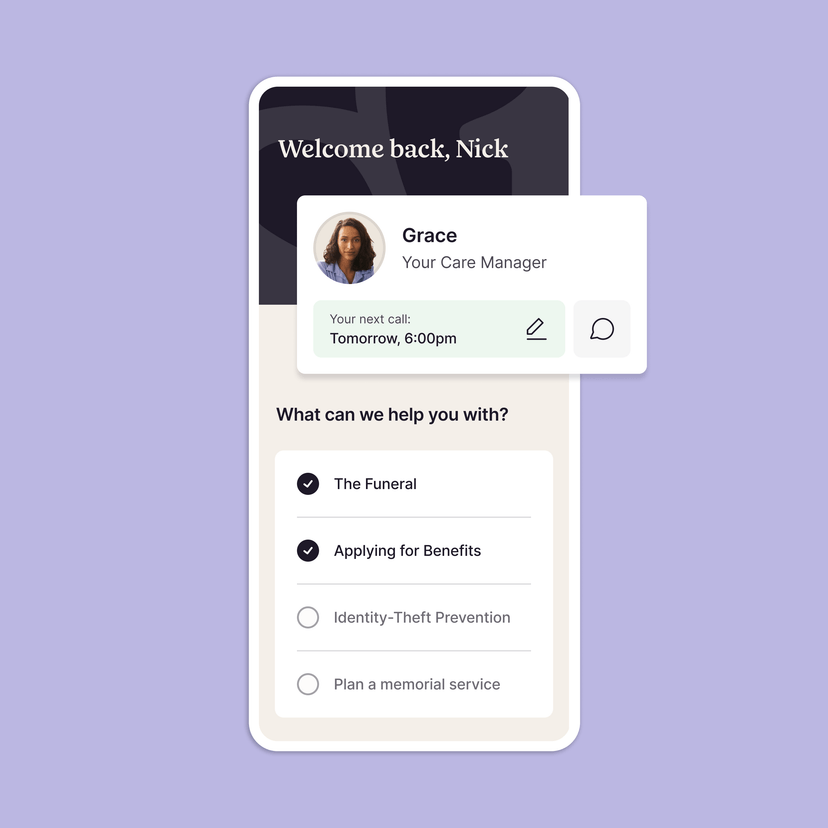
For a covered family, Loss Support looks like a calm dashboard rather than an insurance portal. It turns a chaotic estate into a sequenced plan: arrange the funeral, apply for benefits, prevent identity theft, locate accounts, contact institutions, understand probate. A Care Manager stays available for questions and context. Emotional support sits beside the work instead of in a separate wellness tab that nobody remembers to open.
LifeVault moves upstream. Users can create wills, trusts and powers of attorney where available, catalogue household assets, record directives and prepare for conversations families often postpone. The product gives insurers and wealth firms a “living benefit” - a useful interaction before any claim. It also gives Empathy a relationship with users during planning, when time and attention are less scarce.
Leave Support, launched with MetLife in 2025, applies the same method to approved absences. It combines daily check-ins, mood and medication trackers, breathing exercises, a leave handbook, return-to-work checklists and Care Manager access. Empathy Connect, introduced in May 2026, gives insurance and wealth professionals a dashboard for client preparedness and engagement. Caregiving Support arrived that July, extending the model into a chapter that can last years rather than months.
AI handles repetition; people handle the person
The company's differentiation is less “AI for grief” than a decision about where AI should stop. Empathy has used machine assistance to personalize plans, retrieve guidance, organize information and draft language. Finding Words, released in 2023, helps users begin an obituary. The software can make a first pass at something difficult; the family remains the author.
Human Care Managers handle ambiguity, reassurance and the strange edge cases that every family produces. The arrangement is expensive compared with a content library and more scalable than assigning a concierge to every task. It also creates the possibility of institutional trust. An insurer can offer automation without telling a bereaved beneficiary to discuss the estate with a free-floating chatbot.
What it costs:
Empathy's enterprise contracts are privately priced. Eligible employees, policyholders and beneficiaries commonly receive access at no additional charge through a partner. Direct subscriptions may exist under the company's terms, but Empathy does not publish a current consumer price. The company itself has cost investors $162 million in disclosed capital: $13 million seed, $30 million Series A, $47 million Series B and $72 million Series C.
The moat is a workflow, not a mood
Competitors such as Betterleave, Lantern and Apiary Life address bereavement or end-of-life support; Trust & Will and other estate tools compete with pieces of LifeVault. Traditional alternatives are more fragmented: employee-assistance programs for counseling, lawyers for probate, HR for leave, insurers for claims and family members with heroic spreadsheets for everything between.
Empathy's advantage is the connected workflow and the distribution agreement around it. The company says users save more than 212 hours and an average of $3,611, with a 4.8 out of 5 satisfaction rating. Those are company-reported measures, but they reveal how the business wants to be judged: less by minutes spent in the app than by minutes the app gives back.
Its $72 million Series C in May 2025 brought total funding to $162 million. Adams Street Partners led the round, joined by venture firms and a striking roster of insurance investors. Empathy also formed an alliance with Aflac, Allianz, Citi, MassMutual, Munich Re, MetLife, New York Life, Securian, Sumitomo and TIAA-linked investment arms. Strategic capital can complicate a startup; here it also maps the sales channel.
What changed - and what can be copied
The copyable part is not “build an app for grief.” It is a sequence for products serving rare, high-intensity events. Begin with the complete job the user is trying to survive. Identify the institution that knows when that job starts. Let that institution fund access. Automate the repeatable work, keep experts at the moments of judgment, and measure the burden removed.
- Sell at the trigger. Distribution works when a claim, leave request or advisor conversation naturally opens the door.
- Bundle the messy job. Users experience legal, financial and emotional tasks together, even when industries sell them separately.
- Give AI a narrow promotion. Drafting and routing scale well. Sensitive interpretation still needs accountable humans.
- Measure relief. Hours saved, costs avoided and tasks resolved are stronger proof than generic engagement.
The model has limits. It weakens when the institutional partner cannot identify the right moment, cannot integrate the invitation, or treats Empathy as a buried perk. It also struggles where local probate rules, document laws or cultural practices have not been properly adapted. A guided platform cannot replace a lawyer in a disputed estate, a clinician during a mental-health emergency or a financial adviser making regulated recommendations. Human support must remain good as volume grows; otherwise the feature that earns trust becomes a queue.
A larger category, with larger risks
Empathy doubled revenue in 2025, though it has not published audited figures, and expanded from the United States into Canada and the United Kingdom. TD Bank brought support into Canadian estate services. Zurich and Equitable joined in 2026. LifeVault launched in Canada in April and in the UK in August. Pregnancy and infant loss support, built with psychologist Jessica Zucker, and pet loss support widened the original bereavement experience.
The expansion makes commercial sense and raises a useful question: how far can one platform stretch before “life's hardest moments” becomes every moment? Loss had a clear trigger and a defined backlog. Leave has a return date. Caregiving can be indefinite, medically complex and locally specific. Empathy's discipline will be tested by saying no to features as much as adding them.
Still, the company has already made one durable observation. Institutions tend to appear in a family's life as transactions: a claim paid, a leave approved, a document signed. The person experiences a transition. Empathy sells the connective tissue between the two. Its most persuasive technology is the ordinary relief of knowing what to do next - and that someone will answer when the checklist gets weird.