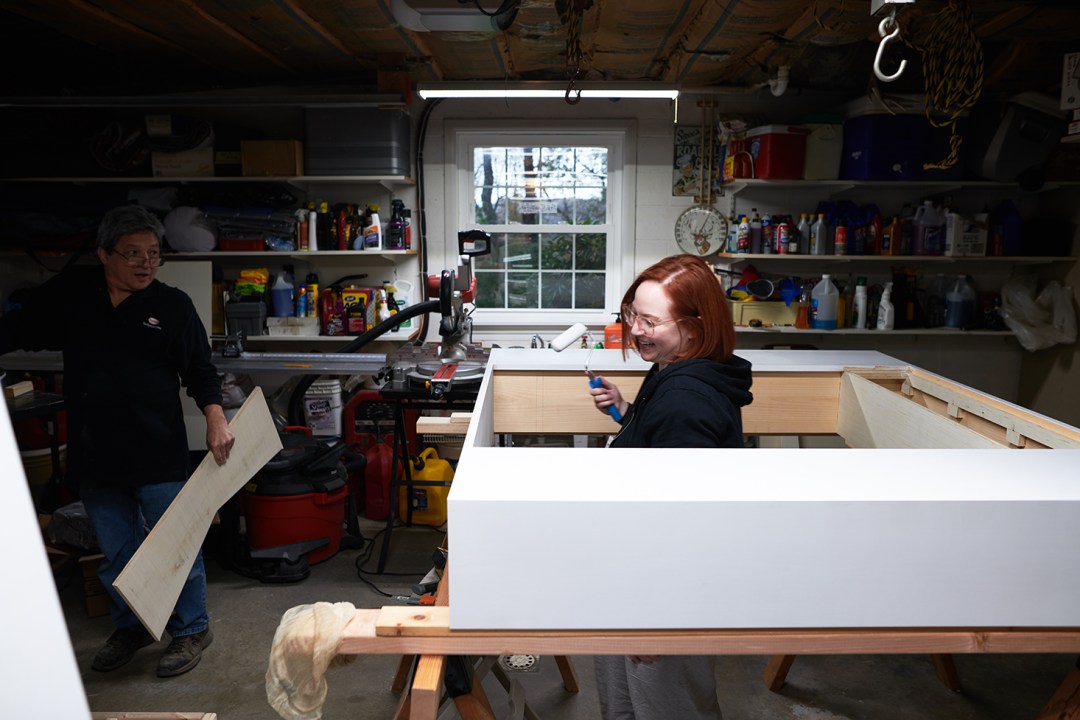
Emily Cosnotti once published a photograph of herself smiling at wood glue. This is an unusually efficient portrait of a creative operator. The smile belongs to somebody delighted by the idea; the glue belongs to somebody who understands that the idea must eventually hold together. In the photograph, she is building a fireplace surround with her father for the main bedroom of her Pittsburgh home. A little later she appears with a tiny paint roller, wearing pajamas and laughing at one of her own jokes. The scene is warm, practical and faintly chaotic. It also resembles a good marketing department more than most marketing departments would care to admit.
Cosnotti is now Chief of Staff to the CMO at Duolingo. Her route there has been agreeably crooked: merchandising, home-goods buying, photography products, mobile photo printing, subscription-box editorial, marketing programs and, throughout it all, interiors. The titles vary, but her subject stays remarkably consistent. She is interested in how a promising thing becomes a finished thing - how taste survives contact with manufacturing, readers, colleagues, budgets, supply chains and ceilings that absolutely refuse to become smooth without a fight.
An education in objects
Cosnotti studied studio arts and art history at the University of Pittsburgh before earning a bachelor’s degree in arts management from Chatham University in 2008. The combination sounds almost suspiciously tailored to the career that followed. Studio art teaches the hand and eye. Arts management asks who orders the supplies, opens the doors, balances the books and gets the audience into the room. Beauty, meet spreadsheet.
At ModCloth, the Pittsburgh-born online retailer, she worked in merchandising and became a category manager and buyer for home. She later bought gifts and electronics for Photojojo, the cheerfully inventive photography shop. Buying is a form of editing conducted with purchase orders. It requires a point of view, but also a precise sense of customer, price and timing. A charming object that arrives late or costs too much is merely an anecdote.
By 2013, Cosnotti was publicly identified as a Photojojo buyer. Two years later, she was brand lead for Parabo Press, the company’s mobile photo-printing venture. The premise was emotionally plain: our pictures had migrated to phones, while the pleasure of living with a photograph had not disappeared. “We grew up leafing through photo albums but now we’ve got all our pictures stashed on our phones,” she said at launch. Parabo turned those files into risograph prints, books, large black-and-white enlargements and other tactile goods. Cosnotti helped develop the brand’s look and carried it through the details, work that a former colleague later praised for pairing aesthetic judgment with unusually determined execution.
One skill, five different materials
Home buying
Photo gear
Physical product
Audience
Executive operations
The newsroom and the owl
At My Subscription Addiction, Cosnotti moved from objects into a publishing system built around them. She led content from 2016 to 2020 and appeared at the 2019 SubSummit as the site’s Creative Director. Her own posts were direct and reader-minded. When the publication considered expanding beyond subscription boxes into ordinary product reviews, she did the sensible thing: she asked the audience. The resulting discussion was not uniformly polite, which made it useful. Process, in this case, meant giving readers a real chance to object before a strategy hardened.
Duolingo offered a larger stage and a more unruly central character. Cosnotti entered the company’s marketing organization, advanced through senior and staff program-management roles, and became Chief of Staff to the CMO in 2025. Program work seldom receives the attention of a mascot in a tracksuit, but it is what allows the mascot to arrive in the correct place, at the correct moment, with legal approval and a functioning landing page.
Two public campaign credits give the job some shape. For the 2021 launch of the second season of Emily in Paris, Duolingo and agency BETC invited real Emilys to improve their French. The campaign offered a free month of Duolingo Plus, recruited six Emilys in Paris for a film, and reached people in 121 countries. Seven thousand offers were redeemed. The joke depended on a name; the result depended on coordinating a global activation quickly enough to borrow the cultural moment before it vanished.
The following year, Duolingo went where distracted learners already were. “Duo Invades Roblox” released an asset pack, invited fan developers to build games, and rewarded players with wearable owl merchandise. The game hub logged more than 13 million visits and 60 million minutes; the work received a Merit at the 2023 One Show. Cosnotti was credited as Senior Marketing Program Manager among a broad internal and agency team. The campaign looked like play because many people did serious coordination offstage.
The house is another organization
Long before corporate biographies began calling everyone a builder, Cosnotti was using the word literally. The Sweet Beast, her interiors site, follows the renovation of a 1929 “Tudor-ish” Pittsburgh cottage and a mountain cabin near Raystown Lake. Its tone is decisive without pretending that decisions are painless. “Life is too short to live with anything you don’t love,” she writes. “There are always choices, so have an opinion.”
Opinion, however, is only the opening bid. Her project posts contain layouts, material choices, affiliate disclosures, budgets, delays and corrections. For one guest room, she sketched abstract compositions on an iPad, bought three canvases and painted them herself. For a cabin bedroom, she replaced every surface, sewed lined curtains, installed flooring, hardwired sconces and removed a stippled ceiling. She later assigned the room 14 points out of 16, calculated 87 percent, and promoted the result to an A-minus before cheerfully calling it an A. Even self-evaluation gets a little art direction.
The jokes matter because they preserve the friction. “In classic Emily fashion,” she wrote, “I took the more difficult road and decided to make a painting.” Elsewhere, her husband Andy reassured her during a deadline crunch that he was trying not to add stress to the stress she had already created for herself. She includes the indecision, the mouse-era carpet discoveries and the project she will never do again. The reveal is satisfying because the struggle has not been airbrushed away.
Her 2024 cabin kitchen shows the method at maturity. Planning stretched across years. The upper cabinets went because Cosnotti could not comfortably reach them and because they blocked light. Plates moved to island drawers. A larger window made room for a larger sink. A formerly unused wall became a coffee and drinks station. The room is handsome, but its real argument is operational: everything has a home, cleanup is easier, and guests can talk to Andy while he makes drinks without standing in the way. It is a small organization chart rendered in oak and soapstone.
What the job titles leave out
Cosnotti’s career can be read as a steady move away from making individual choices and toward building the conditions in which many people can make good choices together. The buyer selects. The brand lead creates a coherent world. The content director builds judgment across a publishing team. The program manager connects specialists. The chief of staff helps an executive and an organization decide where attention belongs.
Yet the earlier roles never disappear. A chief of staff with a merchant’s sense of audience, an art student’s eye and an editor’s suspicion of vague language carries useful equipment. So does a renovator’s tolerance for concealed wiring and decisions that become expensive once the wall closes. Colleagues have described Cosnotti as transparent, pragmatic, scrappy and exacting. Her own writing supplies the warmer evidence: she likes the good bits of a boutique hotel, dislikes asking for help, treasures old family lake photographs, and has no patience for a ceiling trying to become the main character.
The internet taught Cosnotti, by her own account, everything she knows. She has repaid it with unusually clear notes on how things get made. That is the durable thread from Parabo prints to Duolingo campaigns to a cabin kitchen: an idea earns its charm only after someone has measured it, argued with it, scheduled it, revised it and finally made it stand up. Preferably with decent lighting.
There is a modest lesson here for anyone who wants a more creative career. Cosnotti did not leave operations behind to become creative, or abandon creativity to become operational. She kept widening the frame until both fit. The work moved from products to stories to programs; the instinct remained. Notice what could be better, form a clear opinion, and accept responsibility for the unromantic middle. Inspiration gets the sketch. Process gets the room.