Scott Pipitone has a fairly practical answer to the question of how to build a creative company: keep making room. His Pittsburgh agency began as a solo design practice in 1992. It occupied domestic space, acquired neighbors, added disciplines and, more recently, rearranged its office so people from different teams would work together. The furniture has had a long career in organizational development.
Then came the houseplants. In July 2026, Pipitone described an agency exercise in which teams had 30 minutes to invent brands for absurd businesses. One was a dating app for plants. Another sold luxury goods to pigeons. The resulting pitches gave him a compact demonstration of the idea behind all that rearranging: creativity could come from any department, provided the departments actually met.
There is a pleasing continuity here. The designer who needed space for his growing business has become a chief executive interested in what space does to a business. His career can be read through job titles and acquisitions. It can also be read through rooms.
A designer before the corner office
Long before the agency carried his surname, Pipitone was a graphic-design student at Rochester Institute of Technology. In April 1983, RIT recorded his contribution to its Coming of Age symposium on graphic-design history: he designed the graphics for the printed materials and signage. Nearly 300 educators, practitioners and students attended. Massimo Vignelli was the keynote speaker.
It is an unusually concrete early credit. A conference about the history of visual communication needed someone to make its own communication work. Pipitone, then a fourth-year student, had that assignment. The participants could debate design’s purpose; his work had to help them find the discussion.
He earned a Bachelor of Fine Arts in Communication Arts at RIT. His early professional stops included Seay & Associates, Adam, Filippo & Moran, and BD&E, where he became a senior graphic designer before starting his own firm. This was a working designer’s route into ownership, with years spent making things for other people before becoming responsible for the whole enterprise.
His connection to RIT continues through the Saunders College of Business Marketing Advisory Board. The combination is apt: an art-school education, followed by a career in which design became inseparable from business decisions.
The business outgrew the dining room
The first computer and printer came with help from Jeff Barber, who lent Pipitone the money to buy them. His early business memories are populated by people who supplied something specific: equipment, advice, an introduction, financial discipline. Entrepreneurship, in this telling, has a rather crowded supporting cast.
As the practice expanded, work took over living and dining space. By November 2000, the firm moved into a building in Observatory Hill. The address changed the daily arrangement of work, but kept the company in the neighborhood where Pipitone had put down roots.
His recollection of the move includes the detail that employees would lose the smell of Stella’s sauce cooking at home. It is a better measure of the early office than a floor plan. A business can occupy a house so thoroughly that leaving it means losing part of the lunch atmosphere.
That memory also makes later office decisions easier to understand. Domestic comfort was part of the company’s experience before it became a design objective. The agency would eventually need more space and more specialized people. Pipitone kept returning to the question of whether a workplace could still feel welcoming as it grew.
A neighboring property, then a neighboring discipline
In 2002, the firm acquired the neighboring property. A later expansion involved architect Vincent Finizio, contractors and space planners, with the existing residential and storefront character retained. The 2019 plans included collaboration booths, a fireplace and glass walls that could open the meeting area into a communal space.
Pipitone put his reasoning plainly: “When employees feel like themselves, fresh and creative ideas surface.” The proposed environment borrowed from the coffee shop as much as the conventional office. Glass garage doors would open toward Perrysville Avenue. Even the boundary between work and the street was being reconsidered.
Adding a building and adding a professional discipline are different undertakings. Both, however, ask a founder to decide what belongs nearby. By 2020, Pipitone had an answer for public relations: the agency acquired PUSH SEVEN, a firm with which it already shared clients.
The overlap included PPG, Vitro Architectural Glass and the Allegheny County Airport Authority. These were working relationships before they became an acquisition rationale. Pipitone praised the other team’s capabilities across planning, messaging, media relations and communications, and described the combination as a way to expand what clients could obtain from the business.
For a founder trained to solve a visual problem, the brief had widened. The organization now had to coordinate the people who developed a message, designed its presentation, built its digital setting and helped it reach the public. An idea could require several kinds of expertise before it was ready to leave the room.
“I like to build.”
Scott Pipitone, LinkedIn profile
Permission to arrive with an idea
The human side of that coordination appears in a former colleague’s 2014 account of working with Pipitone. She recalled him expecting people to think through problems and bring possible solutions. Her description credits him with strengthening her initiative and professional confidence. It is a small, useful glimpse of management as a repeated conversation.
There is another glimpse in designer Shanna’s account on Hot Designs. She remembers Pipitone hiring her to learn unfamiliar software and explain what it could do. He wanted knowledge brought into the business; she got paid to acquire it. The exchange gave curiosity an actual place on the timesheet.
Neither anecdote requires a grand leadership doctrine. Both describe opportunities to contribute something beyond a completed assignment. A colleague could propose a solution. A designer could investigate a tool. Those are modest permissions, but the work of an agency depends on people using them.
The official description of Pipitone’s current role includes developing business-growth messaging and collaborating on ideas for the agency itself. It also identifies employees’ success as a particular reward for him. After decades of expansion, the founder’s work still involves helping other people do theirs.
Thirty minutes, several improbable customers
The 2026 Brand Makeover Challenge gave that outlook a comic test. Teams had to define their invented brand, its audience and the problem it solved, then give a short pitch. The products were preposterous. The questions were ordinary marketing questions, which made the exercise harder to dismiss as office entertainment.
The introvert’s sparkling water became Don’t Sparkle @ Me. The houseplant dating service became PollinDate. A luxury pigeon brand went by Seed Sommelier, a name that deserves at least a moment of respectful silence before anyone discusses the target margin.
For Pipitone, the point was participation across the agency. His account explicitly connected the results to the office rearrangement that winter. People with different responsibilities had worked on the same creative problem. The short deadline gave them a reason to commit to an idea and explain it to everyone else.
Define the brand. Choose its audience. Explain the problem it solves.
Then: a 3-5 minute team pitchThe renovated office supports a more deliberate version of that meeting. A February 2026 account by growth officer Gray Pipitone described more shared space, movable furniture, improved hybrid-meeting technology and quiet places for concentrated work. The plan recognizes that collaboration and concentration need different surroundings. Moving everyone closer is only the beginning.
The neighborhood gets a place at the table
The agency’s idea of participation also extends outside the office. In December 2023, Pipitone introduced GivesaHand, a corporate giving program whose opening commitment included at least $75,000 in pro bono work for Humane Animal Rescue of Pittsburgh during 2024.
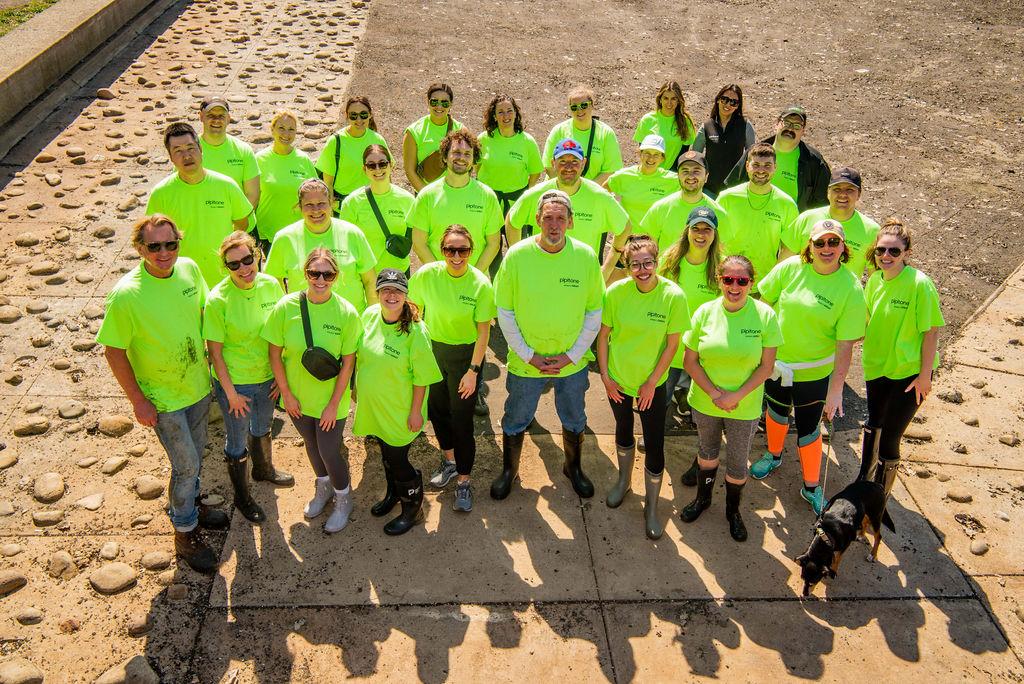
The program also brought together neighborhood volunteering, including Lake Elizabeth’s What the Muck event and a Riverview Park cleanup. These projects locate the agency’s civic life in specific places. A company can talk about community at almost any altitude. A park cleanup eventually requires everyone to come down to ground level.
In December 2024, the agency donated five iMacs to Urban Impact Foundation for teaching videography and sound editing. The donation was intended to double the organization’s teaching capacity for those skills. That is a particularly tangible contribution from a business whose founder once needed a loan for his own computer and printer. Equipment helped one designer begin; equipment could help young people learn.
Pipitone’s civic connections have included service on Partner4Work’s board, placing him alongside a regional organization concerned with employers, job seekers and workforce opportunities. The connection fits a career spent assembling people with complementary abilities, while reaching beyond the agency’s own hiring needs.
What the bigger room makes possible
In February 2026, Pipitone celebrated 13 agency honors at the PRSA Pittsburgh Renaissance Awards. Work for Vitro’s BirdSmart Bird Safe Glass received Best in Show. The recognized projects ranged across product marketing, internal communications, events and digital work. The range gives a concrete sense of how far the firm has traveled from its original design practice.
He also celebrated colleague Lynn McMahon’s induction into the PRSA Hall of Fame. Their working connection reached back to his firm’s early days, before she later joined the agency. The evening supplied both a current result and a reminder of the relationships behind it.
The company now describes a team of more than 55 people. Growth has required properties, acquisitions, equipment and a willingness to alter the arrangement again. Yet the recurring action in Pipitone’s story remains approachable: bring someone into the work, give them room to contribute, see what happens. Sometimes the result is an award-winning campaign. Sometimes a pigeon acquires expensive taste.