At thirteen, Bessie Ramirez was already playing volleyball for Puerto Rico’s national team. Most people that age are negotiating for a later bedtime. She was learning to perform in a game where the next touch belongs to somebody else. Decades later, as the founder of Marketing SI, she would argue for a similar kind of proximity in business: agency partners working inside the client’s organization, close enough to understand how the whole operation moves.
The resemblance is tempting. A volleyball court supplies a ready vocabulary for corporate life, and corporate life has never been shy about borrowing sports equipment. But Ramirez has made the connection herself. When she was recognized at Puerto Rico’s volleyball Hall of Fame ceremony in 2022, she spoke about the sport’s influence on every facet of her life. The lessons, she said, went with you.
Her career gives that thought some substance. There is the national team, then Penn State. There is an interdisciplinary education, a run through consumer strategy and consulting, and the agency she founded in 2015. Alongside those jobs sit years of coaching and volunteer leadership. It is a life with several teams on the schedule.
Thirteen, and already on the national team
Ramirez was born in Río Piedras, Puerto Rico, and began playing at nine with BUCAPLAA. She graduated from high school in Mayagüez in 1986 and went on to Penn State. By the time she entered college, the word freshman described her academic standing rather better than her experience on a volleyball court.
Her first season produced the Atlantic 10 Rookie of the Year award and five conference Freshman of the Week selections. She recorded 479 kills and earned second-team all-conference recognition. Against Nebraska in the NCAA playoffs, she had 19 kills. Those details give the early national-team selection a useful sequel: she arrived in a different competitive setting and contributed immediately.
Atlantic 10 Rookie of the Year
In 1987, she was named most valuable player of the Penn State Open and received second-team Atlantic 10 honors again. Her junior season brought 403 kills, 349 digs, 82 blocks and 39 service aces. She was recognized on the All-Northeast Region team and named MVP of the Penn State Preview. The numbers describe several kinds of contribution, from finishing a point to keeping one alive.
Coach Russ Rose’s assessment in 1989 was economical: “She’s a competitive and smart player.” It is the kind of compliment that leaves very little room for decoration. Intelligence had a job to do. So did competitiveness. On a court, both have to become decisions somebody else can use.
An education without a single lane
At Penn State, Ramirez also took an academic route that crossed departments. She has described building her General Arts and Sciences curriculum around technology, business and communications. Artificial intelligence belonged to that education long before it became a standing item on every marketing agenda.
There is a practical affinity among those subjects. A technical possibility has to make business sense; a business proposition has to reach another person. Studying across them offers more than variety. It makes the boundaries visible. Years later, Ramirez would describe Marketing SI as an agency looking forward through marketing technology and AI. Her interest in bringing disciplines together has a university chapter.
By 2013, she was working at Santiago Solutions Group, a Los Angeles firm focused on Latino markets. Asked about Goya and Beech-Nut’s planned baby-food collaboration, she examined the product itself: mango, guava, papaya and the opportunity to offer different flavors within a familiar category. Her assessment centered on innovation, the partners’ respective markets and Hispanic millennials.
It was a small consumer story with a substantial strategic question inside it. How far can a familiar product move before it becomes unfamiliar? A label alone cannot settle that. Flavor, convenience and the intended buyer all belong in the discussion. Ramirez’s commentary treated the audience as people making choices, with a product in front of them.
In September 2014, she joined Terry Soto at About Marketing Solutions as managing partner, following her role as a principal at Santiago Solutions Group. Her consulting experience already included companies such as Quaker, The Home Depot, Wells Fargo, Procter & Gamble, Hewlett Packard and Bacardi. The list runs across purchases with very different prices, frequencies and stakes. Consumer understanding has to survive those differences.
The rulebook on the airplane
In January 2015, Ramirez published an essay with a rather less conventional piece of business equipment at its center: a holiday book. She had found her copy of Don Miguel Ruiz’s The Four Agreements, reread it while away and started considering its implications for strategy.
Her subject was the belief system an organization inherits. A company accumulates assumptions about what works, what belongs and which ideas deserve a hearing. Eventually, those assumptions can acquire the authority of rules. Familiarity does a convincing impression of evidence; it even knows where the meeting room is.
Ramirez applied the book’s idea of a personal rulebook to the habits that shape business decisions. Seeking growth among audiences an organization has overlooked may require changing how the organization thinks. Naming the opportunity is only part of the work. People also have to reconsider the conventions that kept it outside the plan.
The essay ended with her plane about to land and the next part of the discussion still ahead. It is an unusually human ending for a strategy piece. There was a book, a holiday, a thought that followed her back toward work, and an aircraft imposing an editorial deadline. Later that year, she founded Marketing SI.
A place inside the team
Marketing SI operates from Los Angeles, with additional offices in Texas and Florida. It brings together research, planning, creative work and execution for general, multicultural and Hispanic audiences. Its stated approach emphasizes working with communities and stakeholders when developing solutions. The people affected by the work are meant to contribute to its design.
That matters because an audience category can be useful on a planning slide and insufficient in practice. The organization has to ask more questions. Which people? In what situation? What would make this useful to them? Participation gives those questions somewhere to go beyond the assumptions of the people writing the brief.
A sequence of responsibilities that has to function as one effort.
The agency’s work spans consumer brands, financial services, sports and education. Its website describes helping a school district secure $250 million in funding. That is a collective project with public consequences, rather than a personal score to add beside Ramirez’s college statistics. It also shows the range of situations in which communication has to do something tangible.
Ramirez’s public position on agency relationships became especially explicit in a December 2025 post about AI and marketing. She called for end-to-end integration and partners able to work within the client organization. Her concern was the connection between strategic thinking, analytical capability and actual business impact.
“Marketing cannot unlock the value of AI without end-to-end integration.”
Bessie Ramirez, December 2025
That is a demanding proposition for an agency. Being close to the business means understanding the constraints as well as the possibilities. A recommendation enters a world of budgets, workflows, colleagues and decisions already in progress. It needs people who can carry it from one stage to the next. The clever sentence in a presentation is only beginning its working life.
The lessons that stayed in play
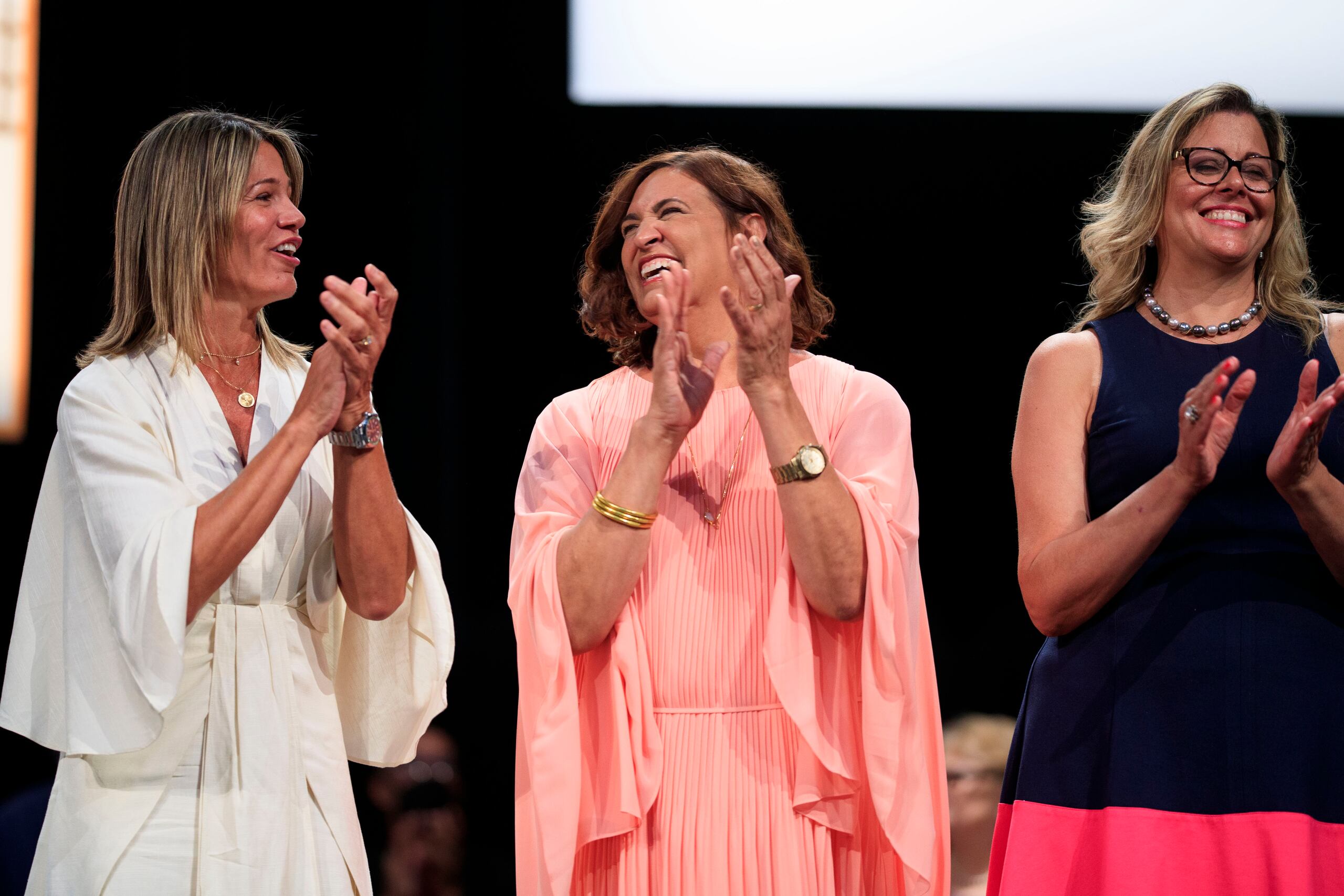
In April 2022, Ramirez was among the athletes and other volleyball figures recognized at a ceremony at the Inter American University’s metropolitan campus in Puerto Rico. The gathering honored a generation associated with the 1980s. In a photograph from the event, she appears beside Elaine López and Carmen Luisa Tapia, smiling and applauding. The expression is less quarterly review than very good reunion.
The sporting chapter continued in other ways. Her volunteer record includes volleyball coaching at SPAS from 2013 to 2018. She also led a Girl Scouts of Greater Los Angeles troop from September 2009 to June 2022, working with 15 girls on leadership and self-reliance. Those are long stretches of responsibility, measured in seasons and school years rather than campaign launches.
They offer another setting for the question that runs through her public work: how do people become able to contribute? A coach has to work with the players in the gym. A troop leader has to make room for young people to grow into responsibility. An agency leader has to connect specialists, clients and audiences around work they can actually carry forward.
Ramirez’s story contains room for a smaller loyalty, too. In a public Penn State discussion, she enthusiastically recommended the Creamery’s Grilled Stickies ice cream. A college education can leave you with an intellectual framework, a competitive record and strong opinions about dessert. Happily, there is no requirement to choose.
The national-team player has become a founder with an argument about how agencies should work. Her subjects have changed; the need for coordination remains. Somebody has to understand the situation, make a useful decision and leave the next person a chance to do something with it. For Ramirez, there has been plenty of life beyond the court. The next pass still matters.