On a Montreal winter day, the sidewalk edits every fashion claim. Leather can look handsome. A silhouette can feel current. A campaign can promise adventure. Then the temperature drops, the slush arrives, and a thin shine of ice asks the only question that matters: does the boot work?
Elise Golbert has spent her career close to that question. She is Chief Marketing Officer of Pajar Canada and a footwear designer, part of the third active generation inside the Montreal company and the fifth generation in a family shoemaking tradition. Her job sits where product and promise meet. At Pajar, those two cannot afford to drift far apart. The climate will notice.
The public outline of her life is compact. She studied at Montreal's Academy International of Design and Technology from 2002 to 2004. She joined a business her grandfather Paul founded in 1963 and now works alongside her brothers, Michel and David. Her father, Jacques, represents the generation between them. Her professional record also lists work on an ice-gripper patent, a fitting piece of evidence for a designer formed by a city where traction is not an abstract benefit.
A company name that remembers dinner
Pajar began as a compact family portrait. Paul Golbert made the name from the opening letters of Paul, Jacques and Rachel - himself, his son and his wife. Before the label became a familiar mark on winter footwear, Paul had carried a shoemaking education from France to Canada. He started by importing European shoes, opened a downtown Montreal showroom in 1967 and established a factory near Coloniale and Mont-Royal in 1973.
That sequence matters because it keeps the company story concrete. A surname became a name. A name became a showroom. A showroom became a factory. The factory still makes part of Pajar's Heritage collection in Montreal. For Elise, heritage is therefore not an abstract aesthetic assembled from sepia photographs. It has an address, a production rhythm and relatives with defined jobs.
Family companies are often described through longevity, as if survival alone were the achievement. Longevity is only the opening condition. The sharper problem is translation. A craft learned for one era must make sense in another. A local manufacturer has to speak to international retailers. A business famous for winter must develop footwear, outerwear and accessories without dissolving the identity that made expansion possible.
The inheritance, in motion
From Parisian craft to Montreal performance fashion
Elise's lane in that translation combines design and marketing. One discipline asks how the product should be made. The other asks how it should be understood. Pajar's strongest answer is usually physical: a waterproof construction, insulation rated for cold, a local factory, or retractable steel cleats that can grip an icy surface and fold away indoors. The feature carries the story before the copywriter arrives.
“Three generations strong and still proudly made in Montreal!”Elise Golbert, on Pajar's Heritage production
The useful tension inside a winter boot
Performance fashion contains a productive argument. Fashion asks a product to participate in culture. Performance asks it to survive contact with the ground. In Pajar's case, Montreal supplies both the culture and the ground. The city is design-conscious, bilingual, international and severe enough in winter to make vague product language look foolish.
The Ice Gripper system makes the argument visible. Its cleats open for difficult surfaces and retract when the wearer steps indoors. It is a small mechanical drama built into the sole: city outside, city inside; ice, then tile; exposure, then shelter. The boot changes because the day changes.
That adaptability is also a reasonable way to understand Golbert's role. A Chief Marketing Officer in a family manufacturer does more than buy attention. She has to move between the archive and the collection, the factory and the feed, long-time customers and people meeting the name for the first time. Her public posts return repeatedly to Montreal manufacturing, the family team and new collections. The message is consistent because the underlying objects are consistent.
In 2021, Golbert joined members of her family and Pajar executives at the opening of the company's SoHo flagship in New York. The image captured the business in expansion mode: a Canadian winter brand planting a store in one of fashion's global neighborhoods. Yet the most durable sentence in her recent public commentary points home. Reviewing attention around the made-in-Montreal Heritage line, she wrote that she was “very proud.” The pride had a precise object - three active generations and a factory still producing in the city where the company began.
A second workshop across town
Golbert's other visible role shifts the materials but preserves the instinct. She serves as event committee chairman for Friendship Circle of Montreal, a community organization built around friendship, dignity and inclusion. Her work there has included events, fundraising and the public launch of a social-enterprise expansion.
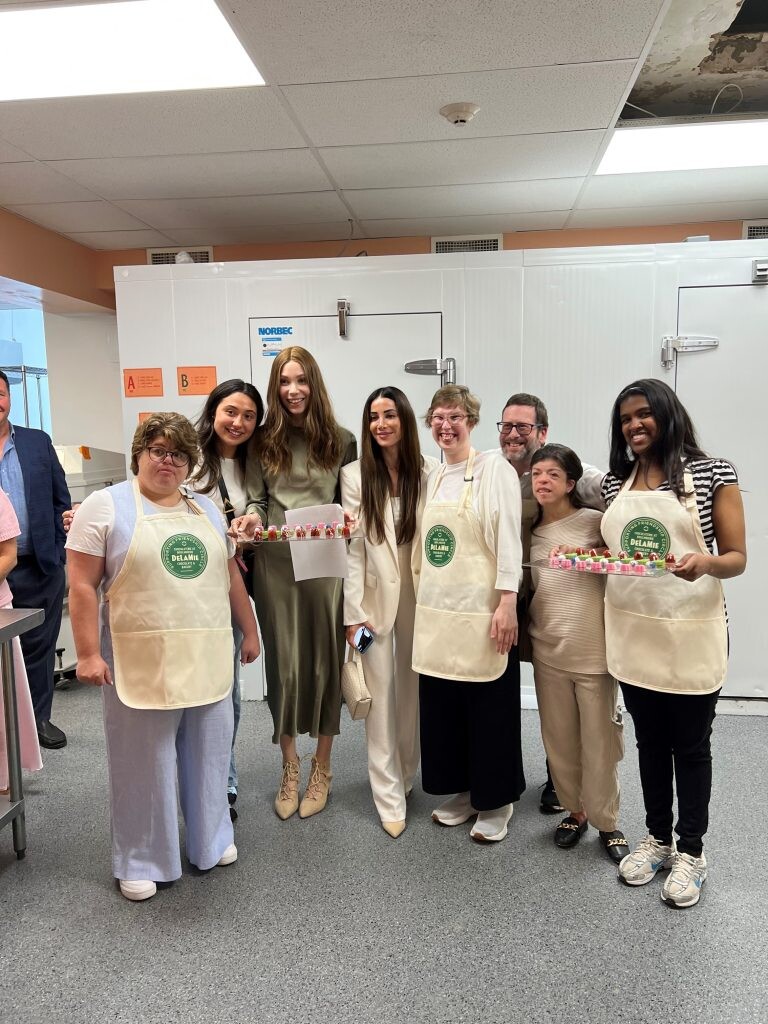
In June 2024, she stood inside the expanded DeLaMie chocolatier, an extension of a bakery where young adults of different abilities make and sell baked goods. The scene offered a different sort of product launch. There were samples, flavors, production equipment and people preparing to work. Golbert explained the renovation with the plain satisfaction of someone who could see the before and after: “There used to be a wall here. Now we've expanded into this giant room here with high ceilings.”
The removed wall is a useful detail. Big words such as community and inclusion can become soft around the edges. A wall is harder to blur. It either blocks the room or it does not. Take it down and the floor plan changes. More people can gather, learn a process, make something and offer it to a customer. The principle becomes spatial.
At the launch, Golbert described the group in family terms: “It's such a beautiful thing to be a part of. And they're my family as well.” The line lands differently beside her work at Pajar. In one place, family is inherited through names, craft and formal roles. In the other, family is chosen through repeated participation. Both require more than sentiment. They need schedules, rooms, products, events and people willing to do unglamorous work.
“There used to be a wall here. Now we've expanded into this giant room here with high ceilings.”Elise Golbert at the DeLaMie chocolatier opening, 2024
Belonging needs an operating plan
Golbert's community work has also reached beyond a single room. She appeared at Friendship Circle's 2023 national retreat, an event that brought young participants from across Canada to Quebec's Laurentian Mountains for programs around leadership and inclusion. In 2025, she promoted Walk4Friendship after organizers reported more than 700 families, volunteers and supporters had gathered and $541,673 had been raised at that point in the campaign.
Her response was not a detached executive endorsement. She wrote that she was proud to help inaugurate the walk and praised a model of community rooted in “inclusion, dignity and real friendship.” When she later shared reporting on the Golbert family's fundraising, she called it her recent work and thanked the community around it.
There is a practical lesson here for anyone tempted to separate brand work from civic work. Golbert's public record does not present a grand theory joining the two, so it would be careless to invent one for her. The pattern is visible without mind-reading. Both arenas reward patient continuity. Both turn values into physical experiences. Both depend on products and gatherings that work for real people, not imagined audiences.
A boot earns trust by carrying someone across a difficult surface. An event earns trust by making it easier to enter a room. Marketing at its most useful tells the truth about those experiences, clearly enough that another person wants to try them.
What the next generation actually inherits
Elise Golbert inherited access to a long story. She also inherited its constraints: a recognizable name, a city that matters to the product, relatives inside the organization and customers who can distinguish heritage from costume. Those constraints can narrow a career, or they can sharpen it. Her path suggests the second possibility.
She learned design before taking on an executive marketing title. She remained close to footwear while the company expanded into broader categories and international distribution. She speaks publicly about the factory rather than treating production as backstage scenery. And away from the business, she lends her event experience to an organization where success is measured in participation, funds raised and room made for other people.
The result is not a reinvention myth. Pajar did not need a new founder story. It needed another generation able to decide which details still carry force. The family acronym still does. The Montreal factory does. A winter boot with a visible solution to ice does. So does a wall removed from a community workspace.
There are flashier ways to describe leadership. Golbert's version looks more like stewardship with a product deadline. Keep the valuable thing alive. Make it legible to people who were not present at the beginning. Add what the present demands. Then test the promise against the sidewalk.