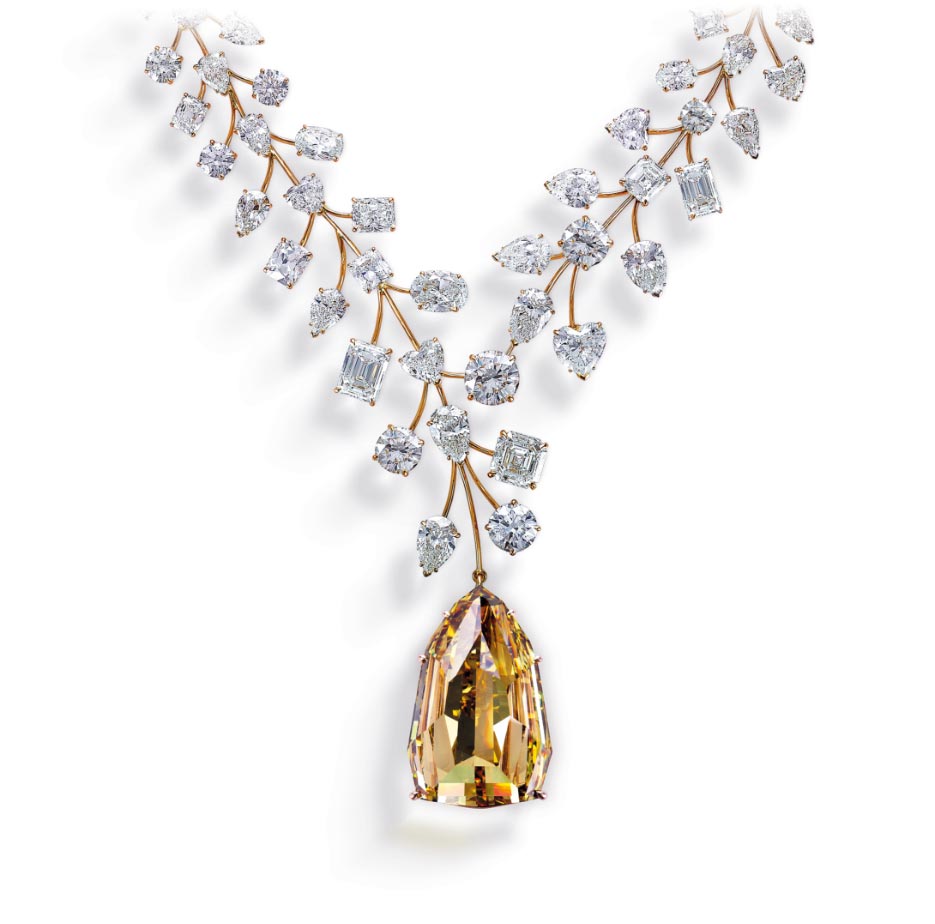
In 2013, Mouawad put a yellow diamond weighing 407.48 carats at the center of a necklace. White diamonds curled around it on rose-gold branches. Guinness World Records certified the finished object at $55 million. Even the name, L’Incomparable, seemed designed to save a copywriter some trouble.
But consider the audience. Very few people could contemplate buying it. Many more could remember it. For a family jewelry house, a spectacular object can do two jobs: demonstrate what the workshop can make and give strangers a reason to learn the name. Mouawad’s business becomes easier to understand when you keep both audiences in view.
- Collections, bridal jewelry, watches and custom commissions are the business.
- Rare stones and ceremonial crowns make the craft visible.
- Personal stories give individual customers a reason to choose a particular piece.
01 / A necklace with two audiences
The $55 million figure was a certified valuation in January 2013. It was not a disclosed production budget or proof of a sale. That distinction matters. A record tells you about an object’s assessed value; it cannot tell you whether the maker earned a return. The commercial interpretation is more modest: L’Incomparable made a difficult-to-explain skill immediately visible.
The same logic helps explain Mouawad’s pageant commissions. The Force for Good crown, unveiled for Miss Universe in December 2022, was valued by the company at approximately $5.75 million. Its blue sapphires and diamonds form waves that grow upward. Here, a jeweler supplies both a physical object and a visual language for a televised ceremony.
02 / The family followed the money
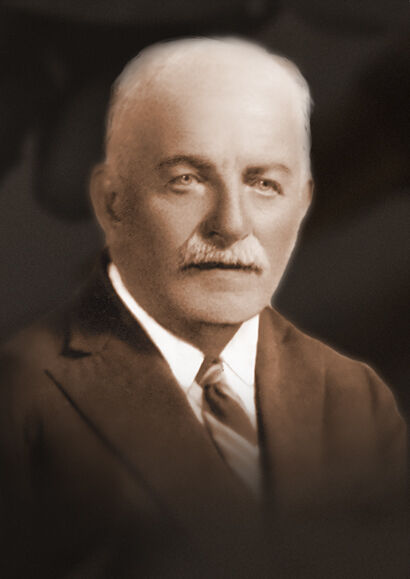
Mouawad dates its heritage to 1890, when founder David Mouawad left Lebanon to learn his craft abroad. Its current history places his first Beirut workshop in 1908. Repairs supplied the everyday work; commissioned clocks and jewelry allowed more imagination. The origin was practical, with room for ambition.
His son Fayez moved to Jeddah in 1950, as Saudi Arabia’s oil economy was creating wealthy customers. Robert, the third generation, later moved the headquarters to Geneva and expanded internationally. Each move put the family closer to a different kind of buyer. Geographic expansion followed changes in where customers lived and what they wanted.
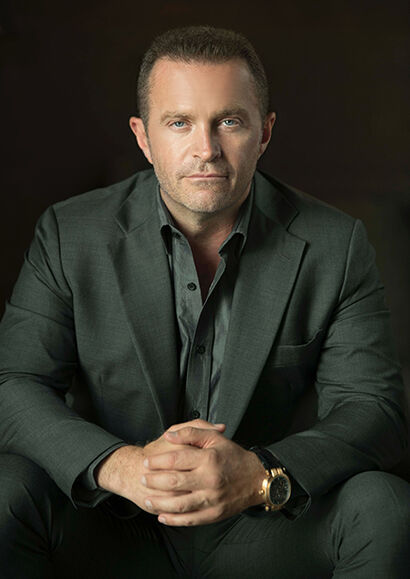
Pascal moved the U.S. office from New York to Los Angeles in 2006. His own account describes celebrities as “modern-day royalty.” It is a revealing phrase: the customer changed, while the idea of serving a conspicuous elite survived. Collaborations with Heidi Klum and Victoria’s Secret brought the family’s work into popular culture.
03 / The expensive art of subtraction
Behind that visibility sits an industrial capability: Mouawad has its own diamond-cutting factory. Its published manufacturing example starts with 49.70 carats of rough and reaches 10.03 carats at final bruting. Roughly four-fifths of the starting weight has gone. This is one illustrated sequence, not a typical yield promised for every diamond.
That subtraction requires judgment about shape, inclusions and the desired result. The house says planning and cutting its 54.21-carat Mouawad Dragon took over six months. For a collector, such expertise helps explain the appeal of a stone-led jeweler. For the maker, control of cutting gives design decisions a place to begin before a finished gem reaches the display case.
The family also has a connection to the institutions that teach people to examine gems. Its donation supported the Gemological Institute of America’s Carlsbad headquarters, whose campus bears Robert Mouawad’s name. The house’s Diamond Impact Fund focuses on communities in diamond-producing countries. These initiatives extend the family’s involvement beyond selling finished pieces, into education and the places from which the raw material comes.
04 / A clover with consequences
Celebrity attention does not resolve every problem. Heidi Klum’s clover-inspired jewelry with Mouawad became the subject of a dispute with Van Cleef & Arpels over its Alhambra designs. In 2008, Lucire reported a settlement without admission of liability. In 2009, the jewelry trade publication JCK reported that Klum had discontinued the line following the dispute.
“They just wanted to own the clover motif.”Heidi Klum, quoted by JCK, 2009
The quote expresses Klum’s view, not a court’s finding. The useful lesson is specific: a recognizable motif can bring a collection customers and also bring competing claims. Fame and distribution cannot answer a question about design rights. The documented casualty was a collaboration, and its ending belongs beside the family’s more photogenic achievements.
05 / A nickname becomes a ring
For a buyer, the more approachable side of Mouawad is its range of collections, engagement rings, wedding bands and watches. Its bespoke form lets customers specify a category, metal and gemstones, then add a message and reference image. Someone with an occasion and an idea has a clear, concrete way to start a conversation.
In July 2025, the house described the engagement ring it made for Sid Wilson and Kelly Osbourne. Osbourne’s nickname, Honeybee, supplied the brief. The result used a beehive-inspired structure, 18-karat yellow gold, white and yellow diamonds, and citrine accents. A private detail became a design decision. That is the service a customer can understand without knowing how to grade a diamond.
Mouawad earns its place among high jewelry alternatives such as Graff, Harry Winston and Cartier through this combination of rare-stone expertise, family continuity and individual commissions. Customers buy finished collections through boutiques and online, or work toward a bespoke piece. The distinctive proposition is the connection between material knowledge and a customer’s particular story.
For someone considering a commission, that form suggests a useful preparation exercise: decide what the piece must commemorate, identify materials you like, and bring an image that communicates the shape you have in mind. The Honeybee example shows why a personal detail belongs in that conversation. It gives the designer something more useful to work with than a request for something expensive.
06 / The next room is in Bangkok
Recent expansion makes the strategy tangible. Mouawad announced a Muscat boutique with Majan Jewelry in May 2025 and its first Thailand boutique at Bangkok’s Emporium later that year. In February 2026, a Bangkok event presented Illuminated Wonders and Sun on the Seven Wonders. Public spectacle still leads toward a room where someone can examine the work.
There is a lesson here for businesses with less glitter in their inventory: make expertise visible, then listen for the detail that gives the purchase meaning. Copying the rare-stone supply chain requires capital and experienced hands. Copying the careful brief is cheaper. Mouawad’s Honeybee ring is a useful reminder that the customer can supply the most interesting starting point.