At fifty dollars a megabyte, the future of photography had a small accounting problem. Four megabytes for a picture meant two hundred dollars of storage before anyone had framed the photograph. Eli Harari could see why people might prefer a roll of film. He could also see a business that would exist if enough engineers spent enough years making that arithmetic look ridiculous.
That distance, between a working invention and something people can afford to carry in their pockets, became the territory of his career. Harari helped develop electrically erasable memory, co-founded SanDisk in 1988 and led it through 2010. The little cards eventually looked inevitable. In the beginning, they looked expensive.
There is an appealingly inconvenient detail in this story: SanDisk followed an earlier company in which his original storage plan had gone nowhere. The physicist had already tried being early. He returned for another attempt, bringing a better sense of timing and a rather personal education in how companies lose their way.
An English education, then an American laboratory
Born in Tel Aviv in 1945, Harari was sent to school in Brighton at thirteen. His parents wanted an English gentleman. He later remembered appreciating the decision rather more in retrospect than at the time. School abroad, Israeli air force service and university study made for a less direct route than a tidy executive biography suggests.
He studied mathematics and physics at the Hebrew University of Jerusalem before completing his physics degree at Manchester. Princeton followed. He earned his doctorate in 1973, in the university's mechanical and aerospace engineering department. His work concerned materials and the effects of radiation on electronics, an education whose eventual destination was considerably closer to the ground than a spacecraft.
A photograph, a song, a file: all would eventually depend on what happened inside exceedingly thin layers of material. Harari's training let him ask questions at that scale. The route from aerospace research to a camera card was long, but the intellectual tools travelled well.
The useful trick of erasing
At Hughes Aircraft in the 1970s, Harari's research into electronic tunnelling through thin insulating films led to a practical floating-gate EEPROM. The initials are a small endurance test: electrically erasable programmable read-only memory. The useful words are “electrically erasable.” Information could be changed without the cumbersome erasure procedures of earlier devices.
That work helped prepare the ground for flash storage. Remembering data after the electricity disappears is an unglamorous requirement until the data happens to be yours. Batteries run down. Devices are switched off. A storage technology intended for daily life has to preserve its contents through both.
The vocabulary can make this history sound like a succession of solitary revelations. It was a crowded field, with different researchers advancing devices, fabrication methods and architectures. Harari's distinctive contribution would extend beyond the memory cell to the engineering needed to turn imperfect components into usable storage.
“I still love inventing.”
Eli Harari, 2006
Two very different teachers at Intel
Intel gave him another education. In a recorded 2006 interview, Harari remembered Gordon Moore's humility: a scientist who listened, spoke when he had something to add and kept the larger picture in view. Harari had worked several levels below him, yet the example remained vivid decades later.
Andy Grove offered a more punctual kind of instruction. Harari once requested an hour. The answer came back: half an hour, in Harari's office, at eight. Grove arrived at eight and left at eight-thirty. Everything had been covered. One suspects the meeting agenda had acquired a healthy respect for the clock.
Harari also admired Grove's willingness to move Intel away from memory and concentrate on microprocessors. What interested him was the courage required to relinquish an established business for a still uncertain one. His recollections make room for both temperaments: Moore's quiet scientific judgment and Grove's managerial discipline.
Those are revealing choices of teachers for an inventor who became a chief executive. An interesting phenomenon needs patient attention. A company also needs decisions, deadlines and a reason for the next customer to pay.
The first company was a rehearsal with bills
In 1983 Harari founded Wafer Scale Integration. He wanted to develop mass storage using EEPROM, but the company pursued a different course. The original ambition was ahead of the available technology. By his later account, memory and programmable logic pulled the business in different directions, and its resources were stretched.
He was unsparing about his own part. The strategy had been flawed; he had made mistakes. This was an expensive way to discover that assembling a capable team does not settle the question of what that team ought to build.
When he left, flash was becoming a more plausible basis for storage. In 1988 he began SunDisk with Jack Yuan and Sanjay Mehrotra. Yuan brought process engineering, Mehrotra memory design and product engineering. System architect Bob Norman joined the early effort. Each discipline addressed a different part of the same stubborn problem.
Potential investors questioned the insistence on developing a flash chip rather than buying existing parts. Harari put in $15,000 himself. Irwin Federman supplied $250,000 of seed funding. The venture needed people willing to finance an engineering programme before there was a comfortable consumer market waiting at the other end.
Early flash economics made storage a luxury. Reducing cost was part of the invention.
IBM wanted a disk that could take a knock
The early customer that made the challenge concrete was IBM. In 1991, SunDisk supplied a 20-megabyte solid-state drive for its ThinkPad project. The order called for 10,000 units. The device had to replace a conventional drive while presenting an interface the computer already understood.
Here was a useful act of impersonation: a semiconductor device speaking the language of a mechanical disk. The customer wanted the convenience of compatibility along with the advantages of storage without rotating parts. Inside, controllers and firmware had to make flash behave reliably.
The earliest engineering samples did badly under IBM's diagnostic tests. Success would mean units surviving a weekend of testing without failure. It took six months to get there. The milestone sounds modest beside a product launch, but a reliable weekend can be the difference between a demonstration and a business.
How a difficult component becomes dependable storage
The engineering lives in the relationship between the parts.
A smaller bill, a larger market
CompactFlash cards arrived in 1994, opening a route into digital photography. A camera buyer could buy a memory card separately. That aftermarket helped turn a supplier of technology into a consumer brand: the name on a small object people bought to keep their pictures.
The wider ambition was to replace photographic film and magnetic storage with semiconductor memory. Getting there required improvements in speed, reliability and cost together. A cheaper component that loses a photograph would be an unusually efficient way to disappoint a customer.
SanDisk's engineers combined shrinking transistors with multi-level cell techniques, storing multiple bits in each cell. Over two decades, the cost of flash fell by more than 100,000 times. The number describes accumulated work across generations of technology, rather than one fortunate afternoon at a laboratory bench.
Harari also understood that this work needed partners. SanDisk's relationship with Toshiba paired its storage expertise with manufacturing capability. In a 2008 interview he described partnerships as a necessity in a business whose opportunities exceeded what one company could accomplish alone. Even a strong technical conviction needed other organisations willing to build around it.
A medal for making it practical
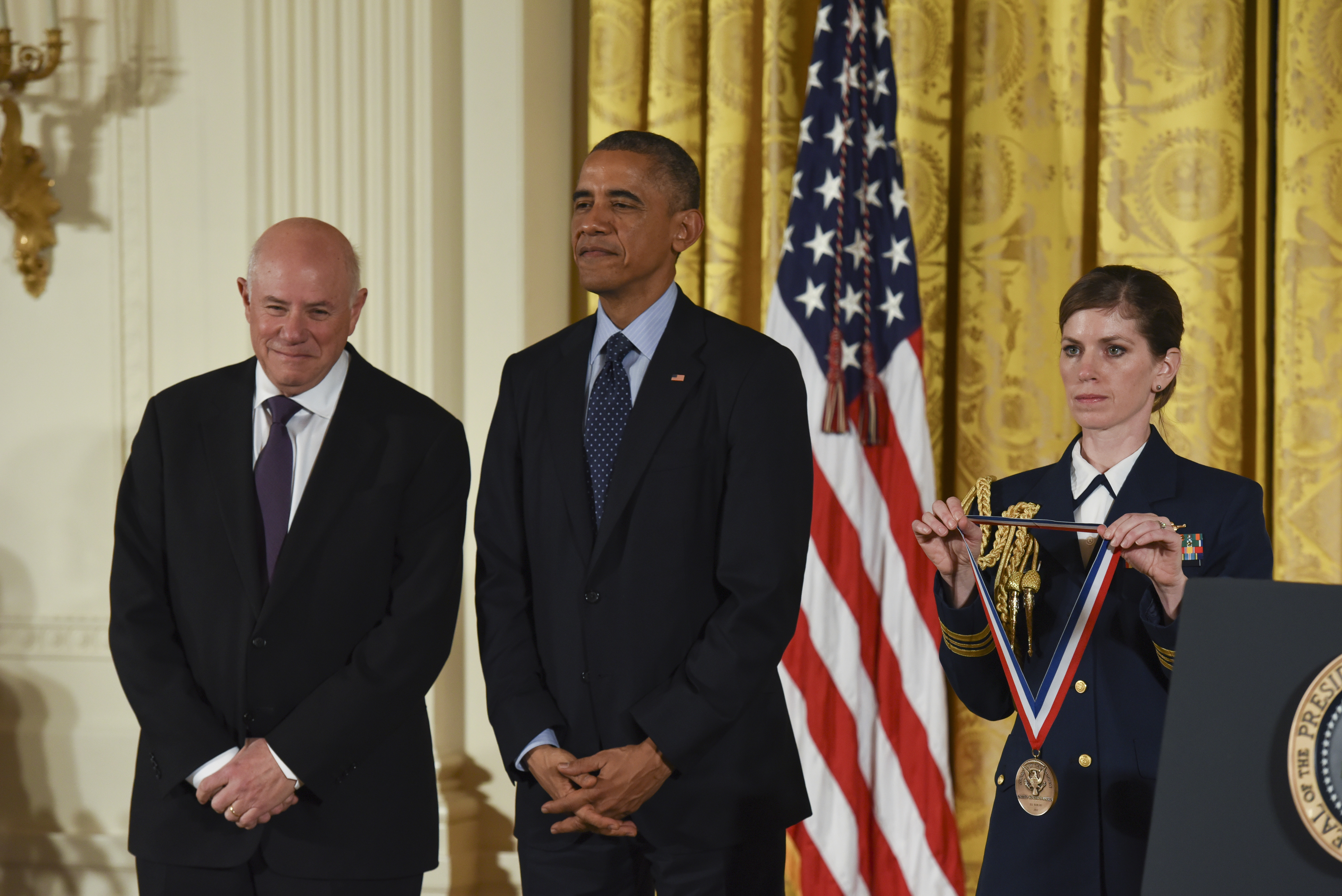
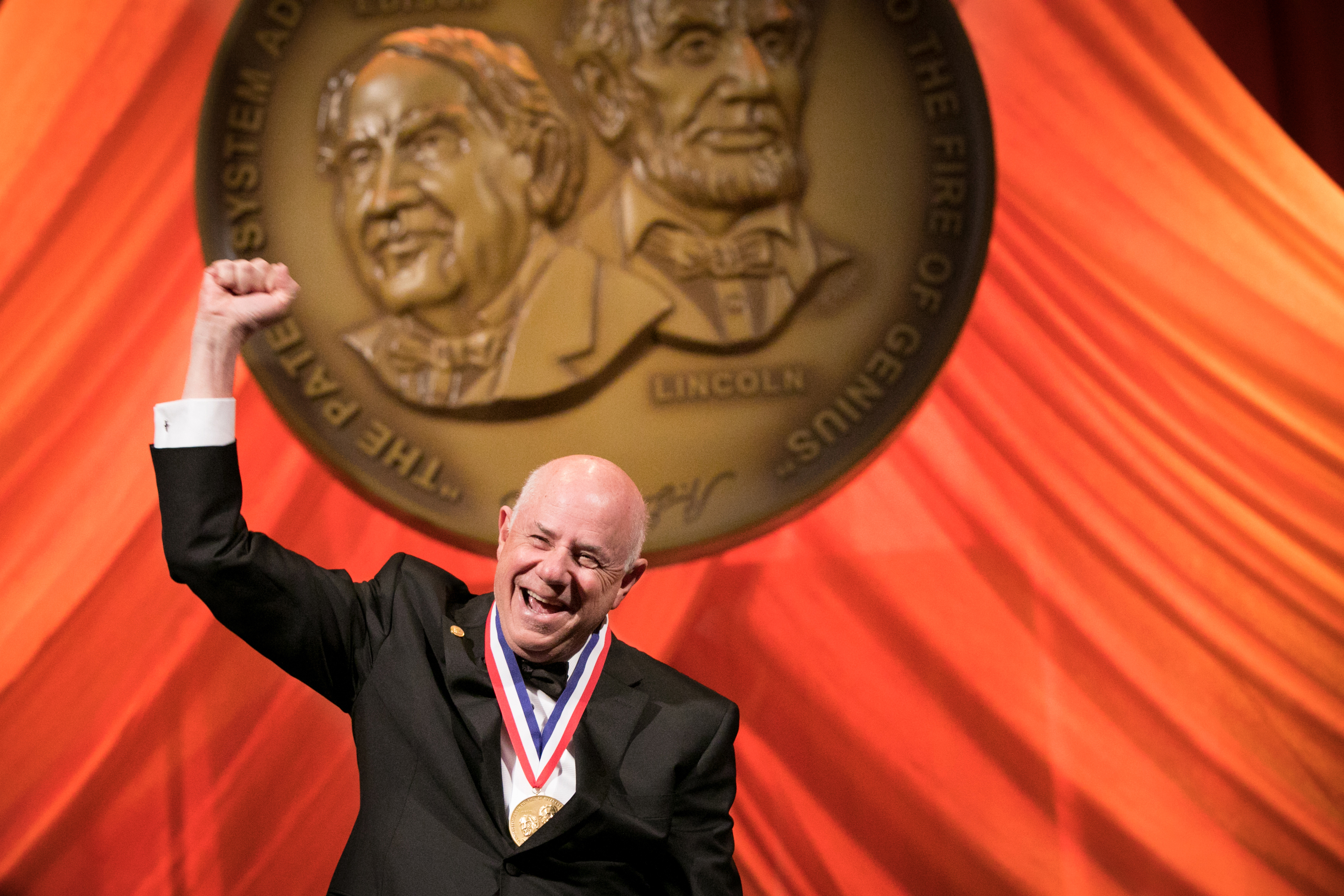
Harari retired from SanDisk at the end of 2010. Recognition followed: the IEEE Robert N. Noyce Medal, awarded in 2009, the National Medal of Technology and Innovation presented by President Obama in 2014, and induction into the National Inventors Hall of Fame in 2017.
At the White House ceremony, Obama connected the young researcher arriving in America after the moon landing with the storage technology inside portable electronics. There was something pleasingly concrete about the occasion. A career in microscopic structures had produced objects the audience could have brought along in their pockets.
The medal recognised invention and commercialisation together. That pairing suits Harari. A phenomenon can be demonstrated; a product must also be manufactured, tested and sold at a tolerable price. His career repeatedly crossed that boundary, sometimes awkwardly, eventually with consequences visible far beyond the semiconductor business.
Retirement had another memory problem
In June 2016, Harari founded SunRise Memory. He is its chairman and CEO. The company is developing three-dimensional ferroelectric RAM for demanding computing applications, including AI. Its argument begins with a familiar concern: whether existing memory technology can keep up with the capacity, bandwidth and energy requirements of the systems using it.
SunRise describes a target of ten times DRAM's bit density through three-dimensional scaling. That is an ambition, rather than an established product result. The distinction matters in a story about someone who has already spent years travelling between what physics permits and what customers can buy.
There is no need to imagine what keeps him interested. The work itself supplies the continuity: more information, less space, a smaller energy bill, another awkward engineering problem. After the laboratory, the first startup, the second startup and the medals, Harari has returned to a question with which he has considerable experience. What would people do with memory if the constraints changed?