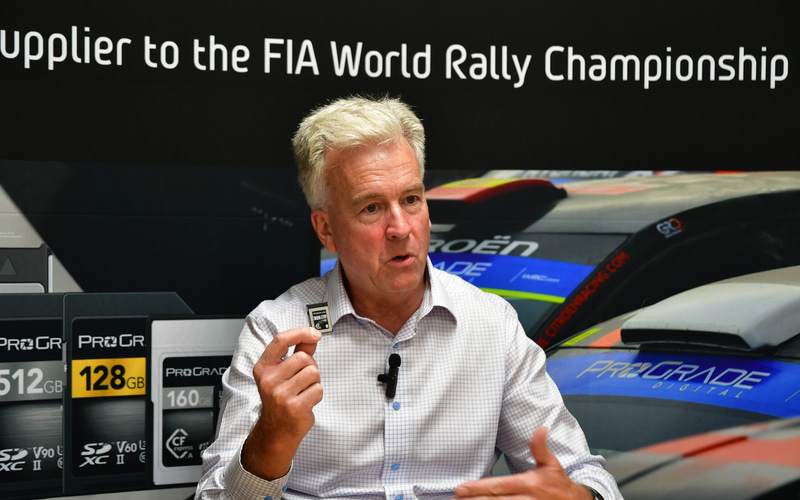
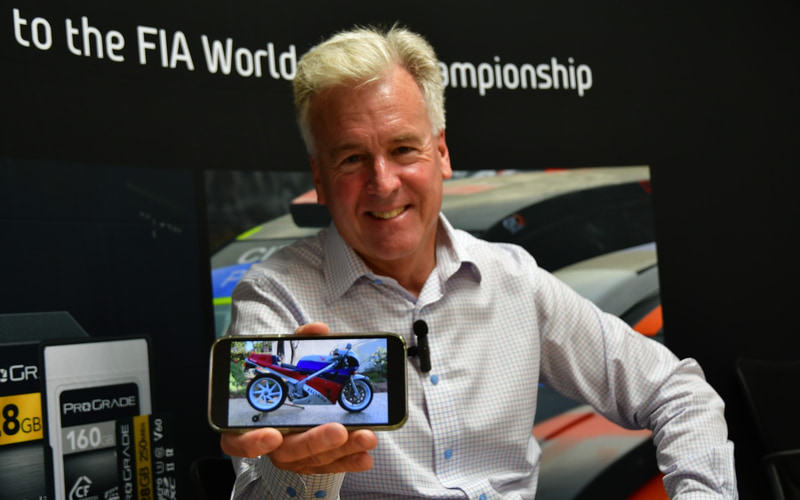
Wes Brewer is holding up a photograph of a motorcycle. This is a modest departure from the memory cards. At Rally Japan in 2022, the founder of ProGrade Digital has a Honda VFR750R RC30 to show off, and the smile suggests the conversation has reached agreeable territory. On the journey from Tokyo to Aichi, he has found time to visit a Yamaha museum. A business trip benefits from having the right detours.
The motorcycle makes a useful introduction to Brewer. His working life concerns speed, heat, equipment, and the consequences of things failing to behave. It also involves a pleasure less obvious than a racing machine: the satisfaction of a file arriving intact. Professional photographers may discuss light and lenses for hours. Brewer has spent decades attending to the small piece of hardware that gets entrusted with the result.
He came to founding relatively late in a long storage career. ProGrade Digital was established in December 2017 and launched its first products in February 2018. The name was new; the people had considerable mileage. Brewer had already led Lexar and held a senior role at SanDisk. Starting again meant taking familiar problems into a company where he could decide what deserved attention.
A working life inside the drive
Brewer’s route begins in the disk-drive business. In 1978, he was a senior applications engineer at Shugart. Product roles at Fujitsu America and Conner Peripherals followed, then responsibility for desktop and mobile products at Seagate. Long before the camera card became his subject, storage was his trade.
The sequence matters because his later job was broader than choosing what went on a package. At Lexar, his responsibilities encompassed product marketing, engineering, quality, manufacturing, supply, and demand planning. He had to consider what customers wanted alongside what factories could deliver. An attractive product that cannot be supplied presents a rather awkward sales opportunity.
At SanDisk, where he led the Cards and Accessories Division, he helped build the retail business. He also held a leadership role at Magellan Navigation. His public record describes an executive moving between product development and commercial responsibility, repeatedly dealing with devices people expected to work without ceremony. These are businesses in which the successful interaction often ends with the customer thinking about something else.
A new name after Lexar
Micron’s decision to leave the Lexar removable-storage business in 2017 gave Brewer a practical reason to reconsider his future. A group of colleagues assembled a new venture. Mark Lewis, Michael George, and Ed Chelini brought experience in marketing, engineering, and operations. Their shared professional history gave the startup people who understood different parts of the same product.
The opening range was focused: CFast and SD cards, plus a dual-slot reader. The company’s February 2018 launch announcement committed it to professional photography and cinema. That choice gave Brewer a defined customer to answer to. Someone recording a paid assignment has different concerns from someone buying an inexpensive spare drive at a checkout counter.
One early episode helps explain the emphasis. Filmmaker Jaron Schneider had lost access to irreplaceable oceanography footage on a Lexar card. Recovery software was developed to retrieve it, and Brewer helped get that work completed. It is an unusually concrete way to understand customer service: the person needs the pictures back.
At ProGrade’s start, Brewer described factory testing that wrote to every memory location on each card. Serial numbers helped trace individual units. These were operating choices with a cost attached, and they gave the new business a specific proposition beyond having another logo to put beside a camera.
at Shugart
is founded
is announced
The number on the label
Brewer also writes. His explanations of memory-card technology concern the questions a buyer might reasonably ask before surrendering a credit card. In a May 2019 article about transfer speeds, he separated writing data onto the card from reading it back. A performance figure describes a particular operation. The operation is what gives the number meaning.
During capture, the camera’s buffer temporarily holds data before it can be written to storage. Once that buffer fills, a slow card can interrupt the pace of shooting. Afterward, read performance affects how quickly the material can leave the card. A photographer’s afternoon can contain both problems, sometimes in quick succession.
His companion discussion of SD Express and CFexpress examined interfaces, physical formats, and compatibility. The subject can rapidly become an alphabet collection. Brewer’s essays are useful for revealing how he thinks about the purchase: what the equipment can support, which task needs the speed, and where the limits sit. The specification has to survive contact with the camera.
That concern also showed up in ProGrade’s early CFexpress work. In 2019, the company offered evaluation samples to development partners before general consumer availability, which depended on compatible cameras or firmware. A card standard needs hosts. Getting the surrounding equipment ready is part of bringing the card into use.
- CaptureWrite to the card
- TransferRead through a reader
- IngestCopy, organize, verify
A conceptual workflow, rather than a speed benchmark. Each stage asks something different of the equipment.
The journey after the shutter
Brewer’s product decisions kept following the file. ProGrade introduced Recovery Pro in 2019 after nearly a year of development. It addressed damaged or missing image and video files across different camera types. The software placed the uncomfortable part of photography within the company’s remit: what to do when the assignment is over and the expected files are missing.
Refresh Pro addressed card maintenance and visibility into remaining flash life. Rather than asking a photographer to interpret the workings of NAND memory, the software used simple status indicators and provided a refresh function. Hardware could be accompanied by a tool that helped its owner decide what to do before another assignment.
In April 2024 came Ingest Pro, developed with Hedge. Its functions included transferring material, organizing it, making backups, managing metadata, and verifying file integrity. The offering extended Brewer’s attention to the desk where the day’s shooting becomes usable material. A memory-card company could reasonably stop at the card slot. His company kept finding work farther along the route.
The pattern is visible without pretending every product solves every difficulty. Recovery, maintenance, and ingest are distinct jobs. Together they describe a founder interested in the responsibilities that gather around a photograph after the interesting part appears to have happened.
A detour to the Yamaha museum
Then there is the motorcycle. Brewer collects Japanese bikes, including the Honda RC30 he displayed during the 2022 interview. That interest gives his motorsport connections a personal dimension. Technical sponsorship is still business, but a motorcycle collection suggests he does not require a quarterly presentation to explain the appeal of machinery.
ProGrade’s relationship with the World Rally Championship put its storage into an exacting environment. In the 2023 partnership extension, the company described onboard cameras facing dust, impacts, and cabin temperatures exceeding 50°C, while crews in Sweden could work below -25°C. A rally offers a less accommodating test environment than a tidy desk.
For Brewer, that application connects the hardware to an audience. The viewer wants the corner, the slide, the driver’s hands. A card has to keep recording while the car supplies considerably more vibration than an office chair. The resulting footage makes the storage useful; the logo alone cannot do that work.
The box gets a shorter life
In April 2022, Brewer turned his attention to something designed to be discarded. ProGrade announced a move to recyclable and naturally biodegradable packaging, replacing plastic card cases with trays made from sugar cane fibers and wood pulp. The package’s job was brief. Its material did not need to linger indefinitely after completing it.
“What’s the use of a great camera if you don’t have a planet to take pictures of.”
Wes Brewer · 2022
The company also announced a commitment to donate approximately one percent of net profits to the 5 Gyres Institute. That is a stated commitment, distinct from a tally of donations delivered. It nevertheless adds a specific decision to Brewer’s public record: attention to the material around the product, alongside attention to what went inside it. Even a very small card arrives in a box.
A card for a future lunar camera
By January 2026, the destination had become more unusual. ProGrade announced a Space Act agreement with NASA covering Iridium CFexpress Type B cards and readers for future Artemis missions. The intended application was the Handheld Universal Lunar Camera, using a specially designed Nikon Z9.
Brewer described work involving ProGrade’s San Jose engineers, NASA’s Marshall Space Flight Center, and Phison Electronics, with sample submission to hardware delivery taking just under 18 months. The announcement concerned qualification and planned mission use. It gave the familiar problem of retaining pictures a setting where a return visit would be rather more complicated than booking another studio afternoon.
The ordinary work continued alongside it. In April 2026, Brewer discussed the architecture, cooling, and packaging effort behind two new USB 4.0 dual-slot readers. Even with a lunar camera in the conversation, someone still needed to get two cards into a computer efficiently.
That is the recognizable thread through his career: attention to what the equipment must do after its name has been chosen and the package has been printed. The rider wants the bike to respond. The photographer wants the file to open. Brewer has made a working life out of the details between those wishes and a result someone can use.
Follow the file
More from Brewer and the world around his work.