Before Ekaterina Damer could study people, she had to find them. About a year into her psychology PhD, recruiting participants had become a problem of its own. The online service she wanted - flexible, transparent, built for researchers - was missing. A thesis already contains enough unanswered questions. The plumbing is supposed to work.
In April 2014, Damer and Phelim Bradley launched Prolific. She was studying at Sheffield; he was a doctoral student at Oxford. They began with the kind of problem that rarely makes a glamorous business pitch: getting suitable people to take part in studies. Yet the inconvenience contained a larger question. How much could anyone trust a finding without understanding the people behind the answers?
That question has followed Damer from postgraduate research to running a company, then to backing another generation of founders. It also gives her story an unusual shape. The psychologist built a marketplace, learned to test the marketplace, and eventually invested in widening the population that marketplaces could reach. The subject kept getting bigger.
The work before the startup
Damer's preparation involved considerably more than an idea and a laptop. She studied integrated social and cognitive psychology at Jacobs University Bremen, now Constructor University, from 2008 to 2011. Her early work included helping run psychology experiments and recruit participants. The apparently minor administrative obstacle that later became a business was already part of her working life.
A 2010 internship at Columbia University involved literature reviews, study design discussions, coding research data and preparing material for an institutional review board. At Bremen she also worked as a teaching assistant on a course about stereotypes, prejudice and discrimination. These were practical encounters with the machinery of research: designing it, organising it and finding people willing to contribute.
Cambridge followed in 2012-2013, where she studied social and developmental psychology. Her Sheffield doctoral studies ran from 2013 to 2018, including a visiting-researcher spell at Stanford in the first half of 2016. Prolific took shape inside those years. Finishing the doctorate and building the company overlapped; entrepreneurship entered through an unresolved research task.
Her academic interests help explain why participant recruitment mattered to her beyond convenience. She has studied motivation, diversity, leadership and moral behaviour. A 2018 paper with Thomas Webb and Richard Crisp examined how counter-stereotypical information relates to cognitive reflection. An Oxford-educated bricklayer appears among the examples: a small collision between a familiar category and an unfamiliar detail.
A participant is a person, even in a spreadsheet
Prolific connected researchers with people who could take part in their studies, with participants earning cash rewards. The exchange sounds straightforward. Its usefulness depends on details: whether people qualify, whether they understand the task, whether they return, and whether researchers can see what they are buying. A spreadsheet is wonderfully tidy. The route by which a name reaches it can be less so.
The company entered Oxford's startup incubator in 2014. That brought help with the unromantic essentials of incorporation, accounts and legal questions. By March 2017, Prolific had enabled more than one million responses across over 6,500 studies. More than 1,300 researchers from over 300 academic institutions had used it. A problem shared by two postgraduate students had acquired a substantial constituency.
Those figures describe responses, studies and institutions, rather than interchangeable measures of success. Their relationship matters. A recruitment service becomes useful when it can keep bringing the right participants to different researchers, repeatedly. Its daily achievement is making someone else's experiment possible. That is a modest job description for a company with international customers.
Damer also learned that responding to customers required judgment. Agreeing to requests that exceeded the startup's capacity could absorb disproportionate effort. Networking had its own opportunity cost: time spent at an event was time unavailable for improving the product. Her early advice to other founders included a wonderfully inconvenient suggestion for an academic: “80% is enough most of the time.”
In August 2018, she described Prolific as a team of nine and introduced a best-practice guide for researchers. It covered questions to ask before designing a study, sample size, participant rewards, launching an experiment and analysing the results. It also addressed fair reasons for rejecting submissions. The detail is revealing: helping someone collect data carried responsibilities towards the people supplying it. That same announcement proposed a $5,000 junior-researcher grant scheme, with preregistration among the requirements. Making research easier to run came with an attempt to make its methods more deliberate. Speed had a place alongside preparation, rather than replacing it.
California, with an eight-hour complication
In summer 2019, Damer and Bradley took Prolific to Y Combinator. Five years after starting in Oxford, they had a team of 15. She later described the original venture as a “fun side project.” Side projects have a habit of becoming less casual once colleagues, customers and an ocean are involved.
Damer spent about a week concentrating on the application, with help from friends and colleagues. Afterwards, the founders made their successful application publicly available. Her advice emphasised explaining the business clearly, speaking with founders who had been through the programme, and resisting the temptation to turn interview preparation into an exercise in robotic perfection.
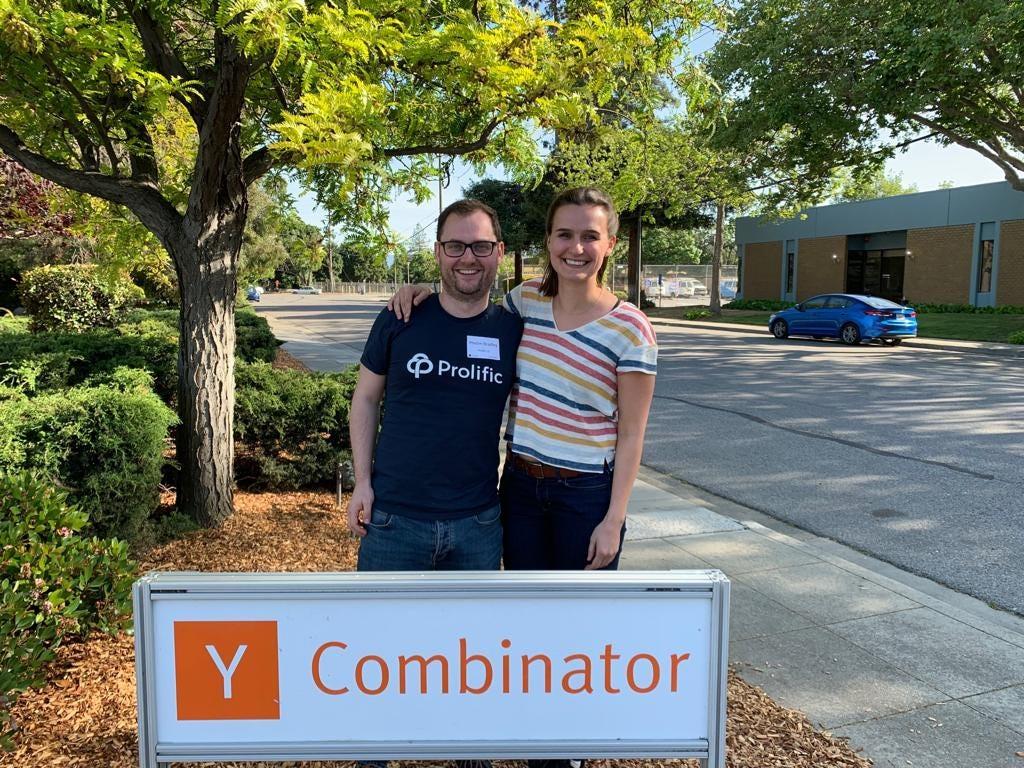
She had reservations about entering Silicon Valley as a woman founder, including whether she would feel she belonged. There was also a scheduling problem: the founders and their British team would be eight time zones apart. The accelerator offered a different working culture; the clock offered no concessions. In her account, collaboration across that distance was difficult but workable.
She came away describing an environment that could combine ambition with kindness. That combination mattered enough for her to write about it. A founder could admit uncertainty and still pursue a large opportunity. The application itself became something to share rather than a private trophy, useful to the next person wondering whether an academic background belonged in a startup programme.
The psychologist surveys her own customers
At Y Combinator, Prolific's founders had to work out whether their traction justified concentrating on growth. They did something appropriate for a research platform: asked a question. Among 210 customers surveyed, 71% said they would be very disappointed if Prolific disappeared. That gave the team evidence of product-market fit in academia, with the useful qualification that academia was the market being tested.
Would be very disappointed if Prolific disappeared.
210 customers surveyed. A historical snapshot.
The next experiments concerned growth. A team including Damer, technical and operating colleagues, analysts and marketing staff considered ideas and met weekly. Sponsoring the philosophy and psychology podcast Very Bad Wizards brought promising leads. The less convenient finding concerned timing. Prolific's prospective customers could take months to become paying customers, making weekly verdicts on some experiments premature.
“Find a cadence that works for you.”
Ekaterina Damer, reflecting on Y Combinator, 2019
The line is useful because it preserves the discipline of experimentation while questioning the timetable. Urgency could help; measuring an outcome before it had time to appear could mislead. Damer's account records a founder adapting advice to the behaviour of her own customers. For a psychologist, the people remained an awkward and necessary part of the equation.
Who is missing from the sample?
By the end of 2019, academic researchers accounted for roughly 90% of Prolific's customers. Damer was exploring how the service could help businesses too. She also spoke openly about gaps in the participant pool: its concentration in Britain and the United States, its younger demographic, and the need to bring in older people and minorities.
The issue reaches further than expansion strategy. When research repeatedly draws on a narrow slice of people, conclusions about human behaviour deserve careful boundaries. Recruiting more participants and recruiting a wider range of participants answer different needs. Damer's attention was moving towards both. A service can be busy while still leaving important voices outside the room.
Her appetite for changing research also extended to its incentives. At BeOnline's Reproducibility 2.0 discussion in 2021, she challenged a system that rewards publication without reliably rewarding the practices that make findings dependable. Her argument was that better tools alone could only go so far if the surrounding incentives kept pointing elsewhere.
She explained that she had considered making Prolific a nonprofit in its earliest days. She chose a business because she wanted revenue that could be reinvested in infrastructure, rather than continual dependence on funding applications. The reasoning joined commercial independence to a scientific purpose. The question was how to build something that could keep paying for the work.
Backing the next recruitment problem
In May 2025, Damer appeared in a different position: investor and advisor to Besample. The company announced a $1.1 million pre-seed round led by Gutter Capital, with Damer and Womankind Ventures among the participants. Founded by Elena Brandt and Tamila Feldman, Besample focuses on research access in populations beyond the Western countries that dominate many behavioural datasets.
The connection to Damer's earlier concerns is direct. In 2019 she had discussed the limits of a participant pool concentrated in Britain and America. In 2025 she was backing founders working on access to underrepresented regions. Besample's announcement identified her as Prolific's former CEO. Her role in this chapter was to support another team's answer to a familiar difficulty.
She has also been sharing the experience with founders. An Amela event on building, fundraising and exiting described her work mentoring entrepreneurs and investing in startups. The invitation returned to the same origin: a doctoral researcher who needed suitable participants and helped build the service she wanted to use.
There is an appealing continuity here, without needing to make every career move part of a grand design. Damer encountered a specific obstacle, stayed with it, and found that it opened into questions about trust, incentives and representation. The first task was finding people for an experiment. Years later, she is still interested in who gets asked.