Phelim Bradley’s company began with a problem that makes a poor dinner-party anecdote: finding dependable people to answer research questions online. There was no shortage of answers. The difficulty was knowing whether they deserved anyone’s attention. For an academic trying to learn something about human behaviour, a beautifully completed spreadsheet could still be a very expensive collection of nonsense.
Bradley helped build Prolific in 2014 while doing his doctorate at Oxford. He wrote the first platform, became its chief technology officer and later its chief executive. More than a decade on, he is selling an idea that has acquired a fresh urgency: if you want to understand what a machine can do, you will eventually need some people you can trust.
The destination looks thoroughly contemporary. The route there involved physics, computational biology, a fellow researcher’s recruitment difficulties and years spent solving an unglamorous operational problem. Bradley arrived at the AI conversation carrying the habits of someone who had already spent a long time worrying about the answers.
A side project with a participant problem
Prolific was launched in April 2014 by Bradley and fellow postgraduate Ekaterina Damer, also known as Katia. Its first audience was academic researchers. They needed participants who could be recruited reliably, screened appropriately and paid for their time. Researchers could already find people through online labour marketplaces. What the founders wanted was infrastructure designed around research itself.
The difference mattered on both sides of the screen. A researcher needed usable responses and tools that allowed an experiment to work as intended. A participant needed clear expectations and a fair reward. Bradley has described those early shortcomings together: poor data, awkward software and inconsistent treatment of the people doing the work. Each could damage the others.
Oxford University Innovation’s Startup Incubator supported the company. Prolific’s intellectual property sat outside the founders’ doctorates, so the incubator was the appropriate route. That distinction helps explain the enterprise: two researchers were building a service around a practical frustration, rather than commercialising the findings of a particular experiment.
By March 2017, more than 1,300 researchers were using it, with universities including Oxford, Cambridge, Stanford and Yale among the institutions represented. A small academic workaround had found a public. The promise remained pleasantly concrete: spend less time hunting for participants, and have more confidence in what arrives.
The programmer keeps his old question
Bradley’s education runs from a physics degree at University College Cork to an MPhil in computational biology at Cambridge and a doctorate at Oxford. His research involved writing software to analyse and search large biological datasets. On his public GitHub profile, the pinned BIGSI project still points back to that earlier work on indexing and search.
There is a useful continuity here. In both research software and participant recruitment, collecting material is only part of the job. It must also be organised so that someone can ask a worthwhile question of it. That is a reading of his career, rather than a claim that he had mapped out an AI business during his student days.
As CTO, Bradley led Prolific’s product strategy. In 2021 he became CEO. The change put the person who had built the first version in charge of the company’s wider direction. His responsibilities had expanded from making a platform work to deciding which problems it should take on next.
There are less corporate details, too. His public biography lists Irish rugby and whisky among his interests. He is Irish and based in London. The academic credentials occupy rather more space in the formal introduction, but a rugby supporter has at least one regular opportunity to practise living with an uncertain outcome.
Five years before the accelerator
Prolific entered Y Combinator’s summer 2019 batch, five years after its founding. That interval gives the story a different pace from the familiar accelerator-to-startup sequence. Bradley and Damer had already spent years learning what researchers needed before joining the programme. The service had a history before the Silicon Valley chapter arrived.
The company became profitable in 2020. In July 2023 it announced a £25 million Series A, co-led by Partech and Oxford Science Enterprises. The intended uses included expanding in the United States and developing its work in AI. Specialised participant groups were part of the plan: software developers, for example, could assess code produced by a model.
Funding made that expansion more practical. It also put a larger commercial question in front of Bradley. How far could a business built around academic experiments travel? Product testing, market research and AI development all needed people, but their requirements would differ. Knowing how to recruit a crowd would only get Prolific so far; knowing which crowd a particular task required was becoming central.
Whose judgment goes into the machine?
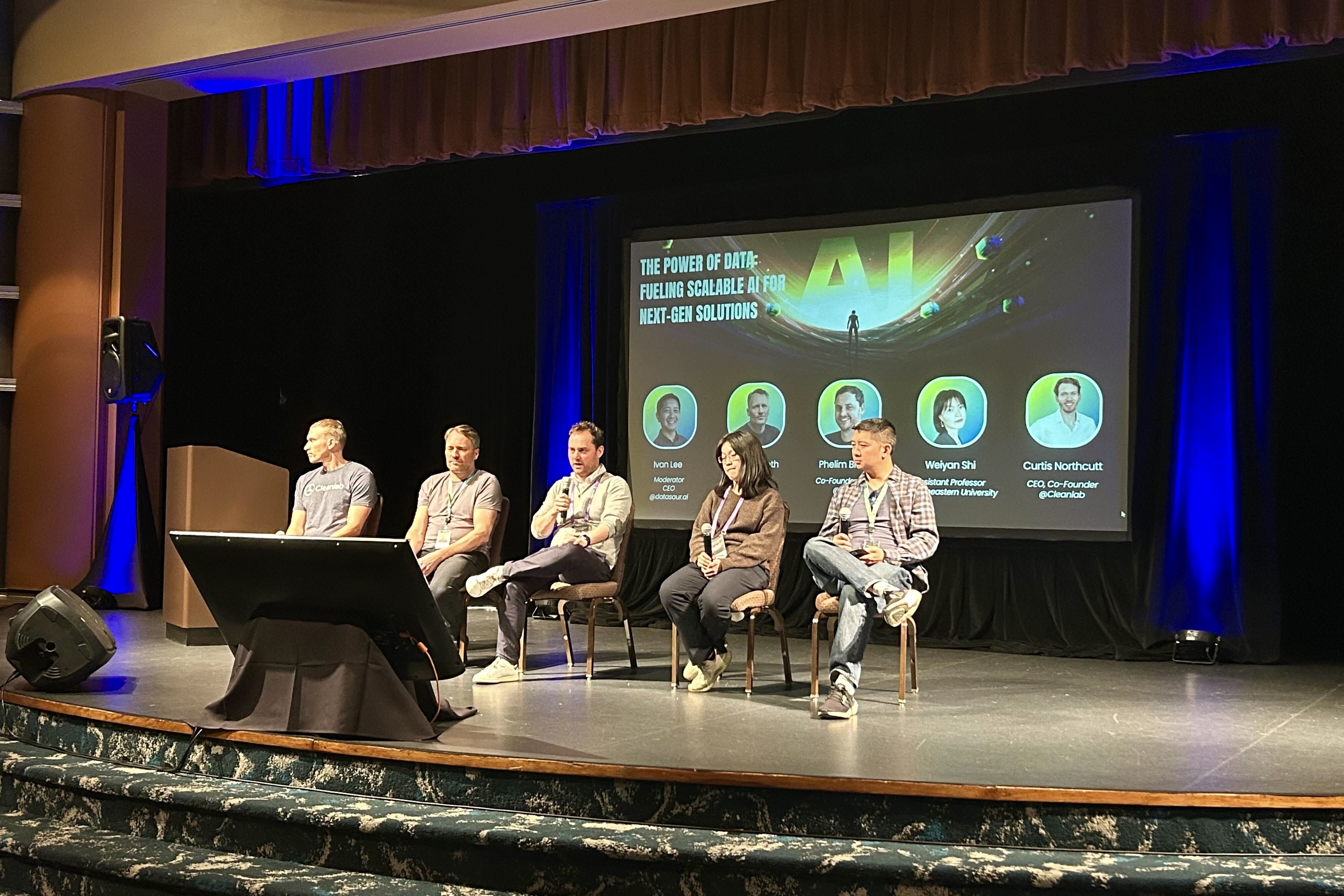
At the 2024 GenAI Summit in the Bay Area, Bradley appeared with Jon Bratseth, Curtis Northcutt, Weiyan Shi and moderator Ivan Lee. Their subject was data for AI. Bradley’s contribution returned to the people supplying it: their expertise, their perspectives and the conditions under which their input was gathered.
He argued for combining human contributions with synthetic data and for bringing specialist perspectives into the development process. The position follows naturally from Prolific’s research origins. A response has a context. Who supplied it, what they understood and what they were asked to do all affect its usefulness.
“The people behind your data matter,” he says. The sentence is short enough for a company slogan, but it also describes an awkward management obligation. You have to know something about those people, verify that they are who they claim to be and give them work that suits the question being asked.
Bradley’s stated ambition is to make AI support human capability. His admiration for the open, community-led approach of the Hugging Face founders fits that preference for wider participation. He also names Mustafa Suleyman among the AI figures whose work he admires. The recurring interest is how the technology gets built and who has a hand in shaping it.
“The people behind your data matter.”
Phelim Bradley
A business plan for things that stay difficult
Ask Bradley how to keep a strategy steady while AI changes around it, and he reaches for Jeff Bezos’s advice about concentrating on things that endure. For Prolific, those include the breadth and quality of its audience and how quickly its platform can help customers work. Better models still leave customers needing useful feedback.
He expects greater demand for specialists and more attention to evaluation after a model has been built. In software terms, he compares evaluations to unit tests: a way to check whether changes have made something worse. A model’s first impressive performance does not settle how it will behave after subsequent development.
This gives the CEO a fairly specific job. He must preserve the quality of a participant network while helping new kinds of customer use it. The infrastructure has to accommodate changing tasks without losing the reliable recruitment that attracted researchers in the first place. It is a strategy with plenty of software in it and a stubbornly human dependency.
- RecruitFind the relevant people
- VerifyCheck identity and fit
- EvaluateGather human judgment
- RepeatCheck the next version
The bot alarm meets the evidence
By May 2026, Bradley was publicly addressing a concern aimed directly at his business: AI agents completing online studies. In an open letter, he described the risk as real while questioning whether the discussion had run ahead of the evidence. It was a revealing argument for a chief executive selling verified human participation. He could have made the alarm louder. He asked readers to look at what had actually been measured.
He pointed to a comparison involving 5,200 participants across ten platforms. As he reported it, detected agent rates outside Amazon Mechanical Turk were at or below one per cent. He also described a complication: actual language-model agents performed well on many conventional quality measures. Passing a check did not, by itself, establish humanity.
These were findings presented by Bradley about research involving Prolific’s own team and external collaborators. They support his stated position, rather than settling every question about automated participation. His practical emphasis was on keeping ordinary human respondents attentive and engaged while continuing to invest in defences against automation.
The concern sounds very much like the one he started with. An answer can arrive quickly and look perfectly respectable. There is still work to do before anyone should rely on it.
Back in a room full of founders
In September 2026, Bradley attended the Future Fifty Forum after Tech Nation selected Prolific for its 2026 cohort. The company’s network had grown to more than 300,000 people, he reported, with more than 90,000 holding specialist qualifications. His account of the occasion returned to verification, feedback and evaluation: the work underneath the more visible model announcements.
He has a life in the startup ecosystem beyond Prolific as well, serving as a venture partner at Pioneer Fund. Yet his own company’s progression offers a particularly patient example for founders. It began in 2014, entered Y Combinator in 2019 and took its Series A in 2023. The chronology leaves ample room for ordinary product work between the milestones.
Bradley’s larger ambition is to make Prolific the service people think of when they need to gather data from other people. “Our ultimate ambition is to become synonymous with online research,” he has said. That is a substantial aspiration for a business that began by helping researchers find someone dependable to answer a question.
The first platform’s author now spends his time explaining why increasingly capable machines require access to human expertise. His company has travelled a long way from an Oxford side project. The question waiting at the other end remains familiar: who, exactly, gave you that answer?
Follow the conversation
- Prolific
- Bradley on LinkedIn
- Bradley on X
- Bradley on GitHub
- Personal site
- Watch: Machine Learning Street Talk
- Listen: Eye on A.I.
- Oxford: the company’s beginnings
- Partech: the enduring business strategy
- GenAI Summit 2024
- The May 2026 open letter
- Future Fifty, September 2026
- World Summit AI conversation
- Prolific’s public interviews
- The 2023 funding round
- Y Combinator company profile
- The 2017 Oxford announcement
- Bradley’s career and interests